When someone has died, flowers often need to do two things at once. They need to express love and respect, and they need to feel right for the person being remembered. Eco friendly funeral flowers can do that beautifully, but only when sustainability is approached with care rather than as a token gesture.
For many families, the first surprise is that traditional funeral flowers are not always as natural as they appear. Large formal tributes can involve imported blooms, plastic wrapping, floral foam and materials that are difficult to compost. If you are trying to make thoughtful choices at a difficult time, it helps to know that there is another way – one that still feels generous, elegant and deeply personal.
What eco friendly funeral flowers really mean
In practice, eco friendly funeral flowers are less about a single perfect product and more about a set of considered choices. The flowers may be British grown where the season allows. The designs are often made without floral foam. Packaging is kept to a minimum, and natural, reusable or compostable materials are preferred wherever possible.
That does not mean the flowers need to look rustic or sparse. A sustainable funeral tribute can still feel abundant, refined and beautifully crafted. In fact, many natural designs have a softness and movement that suit a farewell particularly well. They tend to feel less manufactured and more connected to the seasons, which can be quietly comforting.
There are, of course, limits and trade-offs. Not every flower is available locally all year round, and not every family wants the same style. A sustainable approach should never become so rigid that it ignores the wishes of the person who has died or those arranging the tribute. The most thoughtful choice is usually the one that balances meaning, beauty and environmental care.
Why flower provenance matters at a funeral
At funerals, people often talk about the character of the person they have lost – the garden they loved, the colours they wore, the countryside they knew, the time of year that always suited them best. This is where provenance matters. Flowers with a clear sense of place can make a tribute feel more personal.
British-grown stems often have a freshness and natural shape that differ from imported flowers bred for long-distance transport. In spring, that might mean tulips, narcissi, ranunculus or scented blossom. In summer, it could be garden roses, sweet peas, snapdragons or cornflowers. Later in the year, dahlias, chrysanthemums, berries and textured foliage can create something equally beautiful.
Seasonal flowers also avoid the slightly disconnected feeling that can come from forcing a very specific out-of-season look. There are moments when a family may want exactly that, and that is understandable. But where there is room to work with the season, the result often feels more grounded and sincere.
Foam-free funeral flowers and why they matter
One of the biggest environmental issues in floristry is floral foam. It has been widely used for decades because it holds water and helps create structured arrangements, but it is a single-use plastic product that breaks down into microplastics. For families seeking a gentler option, foam-free funeral flowers are an important part of the conversation.
A skilled florist can create elegant funeral tributes without foam by using mossing techniques, chicken wire mechanics, pin holders, water vials where needed, and thoughtful placement of stems. The method depends on the design. A sheaf, wreath or casket spray can all be created in a way that keeps the flowers secure while avoiding unnecessary waste.
The benefit is not only environmental. Foam-free work often allows flowers to sit more naturally, with better movement and a less rigid outline. That can suit families who want something understated, graceful and less formulaic than a standard tribute.
The most sustainable funeral tribute is not always the biggest
There can be quiet pressure around funeral flowers. Families may feel they need to choose something large or highly formal because that is what people expect. In reality, scale is only one part of a tribute, and it is not the part most people remember.
A beautifully made casket spray in seasonal flowers may say far more than several generic pieces ordered in haste. A tied sheaf gathered with favourite textures and colours can feel intimate and deeply appropriate. Small arrangements for the service or for the wake may also be enough, especially if the family prefers a simpler farewell.
This is often where a more personal florist is helpful. Rather than steering every family towards standard letters or mass-produced shapes, they can ask better questions. What did your person love? Did they garden? Were they drawn to hedgerow textures, soft whites, rich autumn shades, or something quietly colourful? Those details matter more than size for its own sake.
Choosing flowers that can return to the earth
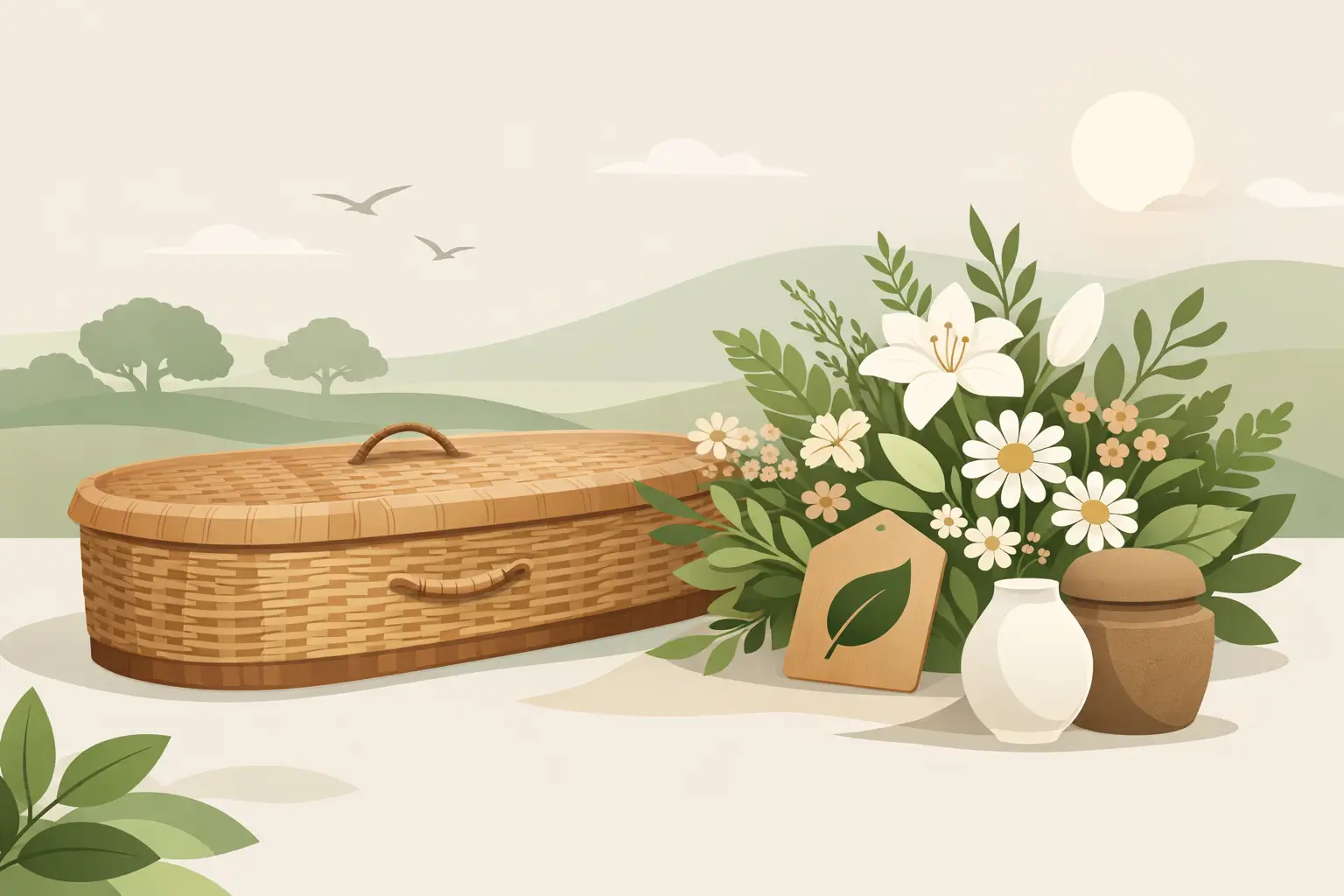
If burial is planned, biodegradable materials become especially important. Natural twine, compostable wraps, willow or vine bases, moss and British foliage can all help a tribute sit more gently within the landscape. This tends to matter most at woodland burials and natural burial grounds, but many families now want the same principles for any funeral.
It is worth checking the requirements of the cemetery or burial site, as some have specific rules about what may be left graveside. A good florist will be familiar with these considerations or happy to adapt the design accordingly.
There is also the question of what happens after the service. Some tributes can be taken apart so flowers may be shared among family members, placed at home, or composted once they have faded. This may sound like a small detail, but it can make the flowers feel less transient and less wasteful.
How to choose eco friendly funeral flowers without added stress
During bereavement, too much choice can feel overwhelming. The simplest starting point is to think about three things: the person, the setting and the season.
The person comes first. Consider colours they loved, flowers they grew, or a general feeling that suits them. Some tributes are best kept very quiet and textural. Others call for warmth, garden-like abundance or a little more colour.
The setting matters next. Flowers for a church service may be different from those for a woodland burial or a direct cremation. A casket spray needs a different scale and shape from a farewell sheaf or a design for beside the coffin.
Then there is the season. Asking for the best available British flowers often leads to the most natural and sustainable result. It also allows the florist to create with freshness and confidence rather than trying to imitate something unsuitable for the time of year.
If sustainability is important to you, it helps to ask clear but simple questions. Are the flowers foam-free? Are British-grown flowers used where possible? What packaging and mechanics are involved? Can the tribute be composted or reused afterwards? You do not need expert floral language. You only need a florist who answers with honesty and care.
Eco friendly funeral flowers can still feel traditional
Some families worry that choosing a more sustainable approach means giving up the dignity or familiarity of funeral flowers. Happily, that is not the case. Wreaths, sheaves, sprays and arrangements can all be created with environmentally gentler methods. The overall look can still be classical if that is what feels right.
The difference is usually in the craftsmanship behind the scenes and the sensitivity of the flower choice. White and green designs remain timeless. Soft mixed seasonal flowers can feel traditional without being stiff. Foliage-rich work can be elegant rather than austere. It depends on the balance of materials and the eye of the florist.
For families in Derbyshire who want flowers that are personal, tasteful and sustainably made, this quieter approach often feels more appropriate than something overtly showy. At Sweetpea Macfie, that means designs led by seasonality, British flowers where possible, and a foam-free method that never loses sight of the emotion behind the work.
Funeral flowers do not need to be extravagant to be memorable. They need to feel truthful. When they are shaped with care for both the person and the natural world, they carry a particular kind of grace – one that honours a life without asking the earth to bear more than it should.
 I’m Marie,
the florist behind Sweet Pea Macfie.
I began Sweet Pea Macfie in 2018 and am a qualified florist with over 13 years’ experience.
The name is an ode to my Grandad, John Macfie, who in his day was one of the best Sweet pea growers in the country. He exhibited at all the major flower shows, and his Chelsea Gold Medal is one of my most treasured possessions, so you could say that growing and arranging flowers is in my blood.
I’m Marie,
the florist behind Sweet Pea Macfie.
I began Sweet Pea Macfie in 2018 and am a qualified florist with over 13 years’ experience.
The name is an ode to my Grandad, John Macfie, who in his day was one of the best Sweet pea growers in the country. He exhibited at all the major flower shows, and his Chelsea Gold Medal is one of my most treasured possessions, so you could say that growing and arranging flowers is in my blood.