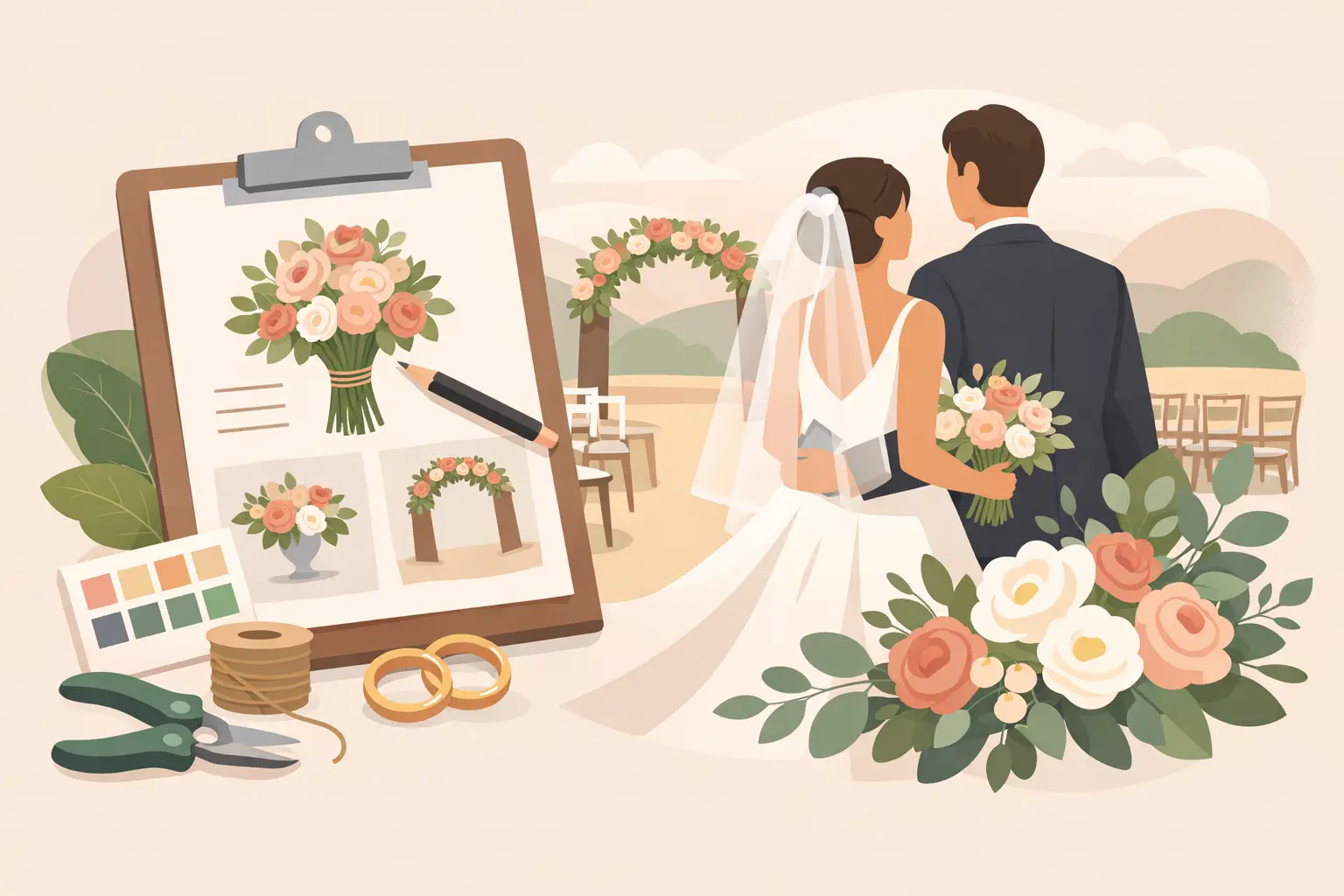
Wedding flowers are often one of the last things couples feel confident about, yet they shape the atmosphere of the day more than many expect. If you are wondering how to plan wedding florals without feeling overwhelmed, it helps to begin not with a list of arrangements, but with the feeling you want the day to carry.
Flowers do far more than decorate a room. They soften a space, connect the ceremony to the celebration, and quietly reinforce the season, setting and character of your wedding. When they are planned thoughtfully, they never feel like an afterthought. They feel as though they belong.
How to plan wedding florals from the feeling outward
A useful starting point is to think less about individual stems and more about mood. Consider the setting first. A marquee in a Derbyshire field calls for a different approach from a candlelit pub, a village church or a stately home. The flowers should sit naturally within the space rather than compete with it.
It is also worth thinking about how you want the day to feel in photographs and in person. Relaxed and gathered? Quietly elegant? Abundant but not formal? Natural floral design is often less about symmetry and polish, and more about texture, movement and a sense of ease. That does not mean it is casual. In fact, the most effortless-looking flowers are usually the most carefully considered.
If you have saved dozens of images, look for patterns rather than favourites. You may notice that what draws you in is not a particular bouquet shape, but a softness of colour, a garden-led looseness, or a restrained palette with plenty of texture. That is far more helpful to your florist than a mixed folder of unrelated ideas.
Start with the parts of the day that matter most
Not every wedding needs flowers everywhere. One of the most sensible ways to approach your budget is to decide where florals will have the greatest effect, both visually and emotionally.
For some couples, the bouquet and ceremony flowers matter most because those are the moments that feel most personal. For others, the priority is the reception, where guests will spend the most time. If you are planning a smaller wedding, you may prefer to invest in fewer pieces done beautifully rather than stretching the budget across every possible surface.
Usually, the most important areas are personal flowers, the ceremony backdrop or entrance, and the tables. Once those are covered, you can consider extras such as welcome arrangements, bar flowers, staircase dressing, cake flowers or loo posies. Lovely additions, certainly, but not essential for every celebration.
This is where good guidance becomes valuable. A florist should help you work out where flowers will genuinely be seen and felt, and where they may be quietly lost.
Budget with honesty, not guesswork
Many couples are unsure what wedding flowers cost, largely because floral pricing depends on season, scale, mechanics, flower choice and labour. A bouquet is not simply the cost of the stems in your hand. It includes sourcing, conditioning, design time, transport and on-site work where needed.
The simplest way to budget is to be open early. You do not need to know exact figures for every arrangement, but you do need a realistic overall range. That allows your florist to design well within your means rather than producing something unsuitable and scaling it back later.
There are always trade-offs. If your heart is set on a large installation, you may need to keep table flowers simpler. If lush bowls of flowers on every table matter more than a dramatic ceremony feature, that is entirely valid too. There is no universal right split. It depends on your priorities, guest numbers and venue.
Seasonality also affects value. British-grown flowers at their natural best can be wonderfully expressive and often more interesting than imported blooms chosen simply for familiarity. Planning with the season rather than against it usually gives a more characterful result.
Let the season guide the flowers
One of the loveliest ways to approach wedding flowers is to allow the time of year to lead. Spring brings blossom, tulips, narcissi and delicate fresh greens. Early summer opens up sweet peas, scented garden roses and airy umbels. High summer can offer abundance, with cosmos, dahlias and textural fillers. Autumn has its own depth, with richer tones, seed heads, berries and shifting foliage.
This does not mean you cannot have preferences. Of course you can. But there is a difference between asking for flowers with a similar spirit to a reference image and asking for an exact imported recipe regardless of month, weather or provenance.
If you love natural, elegant wedding florals, flexibility is often your friend. A seasonal brief allows your florist to choose what is looking exceptional that week and create something that feels alive, not formulaic. It also tends to sit more comfortably with a sustainable, British flower-led approach.
Build a colour palette that can breathe
Colour is where many wedding flower decisions become more complicated than they need to be. Couples often feel they must choose three exact shades and match everything to the last ribbon. In practice, flowers are softer and more nuanced than that.
A better approach is to choose a broad palette and decide how it should behave. Do you want mostly neutrals with a little apricot and soft blue? A gentle run of whites and greens? Muted pinks with deeper claret accents? Giving your florist room to work tonally tends to produce a more natural and sophisticated result than insisting on rigid matching.
It also helps to consider what already exists in the venue. Carpet, curtains, wall colour, wood tones, church stone, table linen and bridesmaid dresses will all influence how the flowers are seen. The most successful schemes acknowledge the room rather than ignoring it.
The practical details couples often miss
Once the overall style is in place, the planning becomes more specific. This is where timelines, logistics and proportion matter.
Bouquets should suit both the dress and the person carrying them. A petite, lightly gathered bouquet can feel far more elegant than something oversized. Equally, a larger, more textural bouquet may be just right with a fuller silhouette or a grander setting. The same thought applies to buttonholes, which should be secure, comfortable and in keeping with the overall design rather than token additions.
Table flowers need careful proportion. Tall arrangements can be beautiful, but only if they do not block conversation or feel disconnected from the scale of the room. Lower centrepieces are often more intimate, though they need enough presence not to disappear on a large round table. Long trestles may suit bud vases, clustered bowls or a more generous floral run, depending on the style of the celebration.
Ceremony flowers are also worth planning with reuse in mind. An arrangement at the church door, registrar table or aisle end may be moved to the reception if designed appropriately. This is often one of the smartest ways to make the budget work harder without making the day feel florally sparse.
How to plan wedding florals with your florist
The relationship with your florist should feel collaborative, not transactional. The strongest results usually come when couples share their preferences clearly, then trust the designer to interpret them with the season, venue and budget in mind.
A good consultation will cover more than colours and flower names. It should include timing, access to the venue, the ceremony and reception layout, who is wearing flowers, whether anything can be repurposed, and how hands-on or hands-off you would like the creative process to be.
It is also helpful to say what you do not like. Perhaps you want to avoid anything too formal, too blousy, too bright, or too tightly arranged. Those boundaries can be just as useful as your inspiration images.
For couples in Derbyshire planning a celebration with a natural, thoughtful feel, working with a florist who understands seasonality, British-grown flowers and foam-free mechanics can shape the whole experience for the better. Sweetpea Macfie, for instance, takes a personal, design-led approach that suits weddings where atmosphere matters as much as appearance.
When less is actually more
There is a temptation, particularly online, to assume that a beautiful wedding needs a great volume of flowers. It often does not. Some of the most memorable floral work is restrained, with attention given to the right placements, the right ingredients and the right scale.
A single statement arrangement in the right place may do more than multiple smaller pieces scattered thinly. A bouquet with movement and scent can feel more special than one packed densely with expensive blooms. A few beautifully dressed tables can create more atmosphere than a room crowded with competing ideas.
This is where confidence helps. You do not need to prove that flowers are present at every turn. You simply need them to feel intentional.
Wedding florals are at their best when they reflect the season, the setting and the people at the centre of the day. If you begin there, with honesty about your priorities and a willingness to be guided, the decisions become much clearer. The aim is not to copy someone else’s wedding, but to create flowers that feel entirely right for your own.
 I’m Marie,
the florist behind Sweet Pea Macfie.
I began Sweet Pea Macfie in 2018 and am a qualified florist with over 13 years’ experience.
The name is an ode to my Grandad, John Macfie, who in his day was one of the best Sweet pea growers in the country. He exhibited at all the major flower shows, and his Chelsea Gold Medal is one of my most treasured possessions, so you could say that growing and arranging flowers is in my blood.
I’m Marie,
the florist behind Sweet Pea Macfie.
I began Sweet Pea Macfie in 2018 and am a qualified florist with over 13 years’ experience.
The name is an ode to my Grandad, John Macfie, who in his day was one of the best Sweet pea growers in the country. He exhibited at all the major flower shows, and his Chelsea Gold Medal is one of my most treasured possessions, so you could say that growing and arranging flowers is in my blood.