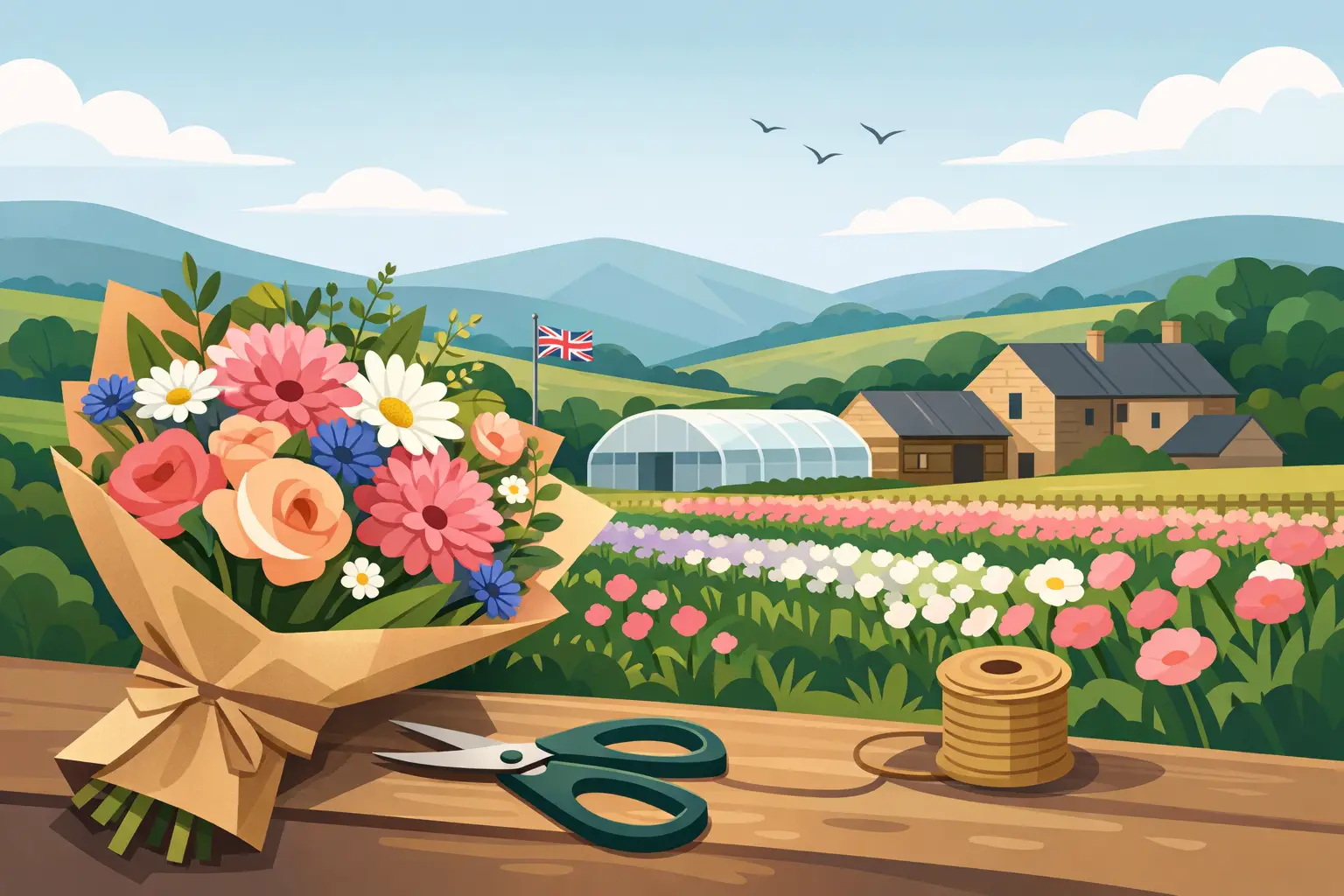
A British grown bouquet is not simply a more local way to send flowers. It is a small expression of the season: scented sweet peas in early summer, richly toned dahlias as autumn draws in, delicate narcissus when the first signs of spring appear. The flowers have a sense of place and time that cannot be replicated by a standard, all-year recipe.
For a birthday, a thank you, a wedding table or a quiet gesture for someone having a difficult week, that connection matters. A thoughtfully made bouquet should feel as though it belongs to the person receiving it and the moment it marks – never like it could have been picked from a shelf anywhere.
What makes British-grown flowers different?
Much of the cut flower trade relies on flowers travelling thousands of miles before they reach a vase. There is nothing wrong with wanting a particular bloom out of season, and imported flowers can have their place. But when flowers are grown closer to home, they can often be cut at the right stage of opening and spend less time in transit, storage and heavy packaging.
That usually means a British grown bouquet has a fresher, more garden-like quality. Stems may arrive with graceful bends, fine tendrils, textured foliage and natural variation in size or colour. These are not flaws to be corrected. They are part of what makes seasonal flowers so expressive.
British growers also offer varieties selected for fragrance, delicacy and character, rather than solely for their ability to withstand a long journey. Think of the perfume of sweet peas, the flutter of cosmos, the soft, loose heads of garden roses or the warm, earthy presence of late-summer dahlias. They bring movement and personality that suit a natural, considered style of floristry beautifully.
Flowers that follow the year
Seasonality is one of the real pleasures of choosing British flowers. In spring, the palette may include tulips, ranunculus, scented narcissus, blossom and the first fresh greens. Summer brings sweet peas, cornflowers, scabious, cosmos and garden roses, often with an abundance that feels relaxed and generous.
By autumn, dahlias, asters, amaranthus, grasses and seed heads offer deeper colour and beautiful texture. Winter can be more restrained, but no less special: branches, berries, evergreen foliage, hellebores and locally grown narcissus create arrangements with quiet structure and a sense of the landscape beyond the door.
This does mean a bouquet will change through the year. You may not be able to request peonies in November or dahlias in April. In return, you receive something more honest and distinctive: flowers at their best, rather than flowers forced to imitate another season.
A bouquet with provenance, not a fixed formula
When ordering flowers, it is easy to focus on a list of stems. Yet the feeling of a bouquet is often created by the relationship between its elements: the way a single beautiful focal flower sits among finer blooms, the softness of foliage, the contrast between open faces and buds still to unfurl.
A British grown bouquet invites a more responsive approach. Rather than working from a fixed design, a florist can choose from what is looking particularly lovely that week and build an arrangement around colour, texture and the occasion. A gentle, pale bouquet might carry a message of sympathy without feeling formal. A bright gathering of seasonal flowers can feel properly celebratory without becoming showy.
For gift flowers, this flexibility is especially valuable. If you know the recipient loves soft apricot tones, wild-looking meadow flowers or a rich, autumnal palette, those preferences can guide the design. If you are unsure, a few details about the occasion and their home can be enough. A bouquet for a kitchen table may call for an easy, cheerful looseness; a significant anniversary gift may suit something more layered and romantic.
At Sweetpea Macfie, the intention is never to make every bouquet look the same. It is to create flowers with a clear sense of the season and a feeling that they were made for this recipient, on this particular day.
The sustainability question, with care
Choosing British-grown flowers can reduce the distance stems travel and support small-scale growers who work with the rhythms of our climate. It can also mean less reliance on plastic sleeves and unnecessary wrapping, particularly when flowers are bought through a florist committed to minimal packaging and thoughtful methods.
However, provenance is not a simple badge. Growing methods vary, as do the practical realities of availability, weather and the scale of an event. British flowers are highly seasonal, and a large wedding in early spring may require a mixture of British and imported flowers to achieve the desired abundance, colour or consistency. Being transparent about that is more useful than making grand claims.
A good florist will help you make choices that reflect your priorities. Perhaps British-grown flowers are central to your plans, with a small number of carefully chosen supplementary stems. Perhaps you would prefer to embrace a fully seasonal palette and let the date guide the design. Both approaches can be beautiful. The important thing is that the choice is considered, rather than automatic.
Beyond the stems
A more thoughtful bouquet also considers what happens around the flowers. Foam-free mechanics, reusable vessels where appropriate and restrained wrapping can all reduce waste without compromising the finished design. The goal is not austerity. It is to put the beauty in the flowers themselves, rather than in layers of disposable materials.
For a gift bouquet, simple wrapping and a water source are often all that is needed to protect the stems on their journey. Once home, a clean vase, fresh water and a quick trim of the stems will help them settle in. Keeping flowers away from direct sun, radiators and fruit bowls can make a noticeable difference too, as ripening fruit gives off ethylene that shortens vase life.
British flowers for life’s important moments
The emotional value of flowers is often strongest when the occasion is personal. For weddings, locally grown seasonal flowers can make the day feel rooted in its setting. A Derbyshire summer celebration may be enhanced by meadow-like colour, airy foliage and flowers that look as though they could belong to the surrounding countryside. For an autumn wedding, dahlias, grasses and richly coloured foliage can bring warmth without feeling overworked.
For funeral flowers, natural seasonal materials allow for gentleness and individuality. A tribute does not need to be large or elaborate to be meaningful. A favourite colour, a particular garden flower, soft texture or a simple country-style shape can speak more clearly than a standard arrangement. At a time when words can be difficult, flowers can offer a quiet, respectful form of care.
Even an everyday bouquet can carry that same intention. A bunch of locally grown stems is a reminder that beauty does not need a grand reason. It may be a way to mark a new home, congratulate a friend, say sorry or simply bring some life into a room during a grey Derbyshire week.
How to order with confidence
The most helpful starting point is not necessarily a precise flower list. Begin with the date, occasion, budget and the feeling you would like the flowers to have. Share any colours to avoid, a favourite flower if you have one, and whether the bouquet is for a bright modern room, a country cottage or a hospital visit where a compact design may be more suitable.
Then allow some room for the season. This is where the most characterful work often happens. A florist who knows the flowers available can select the stems with the best colour, scent and condition, creating a bouquet that feels composed rather than prescribed.
Choosing British-grown flowers is ultimately a choice to notice the season you are in. A bouquet can be beautiful at any time of year, but when it carries the freshness, texture and fleeting character of the local growing year, it becomes more than a gift. It becomes a moment worth pausing for.
 I’m Marie,
the florist behind Sweet Pea Macfie.
I began Sweet Pea Macfie in 2018 and am a qualified florist with over 13 years’ experience.
The name is an ode to my Grandad, John Macfie, who in his day was one of the best Sweet pea growers in the country. He exhibited at all the major flower shows, and his Chelsea Gold Medal is one of my most treasured possessions, so you could say that growing and arranging flowers is in my blood.
I’m Marie,
the florist behind Sweet Pea Macfie.
I began Sweet Pea Macfie in 2018 and am a qualified florist with over 13 years’ experience.
The name is an ode to my Grandad, John Macfie, who in his day was one of the best Sweet pea growers in the country. He exhibited at all the major flower shows, and his Chelsea Gold Medal is one of my most treasured possessions, so you could say that growing and arranging flowers is in my blood.