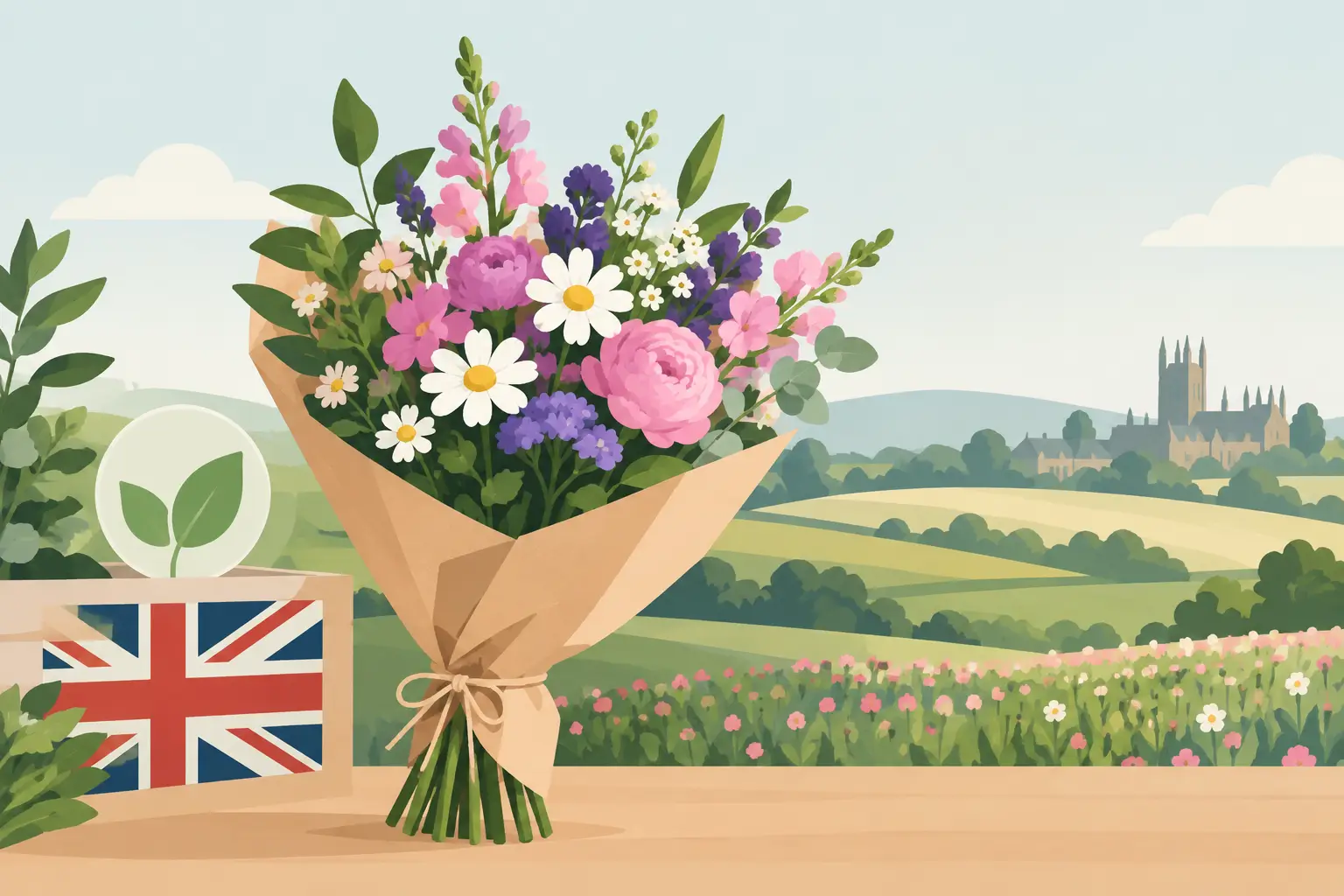
A bunch of sweet peas cut in Derbyshire at the height of June has a very different story behind it from a dozen roses bought in February. So, are British flowers more sustainable? Often, yes – but not simply because they have been grown closer to home.
The honest answer depends on the season, how the flowers were cultivated, the journey they made, and what happens once they reach the florist. British-grown flowers can offer a genuinely lower-impact, more connected choice, particularly when they are grown in season and arranged with care. Yet provenance is only one part of a bouquet’s environmental picture.
For clients choosing wedding flowers, a farewell tribute or a gift for someone they love, this is encouraging rather than burdensome. You do not need to become an expert in supply chains to make a thoughtful choice. A good florist should be able to guide you towards flowers that feel right for the occasion and the time of year.
Why British flowers can be a more sustainable choice
The most immediate benefit is usually transport. Many flowers sold in the UK have travelled considerable distances, often via wholesalers and flower auctions before arriving with a florist. Long journeys can mean refrigerated lorries, extensive handling and layers of packaging. Flowers grown within Britain may still travel from farm to florist, of course, but the route is generally shorter and easier to trace.
British flowers also make it possible to work with the rhythm of the year rather than asking a stem to be available in every month. Spring brings narcissi, tulips, ranunculus and scented stocks. Early summer offers sweet peas, peonies, cornflowers and garden roses; later comes dahlias, cosmos, phlox and autumnal seed heads. This changing palette gives arrangements a sense of place that is difficult to reproduce from a year-round wholesale list.
There is a human element too. Buying from British growers can support small flower farms, growers and skilled local businesses. It helps retain the diversity of cut-flower growing in this country, rather than treating flowers as an anonymous commodity. For a Derbyshire wedding or a locally delivered bouquet, that connection can be part of what makes the flowers feel so personal.
British-grown does not automatically mean low impact
It would be too simple to say that every British stem is greener than every imported one. A flower grown out of season in a heavily heated greenhouse may require more energy than a flower grown in natural sunlight in a warmer climate and brought here efficiently by sea. The exact comparison is rarely visible on a label.
Growing methods matter greatly. Is the crop grown outdoors or under glass? Is heat required? How are water, soil fertility and pests managed? Are flowers harvested by hand on a small scale, or produced intensively with high inputs? British growing is not one single system, and neither is imported growing.
Transport also has different forms. Air freight carries a much higher carbon cost than sea freight, while road transport and cold storage add to the footprint along the way. A flower’s country of origin alone cannot tell the whole story. The more useful question is: what is known about the route, the growing conditions and the season?
That is why a British flower-first approach is more meaningful than a claim that every stem must be local. During winter and the early hungry gap of spring, the British cut-flower selection is naturally limited. Using a small number of carefully chosen imported stems alongside seasonal British foliage or branches can sometimes be a more realistic, beautiful choice than forcing an entirely local brief.
Seasonality is where the difference becomes most visible
Choosing seasonal flowers is one of the clearest ways to align beauty with lower-impact floristry. It reduces the need for heated production and long, complex supply chains, while giving flowers the conditions in which they naturally flourish.
Seasonal design does not mean making do. It means allowing the ingredients to lead. May blossom and cow parsley can bring lightness to a spring celebration. July gardens offer a looseness and perfume that suits relaxed, flower-filled weddings. In September, dahlias and grasses carry richness without needing to look formal or heavy. Winter arrangements can be full of texture through evergreen foliage, bare branches, berries and locally grown dried material.
For weddings, this may mean falling in love with an overall feeling before fixing every variety. Rather than requesting a particular imported bloom that is unavailable or costly outside its natural season, begin with the atmosphere you want: soft and gathered, meadow-like, romantic, wild, or quietly elegant. A florist can then build a palette around what is looking its best.
For funeral flowers, seasonality can feel especially appropriate. Garden-like stems, hedgerow texture and branches can create a tribute that is gentle and distinctive, without relying on standardised forms or excessive materials. The result can be deeply personal while still being mindful of its impact.
The florist’s choices matter as much as the stems
A sustainable bouquet is not only about where the flowers were grown. Floral mechanics, packaging and waste all matter once the stems arrive at the workbench.
Traditional floral foam is useful for holding stems in place, but it is a single-use plastic that breaks down into microplastics. Foam-free methods use alternatives such as reusable vessels, pin holders, chicken wire, moss where appropriate, water tubes and careful stem placement. These methods take planning and skill, particularly for large installations or funeral designs, but they can significantly reduce reliance on disposable materials.
Packaging deserves attention too. A thoughtful bouquet need not arrive swathed in layers of cellophane, plastic and unnecessary decoration. Minimal, recyclable or compostable wrapping can protect the flowers while keeping the focus where it belongs: on the flowers themselves.
Waste is another quieter consideration. Ordering closer to a commission, using seasonal ingredients flexibly and designing with a stem’s natural shape all help to avoid unnecessary surplus. Flowers are perishable, and some waste is unavoidable, but a considered florist will make use of foliage, buds, shorter stems and beautiful irregularities rather than expecting every ingredient to behave like a uniform product.
What to ask when choosing more sustainable flowers
You do not need a lengthy checklist, but a few well-placed questions can make the conversation clearer. Ask what is naturally in season, whether British-grown flowers are available for your date, and whether your florist can work foam-free. If you have a favourite flower in mind, ask when it is at its best and whether there is a seasonal alternative with a similar character.
It is also worth being open about priorities. Some couples want their wedding flowers to be as local as possible. Others have one non-negotiable flower because it carries family meaning, while still wanting the rest of the designs to be seasonal and low-waste. Both approaches can be handled thoughtfully. Sustainability is not a test to pass; it is a series of better decisions, made with the information available.
Budget can be part of that conversation as well. Flowers in their natural season are often more plentiful and can offer better value, although price also reflects a grower’s labour, weather risks and the particular variety. A small, carefully chosen collection of beautiful seasonal stems can have far more presence than a larger arrangement filled with flowers chosen only for year-round availability.
A more considered way to mark an occasion
British flowers are often more sustainable when they are seasonal, responsibly grown and thoughtfully arranged with minimal waste. They are not automatically the lowest-impact answer in every circumstance, but they make it easier to ask better questions about provenance, materials and the fleeting nature of cut flowers.
There is something fitting about flowers that belong to the moment in which they are given. A spring bouquet that smells faintly of the garden, or late-summer wedding flowers full of dahlias and grasses, does not need to imitate another season to feel special. Let the time of year offer its own colour, texture and meaning, and the flowers will usually feel all the more memorable for it.
 I’m Marie,
the florist behind Sweet Pea Macfie.
I began Sweet Pea Macfie in 2018 and am a qualified florist with over 13 years’ experience.
The name is an ode to my Grandad, John Macfie, who in his day was one of the best Sweet pea growers in the country. He exhibited at all the major flower shows, and his Chelsea Gold Medal is one of my most treasured possessions, so you could say that growing and arranging flowers is in my blood.
I’m Marie,
the florist behind Sweet Pea Macfie.
I began Sweet Pea Macfie in 2018 and am a qualified florist with over 13 years’ experience.
The name is an ode to my Grandad, John Macfie, who in his day was one of the best Sweet pea growers in the country. He exhibited at all the major flower shows, and his Chelsea Gold Medal is one of my most treasured possessions, so you could say that growing and arranging flowers is in my blood.