
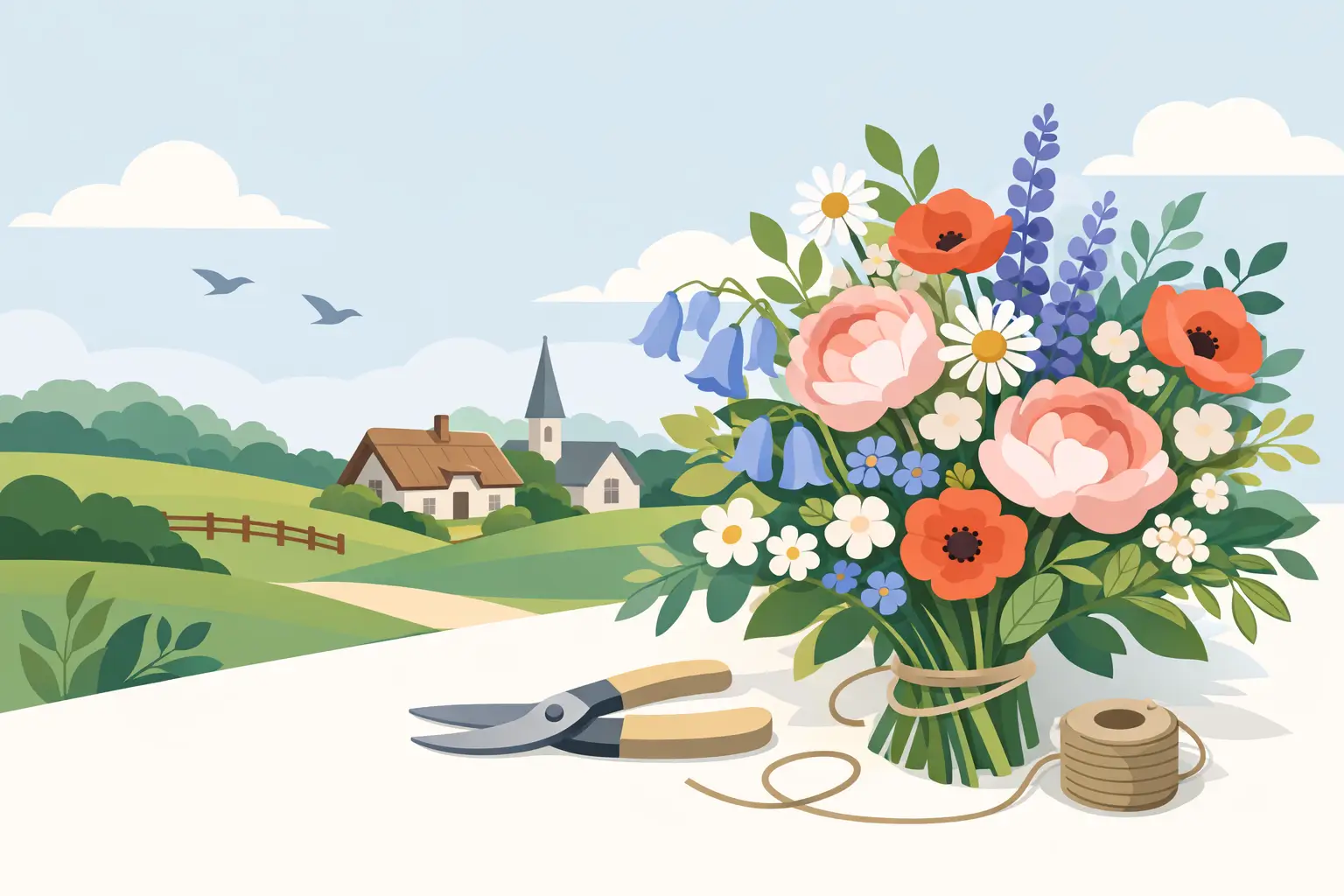
A bouquet of British-grown flowers has a particular sense of place. It may carry the fresh green scent of sweet peas in June, the generous colour of garden roses in July, or the quiet richness of dahlias as autumn begins. The best British flowers for bouquets are not simply the prettiest stems available. They are flowers chosen at their natural peak, arranged with room for their character to show.
For a birthday, a wedding table or a final farewell, seasonal flowers help an arrangement feel thoughtful rather than formulaic. They also bring welcome variation. No two weeks of the British growing season are exactly alike, and that gentle unpredictability is part of their beauty.
What makes a British-grown bouquet special?
British flowers are usually cut closer to the point of arranging, rather than travelling long distances through cold storage. This can mean better freshness, more interesting varieties and a wider range of scent. A locally grown sweet pea, for example, is a very different thing from a flower bred chiefly to withstand transport.
Seasonality also gives a bouquet its own rhythm. Spring brings light, hopeful stems and new foliage. Summer is abundant, scented and romantic. Autumn has depth, texture and burnished colour. In winter, the focus often shifts to sculptural branches, berries and evergreen foliage.
There are practical considerations, of course. A favourite flower may only be available for a few precious weeks, and the weather can move a crop forwards or backwards. For meaningful flowers, this is often a strength rather than a limitation. Working with what is genuinely beautiful now creates a design that belongs to the occasion and the time of year.
The best British flowers for bouquets, season by season
Sweet peas
Sweet peas are one of the great pleasures of an English summer. Their ruffled petals, climbing stems and unmistakable fragrance bring softness without looking overly formal. They are lovely in a small hand-tied gift bouquet, gathered in generous clouds for a wedding, or tucked through a more textured garden-style arrangement.
They are delicate and do not have the longest vase life, so they suit occasions where scent and immediacy matter most. For a thoughtful doorstep gift or an intimate celebration, few flowers feel more personal.
Tulips
British tulips arrive in spring with a freshness that is hard to match. Their clean silhouettes work beautifully in contemporary arrangements, but they can also feel loose and natural when mixed with blossom, narcissi and early foliage.
Tulips continue to grow and curve in the vase, which is part of their charm. A florist will allow for that movement rather than trying to force them into a rigid shape. They are especially effective in a simple colour story: soft apricot, deep plum, cream or one clear shade of pink.
Narcissi and scented daffodils
Early spring narcissi bring brightness at a point in the year when it is most welcome. Smaller scented varieties are particularly graceful, with several delicate blooms per stem. They lend a meadow-like quality to bouquets and make a lovely choice for Mothering Sunday, spring birthdays and relaxed country weddings.
As daffodils release sap that can affect other flowers, they need careful conditioning before they are arranged with different stems. This is one of those small details that makes professional floristry feel effortless, even when the preparation is anything but.
Ranunculus
With layer upon layer of fine petals, ranunculus offer real presence in a spring bouquet. They are available in colours ranging from butter yellow and blush to coral, burgundy and near-black, making them remarkably versatile.
A few stems can add a refined focal point to a bouquet without making it feel heavy. They are a beautiful option for spring weddings, particularly when paired with tulips, flowering branches and airy foliage. Their flowering window is relatively short, so they feel all the more special when they are in season.
Anemones
Anemones have a graphic quality: papery petals surrounding a dark, dramatic centre. They bring contrast to paler spring flowers and are particularly lovely in arrangements with a little wildness and movement.
They are often chosen for weddings where the palette includes white, blue, violet or deep wine tones. In a sympathy bouquet, anemones can feel calm and considered when softened with gentler flowers and foliage. Their bold centres mean a little goes a long way.
Garden roses
When British garden roses begin in early summer, they offer fragrance and fullness in abundance. Their open, many-petalled form is softer and more natural than a tightly packed rose, with colours that range from milky white and shell pink to peach, raspberry and warm gold.
They are wonderful flowers for romantic wedding work, but equally meaningful in a gift bouquet. Not every garden rose has the same vase life, and their open form means they should be handled with care. Their scent and generous beauty more than repay the attention.
Peonies
Peonies are eagerly anticipated for good reason. Their large buds unfurl into lavish, often fragrant blooms, giving a bouquet instant occasion. They are a natural choice for late spring and early summer weddings, anniversaries and celebratory gifts.
Because their season is brief, peonies are best appreciated without asking them to behave like an all-year flower. A bouquet made around them can be beautifully simple: peonies, a few supporting stems and fresh foliage may be all that is needed.
Cornflowers
Cornflowers bring a bright, clear blue that is uncommon in flowers, along with a wonderfully informal feel. They suit meadow-inspired designs and can make a fresh alternative to more traditional focal flowers in summer bouquets.
Their smaller scale makes them especially useful as a supporting flower. Paired with white cosmos, cream roses or soft grasses, they add a note of English countryside character without becoming quaint.
Cosmos
Cosmos are light-catching, cheerful and full of movement. Their open, daisy-like flowers and fine ferny foliage bring airiness to a late-summer bouquet, particularly in white, blush and raspberry tones.
They are not the longest-lasting cut flower, so they are ideal when a bouquet is being enjoyed straight away. For a garden wedding or a seasonal gift made to feel as though it has just been gathered, cosmos are difficult to better.
Dahlias
Dahlias carry late summer into autumn with remarkable variety. Some are neat and rounded; others are loose, spiky or dinner-plate sized. Their colours can be soft and muted, but they are equally at home in rich berry, rust and plum palettes.
They make exceptional focal flowers for a wedding bouquet or a generous seasonal arrangement. Dahlias are more vulnerable to cold weather and need careful conditioning, but while they are thriving they provide depth, detail and real individuality.
Scabious
Scabious is a quietly brilliant flower for adding texture. Its pincushion centres and dancing stems soften more structured blooms, while its seed heads can be just as useful as the flowers themselves.
It works across a wide range of styles, from delicate summer posies to more textural autumn designs. In a bouquet, scabious helps create the gentle, natural movement that makes an arrangement feel alive rather than fixed in place.
Hydrangeas
British hydrangeas come into their own from late summer, offering generous heads of clustered flowers in green, white, blue, pink and antique tones. A single stem can create volume, making them useful for larger arrangements and funeral tributes where a calm, abundant shape is wanted.
They do need plenty of water and can be sensitive in very warm conditions. Used well, however, they bring softness and scale without relying on excessive numbers of stems.
Choosing flowers for the moment
The right bouquet depends as much on the recipient and occasion as it does on the season. For a joyful birthday, scent might be the thing that makes the gift memorable: sweet peas, garden roses or scented narcissi are lovely choices. For a wedding, it is often helpful to begin with the overall feeling – airy and meadow-like, romantic and full, or simple and sculptural – then let the season guide the individual flowers.
For funeral flowers, a more restrained approach can be especially powerful. Soft seasonal whites and greens, gentle movement and flowers with personal significance can say far more than an arrangement that feels crowded or overly ornate. There is no universal right choice, only flowers selected with care for the person being remembered.
A good florist will also consider practical matters: venue temperature, travel time, the size of the bouquet, scent sensitivities and how long the flowers need to look their best. This guidance matters most when the flowers are part of a day that cannot be repeated.
Let the season lead
At Sweetpea Macfie, British-grown flowers are valued not because every stem must be local at all costs, but because the season offers such generous inspiration when it is allowed to lead. The most memorable bouquets tend to have a sense of ease: flowers at their best, thoughtfully combined, with texture, scent and natural movement intact.
If you have a colour in mind but are unsure which flowers will be at their best, begin with the feeling you hope to give. A skilled seasonal choice will usually make the bouquet more beautiful, more distinctive and more meaningful than a fixed flower list ever could.
 I’m Marie,
the florist behind Sweet Pea Macfie.
I began Sweet Pea Macfie in 2018 and am a qualified florist with over 13 years’ experience.
The name is an ode to my Grandad, John Macfie, who in his day was one of the best Sweet pea growers in the country. He exhibited at all the major flower shows, and his Chelsea Gold Medal is one of my most treasured possessions, so you could say that growing and arranging flowers is in my blood.
I’m Marie,
the florist behind Sweet Pea Macfie.
I began Sweet Pea Macfie in 2018 and am a qualified florist with over 13 years’ experience.
The name is an ode to my Grandad, John Macfie, who in his day was one of the best Sweet pea growers in the country. He exhibited at all the major flower shows, and his Chelsea Gold Medal is one of my most treasured possessions, so you could say that growing and arranging flowers is in my blood.