
The moment a couple arrives at their ceremony should feel like a gentle change of scene. Whether you are marrying in a Derbyshire church, a light-filled barn or beneath an old tree, this guide to ceremony flower placement begins with that feeling: flowers should draw the eye towards the promise being made, not distract from it.
The most memorable ceremony flowers are rarely the ones placed everywhere. They are the ones placed with purpose – framing an entrance, softening the walk down the aisle, and giving the space around the vows a sense of occasion. Thoughtful placement also allows a design to feel generous while using flowers carefully, seasonally and with less waste.
Begin with the ceremony itself
Before choosing arrangements, consider how the ceremony will unfold. Where will guests arrive? Which route will the couple take? Where will everyone naturally look during the vows, readings and first kiss? These are the places flowers can make their quietest, strongest impact.
Every setting brings its own considerations. A village church may already have architectural character in its stonework, pews and altar, so flowers can be restrained and responsive to the building. A blank-slate barn may need more definition around the ceremony area, while an outdoor ceremony often benefits from designs that hold their own against a wide view without competing with the landscape.
It is also worth thinking about photographs from the outset. Your ceremony backdrop will appear in many of the images you keep, but it need not be a solid wall of flowers. Texture, movement and a considered shape often photograph more beautifully than symmetry for its own sake.
Guide to ceremony flower placement: choose focal points
A useful approach is to identify two or three focal areas rather than scattering small arrangements throughout the venue. This gives your budget clearer direction and creates a more settled, intentional look.
The entrance
The entrance sets the tone before guests take their seats. A pair of meadow-like urns, generous arrangements in stone vessels, or a loose floral moment around a welcome sign can signal the style of the day without revealing everything at once.
For a church or historic venue, it is important that flowers respect the surroundings. Designs should feel at home with the scale and age of the building rather than obscuring its details. In a smaller doorway, one well-proportioned arrangement may be more effective than two large pieces that restrict the path.
Entrance flowers are especially useful because they can often be moved after the ceremony to the reception. Placed beside the bar, at the top table or near a seating plan, they continue their life through the day.
The aisle
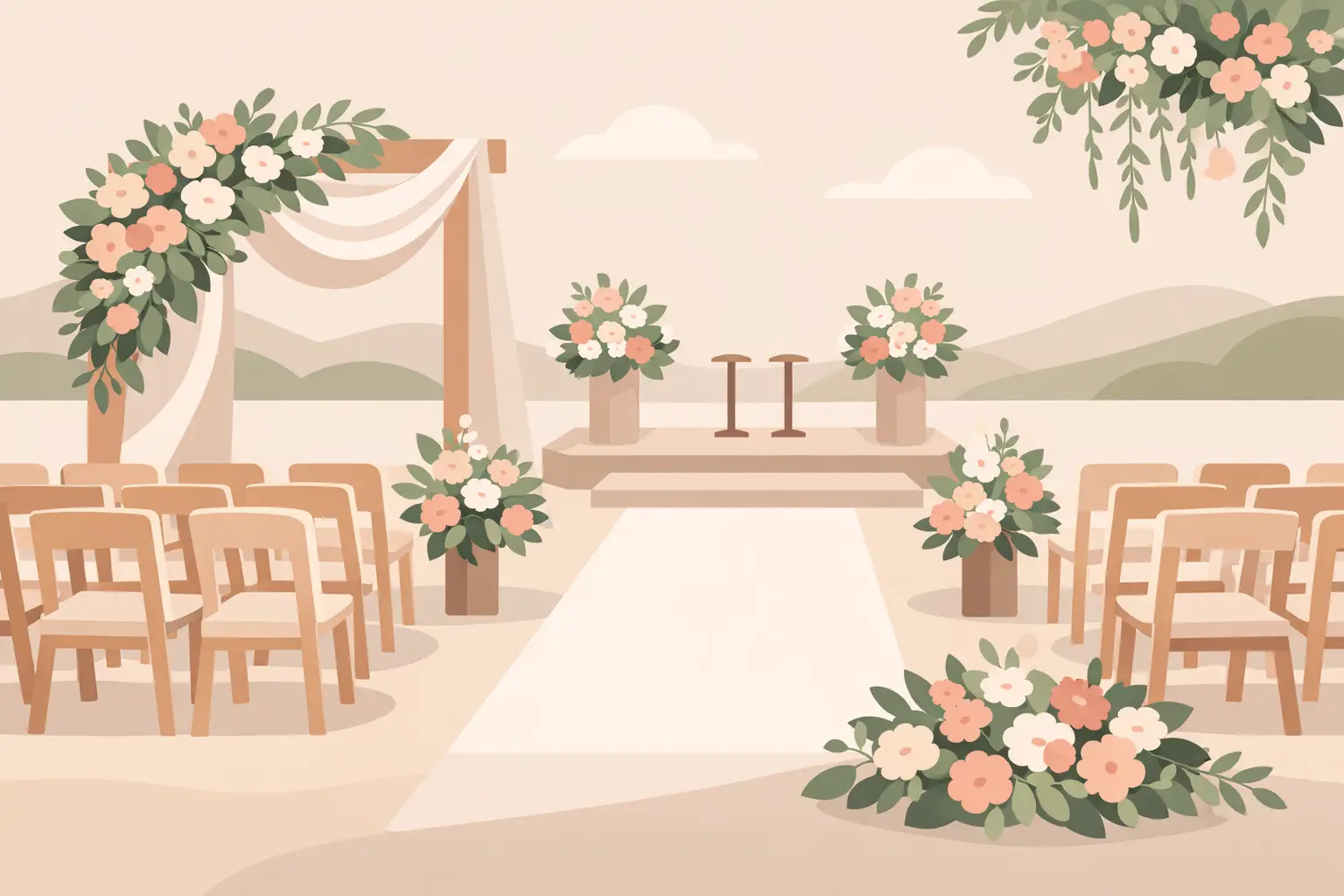
Aisle flowers bring intimacy to the processional walk. They can be as simple as small seasonal posies tied to the end of selected chairs, or as abundant as a run of meadow-inspired floor arrangements that gather more densely near the front.
The key is to allow enough room. Flowers must not narrow the aisle, create a trip hazard, or make guests feel they need to step around them. In many venues, placing designs on the floor just outside the chair line works beautifully. It gives a natural, growing quality while keeping the route clear.
Pew ends suit churches particularly well, though they do not need to appear on every pew. Choosing alternate ends, or concentrating them towards the front, can create rhythm while keeping the overall effect light. Ribbons in a tone that sits quietly with your flowers can add movement, but they should be secured carefully and checked with the venue if candles are being used nearby.
The ceremony backdrop
The place where you exchange vows deserves care, but the right approach depends on what is already there. An old archway, a window, a fireplace or a beautiful view may need only gentle framing. In other spaces, a floral installation can create a clear focal point and bring a sense of softness to a practical room.
Meadow-style arrangements at the base of a table, plinth or ceremony structure are a lovely alternative to a fully covered backdrop. They feel less formal, leave room for the people standing within them, and can be designed with seasonal British flowers that have natural movement. Foxgloves, campanula, garden roses, cosmos, delphiniums and grasses all bring a different character when they are available, though the exact ingredients should follow the season rather than a fixed recipe.
An asymmetric design can be particularly effective. It allows the eye to travel through the arrangement and avoids the overly staged look that can result when everything is identical on both sides. That said, symmetry may suit a formal church altar or a venue with a very balanced architectural setting. It depends on the building, the ceremony style and your own sense of occasion.
Work with sightlines and scale
Flowers should enhance the view for every guest, not only the photographer. Tall arrangements positioned directly between guests and the couple can be frustrating during readings and vows. If you would like height, consider placing it to either side of the ceremony area, behind where you will stand, or at the entrance.
Lower designs are often more versatile. They create texture in photographs without blocking faces, and they can be repurposed more easily at the reception. A pair of floor arrangements can frame the signing table or ceremony table, then later become top-table flowers or sit by the cake.
Scale matters just as much as quantity. A high-ceilinged barn can absorb small arrangements, while a little chapel may be transformed by only a few carefully chosen pieces. During a venue visit, stand where guests will sit and look towards the front. This simple check reveals whether an arrangement needs height, width, or simply a stronger position.
Let the season shape the design
Seasonal flowers do more than support a more thoughtful way of working. They give ceremony arrangements a sense of place and time. A May wedding may call for the fresh, hopeful shapes of blossom, sweet peas and early garden flowers; late summer can carry more relaxed colour and texture; autumn may bring berries, seed heads and richly toned foliage.
British-grown flowers are often wonderfully expressive, but they can be more delicate than imported varieties. This is part of their charm, and it affects placement. Fine stems may be better protected indoors or in sheltered positions, while exposed outdoor ceremonies need flowers and mechanics chosen to cope with sun, wind or a sudden Derbyshire shower.
For outdoor vows, always have a sensible weather plan. Weighted vessels, secure structures and a nearby sheltered location can save unnecessary worry. A floral arch that looks beautiful in still photographs is not necessarily appropriate for an exposed hilltop if it cannot be safely anchored.
Plan for flowers to move on
One of the kindest ways to use your flower budget is to choose designs that can be moved and enjoyed again. This does require a little planning, and someone reliable to move them while guests are being welcomed to the reception.
Entrance arrangements can become statement pieces at the meal. Aisle meadow sections can gather around the top table, cake table or bar. Smaller pew flowers can be given to loved ones at the end of the evening. Larger ceremony installations may remain in place if the reception is elsewhere or the logistics are too disruptive, so it is worth deciding early what is genuinely practical.
At Sweetpea Macfie, this kind of planning is part of creating flowers that feel personal rather than prescribed. The aim is not to make every corner floral. It is to place each design where it will be noticed, appreciated and remembered.
A few venue details to check early
Venues and churches often have rules that influence flower placement. Ask about access times, candle policies, fixing methods, whether anything may be attached to pews or walls, and when flowers need to be removed. Some spaces have protected surfaces or historic furnishings that require particular care.
It also helps to confirm who will open the venue, where water can be found, and whether there is a safe place to keep arrangements before the ceremony begins. These practical details allow the flower design to stay calm and beautiful on the day rather than becoming an avoidable last-minute concern.
The best ceremony flowers do not need to announce themselves loudly. A few beautiful, well-placed seasonal arrangements can make a familiar room feel entirely yours, leaving space for the people, words and promises at the heart of the day.
 I’m Marie,
the florist behind Sweet Pea Macfie.
I began Sweet Pea Macfie in 2018 and am a qualified florist with over 13 years’ experience.
The name is an ode to my Grandad, John Macfie, who in his day was one of the best Sweet pea growers in the country. He exhibited at all the major flower shows, and his Chelsea Gold Medal is one of my most treasured possessions, so you could say that growing and arranging flowers is in my blood.
I’m Marie,
the florist behind Sweet Pea Macfie.
I began Sweet Pea Macfie in 2018 and am a qualified florist with over 13 years’ experience.
The name is an ode to my Grandad, John Macfie, who in his day was one of the best Sweet pea growers in the country. He exhibited at all the major flower shows, and his Chelsea Gold Medal is one of my most treasured possessions, so you could say that growing and arranging flowers is in my blood.