
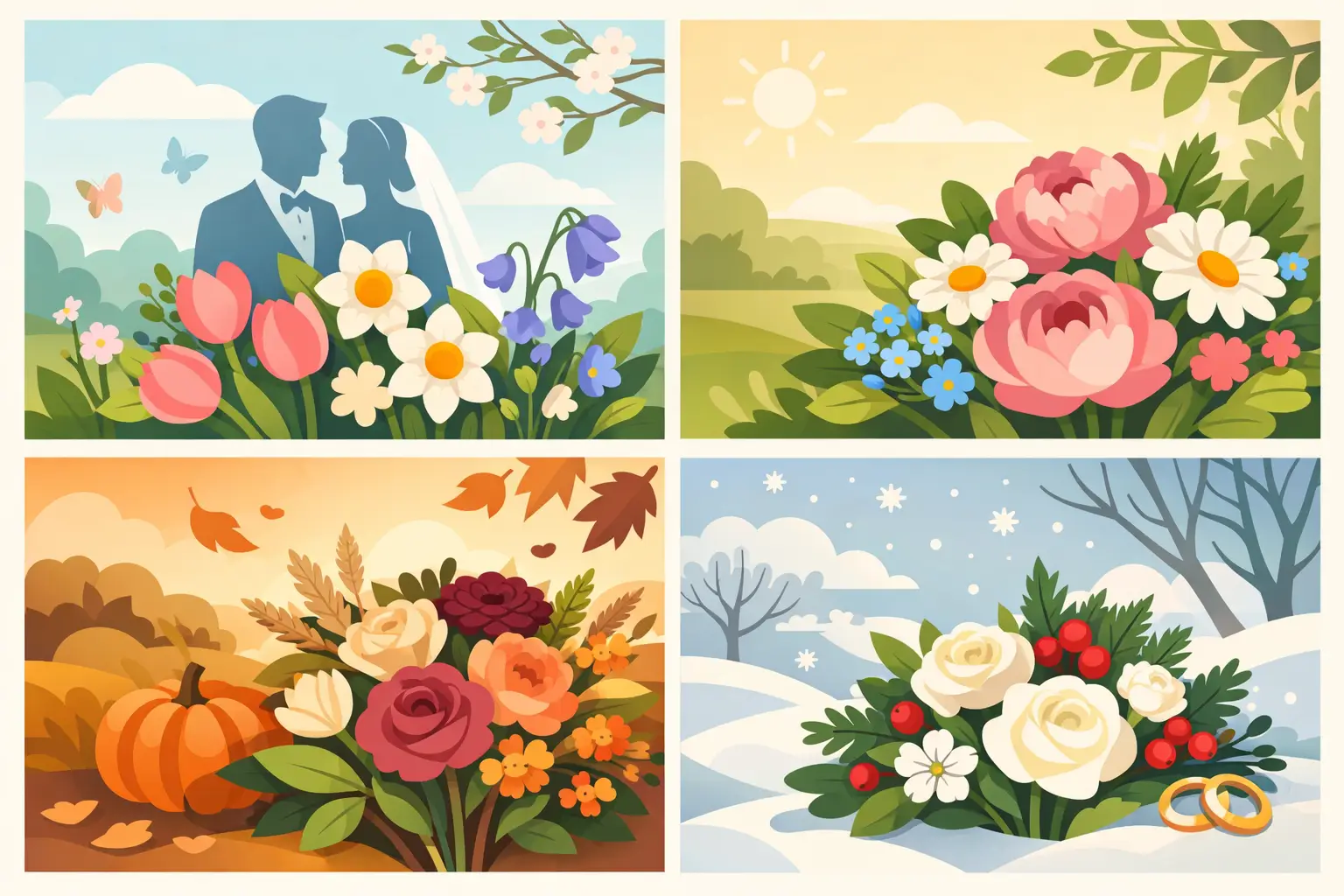
A wedding in May asks for very different flowers from one in November. Not simply because the palette changes, but because the whole feeling of the day does. That is why seasonal wedding flowers UK couples choose tend to feel more convincing, more settled in their surroundings and, quite often, more beautiful for being of their moment.
For many couples, seasonality starts as a practical question. What will look good in the month we are marrying? Very quickly, though, it becomes a design question too. Flowers that are naturally at their best tend to have better movement, better scent and a kind of ease that imported stems can struggle to match. If you are planning a wedding in Derbyshire or elsewhere in the UK, working with the season usually leads to flowers that feel less forced and more personal.
Why seasonal wedding flowers in the UK make sense
There is a quiet confidence to seasonal flowers. They do not need much persuading to look right. British-grown stems in particular often have a softness and character that suits natural wedding work beautifully – garden roses with ruffled centres, airy cow parsley, delicate sweet peas, textural dahlias and branches laden with autumn berries.
There are practical benefits as well. Seasonal flowers are often fresher because they have travelled less and been handled less. That can mean better vase life and a more natural, just-picked quality on the day. They also tend to sit comfortably within a more sustainable approach, especially when paired with foam-free mechanics and minimal packaging.
That said, seasonality is not about strict rules. If you have always loved orchids in February or peonies in September, that is a conversation worth having. The trade-off is usually cost, availability and whether the finished design still feels coherent. The best wedding flowers are rarely about ticking off a list of named blooms. They are about shape, texture, colour and atmosphere.
Seasonal wedding flowers UK couples can expect in spring
Spring flowers have a freshness that is difficult to imitate at any other time of year. This is the season of delicate movement, clear colour and those small, bright details that feel full of optimism. For weddings from March to May, the flower choices can be especially lovely if you want something natural, lightly gathered and full of life.
Narcissi, tulips, ranunculus, anemones, fritillaries, blossom, muscari and early foliage all come into their own in spring. Later in the season, you may also begin to see cow parsley, lilac and the first of the garden roses. These flowers lend themselves to bouquets that feel fresh rather than heavy, with soft shape and plenty of variation.
Spring is often ideal for couples drawn to whites, creams, pale blues, soft yellow and gentle pinks. It can also take stronger contrast well – black-centred anemones against soft ivory, for instance, or bright tulips used in a more modern way. The main thing to keep in mind is that spring flowers can be quite expressive in their own right. Tulips continue to move after arranging, and blossom is naturally fleeting. That is part of the charm, but it is worth embracing rather than resisting.
Summer wedding flowers at their most generous
Summer is usually the season people imagine first when they think about wedding flowers, and with good reason. From June through August, the range opens out considerably. Colour becomes richer, scent stronger and flower forms more abundant. If you love romantic, garden-led florals with softness and movement, this is often when British flowers are at their most generous.
Sweet peas, roses, peonies in early summer, foxgloves, delphiniums, nigella, scabious, cornflowers, ammi, cosmos and herbs can all play a part. There is room for abundance here, but abundance does not have to mean excess. A carefully made summer bouquet can still feel restrained and elegant when the ingredients are doing the work.
This is also a season where provenance matters. British-grown summer flowers have a natural scent and delicacy that imported blooms often lack. They may not always be identical stem to stem, but that variation is exactly what gives arrangements their life. If you want flowers that look as though they belong in a country garden, a stone barn or a marquee looking out onto Derbyshire hills, summer’s palette offers a great deal.
The one note of caution is heat. Some flowers are happier than others in full sun, and ceremony timing matters. A bouquet carried at midday in a heatwave may need different conditioning and flower choices from one used for a later, cooler celebration. Good floristry takes that into account from the start.
Autumn flowers with depth and texture
Autumn weddings can be especially beautiful because the flowers do not have to do all the work alone. The season brings with it berries, seed heads, turning foliage and a naturally richer landscape. That means floral designs can feel layered and atmospheric without becoming busy.
From September into November, dahlias often take centre stage, joined by chrysanthemums, cosmos, rudbeckia, scabious, late roses and branches with hips or berries. Foliage becomes more interesting too, with burnt tones, olive greens and softer browns bringing depth to bouquets and table arrangements.
Autumn suits couples who want warmth without obvious themeing. You do not need to lean into orange if that does not feel like you. Seasonal flowers can just as easily be interpreted through deep plum, old rose, caramel, cream, smoke and burgundy. The result can feel quietly luxurious rather than overtly rustic.
This is one of the loveliest seasons for textural design. Seed heads, fruits, grasses and trailing elements can all add movement and a little wildness. In the right hands, that gives arrangements a refined looseness rather than a stiff, overworked finish.
Winter wedding flowers in the UK
Winter asks for a slightly different approach. There are fewer showy British flowers available, but there is still plenty of beauty to work with. In many ways, winter floristry is about shape, scent and restraint. When chosen carefully, the designs can feel deeply elegant.
For weddings from December to February, hellebores, narcissi, early tulips, scented foliage, berries, branches and textural evergreens may all feature, depending on the exact date. Imported flowers sometimes play a larger supporting role in winter, simply because the British cutting season is quieter. What matters is using them thoughtfully, alongside seasonal materials that anchor the work in the time of year.
Winter flowers often suit more tonal palettes – whites, creams, deep greens, claret, soft taupe or near-black accents. Candlelight, fabric and the setting itself become especially important. A winter bouquet does not need to be large to be memorable. Sometimes a smaller design with exquisite scent and detail says far more.
How to choose flowers by season without feeling restricted
The most successful wedding flowers begin with the overall mood of the day, not a rigid shopping list. If you start with a favourite flower only, you can end up disappointed if it is out of season or not at its best. If you begin instead with how you want everything to feel – relaxed, romantic, understated, abundant, modern, softly wild – there is much more room to create something beautiful.
A good florist will usually ask about your venue, colour palette, dress, tables, the month of the wedding and how formal or informal you want the flowers to appear. From there, seasonal recommendations become much easier. You may think you want peonies, for example, but what you really love is a ruffled, generous flower in a soft blush tone. In that case, a garden rose or dahlia might give you that same feeling in a different month.
This is often where bespoke floristry feels most valuable. Rather than forcing one flower into the wrong season, the design can respond to what is genuinely available and beautiful at the time.
A note on British-grown flowers and flexibility
Choosing British-grown flowers where possible is not about being worthy. It is about quality, character and a closer connection to place. At Sweetpea Macfie, that preference for seasonal British flowers shapes the work because it consistently leads to arrangements with more nuance and natural beauty.
Still, flexibility matters. Weather can shift flowering times by a week or two. A cool spring may delay blossom. A hot summer may hurry certain varieties along. Couples who get the best from seasonal flowers are usually those who hold firmly to a feeling, but lightly to a precise stem list.
That balance allows the flowers to be responsive, and responsive flowers nearly always look better than those designed against the grain of the season.
If you are choosing wedding flowers now, the simplest place to start is with your date. Ask what is naturally beautiful then, what colours the landscape is already offering, and what sort of atmosphere you want your flowers to carry. The answer is rarely just about what is available. It is about what will feel quietly right when the day arrives.
 I’m Marie,
the florist behind Sweet Pea Macfie.
I began Sweet Pea Macfie in 2018 and am a qualified florist with over 13 years’ experience.
The name is an ode to my Grandad, John Macfie, who in his day was one of the best Sweet pea growers in the country. He exhibited at all the major flower shows, and his Chelsea Gold Medal is one of my most treasured possessions, so you could say that growing and arranging flowers is in my blood.
I’m Marie,
the florist behind Sweet Pea Macfie.
I began Sweet Pea Macfie in 2018 and am a qualified florist with over 13 years’ experience.
The name is an ode to my Grandad, John Macfie, who in his day was one of the best Sweet pea growers in the country. He exhibited at all the major flower shows, and his Chelsea Gold Medal is one of my most treasured possessions, so you could say that growing and arranging flowers is in my blood.