
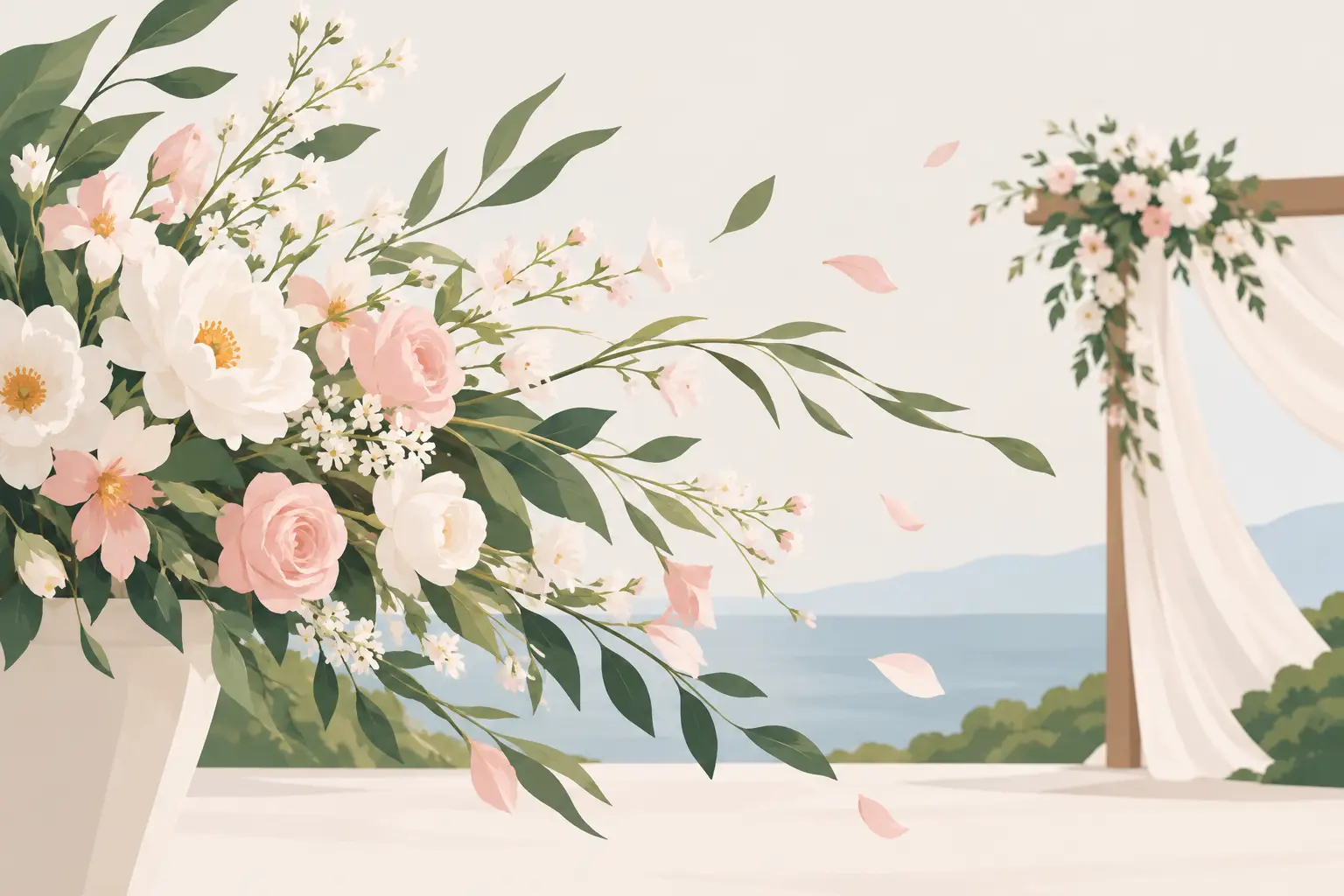
A stem that bends slightly in the breeze can change the whole feeling of a wedding arrangement. Flowers with movement for weddings bring softness, air and a sense that the designs belong to the setting, rather than having been placed there rigidly. They suit couples drawn to natural, seasonal flowers and the quieter beauty of a Derbyshire garden, meadow or hedgerow.
Movement is not simply about choosing loose flowers. It comes from considered combinations of line, texture, scale and space. A bouquet may feel abundant, but it should still have room for individual stems to do their work. The result is romantic without being overly formal, and expressive without looking untidy.
What gives wedding flowers movement?
Some flowers naturally carry themselves with a graceful curve or a light, branching habit. Cosmos nods on fine stems, sweet peas trail and twist, while campanula, scabious and astrantia create delicate changes of height and direction. Grasses, seed heads and airy foliage can be just as important as the focal flowers, catching the light and softening an outline.
The key is contrast. A few round, more grounded blooms such as garden roses, dahlias or ranunculus give an arrangement visual weight. Around them, lighter stems can reach, spill or dance. If every flower is tightly packed and facing forwards, there is little opportunity for movement. If every element is wispy, the design can lose its shape.
This balance is particularly lovely in bridal bouquets. The flowers nearest the hands might be fuller and more tactile, with lighter ingredients extending beyond them in a way that feels unforced. From a distance, the bouquet reads clearly. Up close, it reveals details that feel gathered rather than manufactured.
Choosing flowers with movement for weddings by season
Working with the season is one of the simplest ways to achieve a relaxed, living quality. British-grown flowers often have the character that comes from being grown for beauty, fragrance and seasonal expression rather than for long-distance transport. They may be a little more individual in their stems, which is exactly the point.
Spring: fresh stems and gentle looseness
Spring offers some of the most naturally animated ingredients. Sweet peas, narcissus, tulips, fritillaries, blossom, muscari and early cow parsley each bring a different kind of movement. Tulips continue to grow and curve in water, so they are not the choice for a perfectly fixed, symmetrical look. For a couple who appreciates flowers changing gently through the day, however, they are hard to better.
Spring blossom can give ceremony arrangements a wonderful sense of reach, particularly in a church, a barn or a venue with generous ceilings. It needs careful conditioning and thoughtful placement, but a few branches can create more atmosphere than a large quantity of densely arranged flowers.
Summer: colour, scent and a garden-like feel
Summer is generous. Sweet peas, cosmos, delphiniums, cornflowers, nigella, achillea, scabious, ammi and scented roses offer colour alongside a lightness that is difficult to imitate at any other time of year. This is a season when a palette can be loose as well as harmonious: butter yellow with faded blue, soft pink with apricot, or whites and greens warmed by a touch of honey.
For outdoor weddings, summer flowers with movement can make the most of the surroundings. A meadow-inspired aisle design or a cluster of bud vases along a trestle table can feel especially right when the garden beyond is doing its own beautiful, imperfect thing. The flowers need not match the landscape exactly. They simply need to sit comfortably within it.
Autumn and winter: texture over fragility
Movement does not disappear when the delicate summer stems have finished. Autumn brings grasses, berries, amaranthus, seed heads, smoky foliage and branches with changing leaves. These materials create a more textural kind of movement, with shifting silhouettes and depth rather than flutter.
In winter, evergreen foliage, bare branches, hellebores and dried elements can be used with restraint to keep designs from becoming heavy. A winter wedding can still feel airy, but the movement may come through arching foliage and sculptural line instead of abundant flower heads. It is often more about editing well than adding more.
Where moving flowers make the greatest impact
A bridal bouquet is the most personal place to use these ingredients, because it is held, photographed closely and carried from one part of the day to the next. The stems should feel comfortable in the hand and remain appropriate to the dress. A silk gown with clean lines may suit a more sculptural bouquet, while layered lace or a softer silhouette can carry a wilder shape beautifully. There are no fixed rules, but proportion matters.
Meadow-like ground arrangements at the ceremony are another natural fit. Rather than a pair of identical, upright displays, designs can be created with different heights, directions and textures. They frame the couple without competing with them, then can often be moved to the reception for a second moment of enjoyment.
Tables benefit from movement too, although practicality comes first. Long, low arrangements with small flowering branches, delicate bud vases and lightly trailing foliage encourage guests to look through the flowers rather than around a solid barrier. Taller arrangements need clear stems or enough height that conversation remains easy. The most beautiful table flowers still have to make room for people, plates and glasses.
The difference between relaxed and unruly
Natural-looking wedding flowers require more technical control than they first appear to. Every stem needs to be conditioned properly, supported where needed and placed with intention. A design may look as though it has just been gathered from the garden, but it must travel well, hold its shape and remain fresh through photographs, ceremony and celebration.
There are also practical trade-offs. Very fine, trailing or highly seasonal flowers can be more delicate in heat, strong wind or a long summer day. Large installations with lots of airy material need secure mechanics, particularly outdoors. A florist may suggest a sturdier flower with a similar line, use a more protected location, or reserve the most fragile stems for the bouquet and indoor tables.
Colour needs a little discipline as well. A loose shape does not mean every colour belongs together. Choosing a considered palette gives moving flowers a calm backdrop. Tonal shades, softened contrasts and plenty of foliage or neutral flower heads can stop an abundant design from feeling busy.
A more thoughtful way to plan a natural floral scheme
Start with the feeling you want guests to have as they arrive. Perhaps it is the freshness of an early-June garden, the faded warmth of late summer or the quiet texture of an October hedgerow. Photographs are useful, but they work best when they communicate mood rather than ask for an exact copy of flowers that may not be available in your wedding month.
Be open about the parts of the day that matter most. For some couples, that is the ceremony backdrop. For others, it is a bouquet that feels unmistakably personal, or a shared dining table that looks beautiful in candlelight. A bespoke floral plan can place the budget where it will be most felt, rather than spreading it thinly across every surface.
At Sweetpea Macfie, seasonal availability is treated as a creative starting point. This allows the best British-grown stems to lead the design, while keeping the overall look faithful to the couple and the place they have chosen. Foam-free methods and minimal packaging also support a more considered approach, without compromising the romance of the finished flowers.
The most successful arrangements do not try to freeze nature in place. They allow a stem to lean, a flower to turn towards the light and a little space between the blooms. When the flowers are chosen with care, that gentle movement becomes part of the memory of the day.
 I’m Marie,
the florist behind Sweet Pea Macfie.
I began Sweet Pea Macfie in 2018 and am a qualified florist with over 13 years’ experience.
The name is an ode to my Grandad, John Macfie, who in his day was one of the best Sweet pea growers in the country. He exhibited at all the major flower shows, and his Chelsea Gold Medal is one of my most treasured possessions, so you could say that growing and arranging flowers is in my blood.