A bowl of flowers can look effortless, but the mechanics beneath the stems shape far more than the finished look. When considering foam free versus floral foam, the question is not simply whether one option is greener than the other. It is also about the movement of the flowers, the longevity of the design, the occasion and the care taken in every detail.
For weddings, funeral flowers and meaningful gifts, the most fitting choice is usually the one that supports both the flowers and the sentiment behind them. Foam-free floristry offers a beautiful, thoughtful alternative, but it is helpful to understand where floral foam has traditionally been used and why different designs call for different approaches.
What is floral foam?
Floral foam is the familiar green, lightweight block often used to hold cut stems in place while providing them with water. It can be cut and shaped, which made it a common choice for arrangements in bowls, large installations, wreaths and funeral tributes. For many years, it offered florists an efficient way to create a full, secure display in a particular form.
Its practical appeal is easy to understand. Flowers can be placed exactly where they are needed, stems remain supported, and the design can be transported with relative confidence. For formal shapes or intricate work, it gave a reliable structure.
The difficulty is that conventional floral foam is a single-use plastic material. It does not break down naturally and can fragment into tiny particles during use and disposal. It is also not generally recyclable through household collections. Once its floral purpose is complete, it leaves behind material that does not belong in compost, garden waste or the natural landscape.
That is why many florists and clients are now asking more careful questions about the materials behind their flowers.
Foam free versus floral foam: the difference in practice
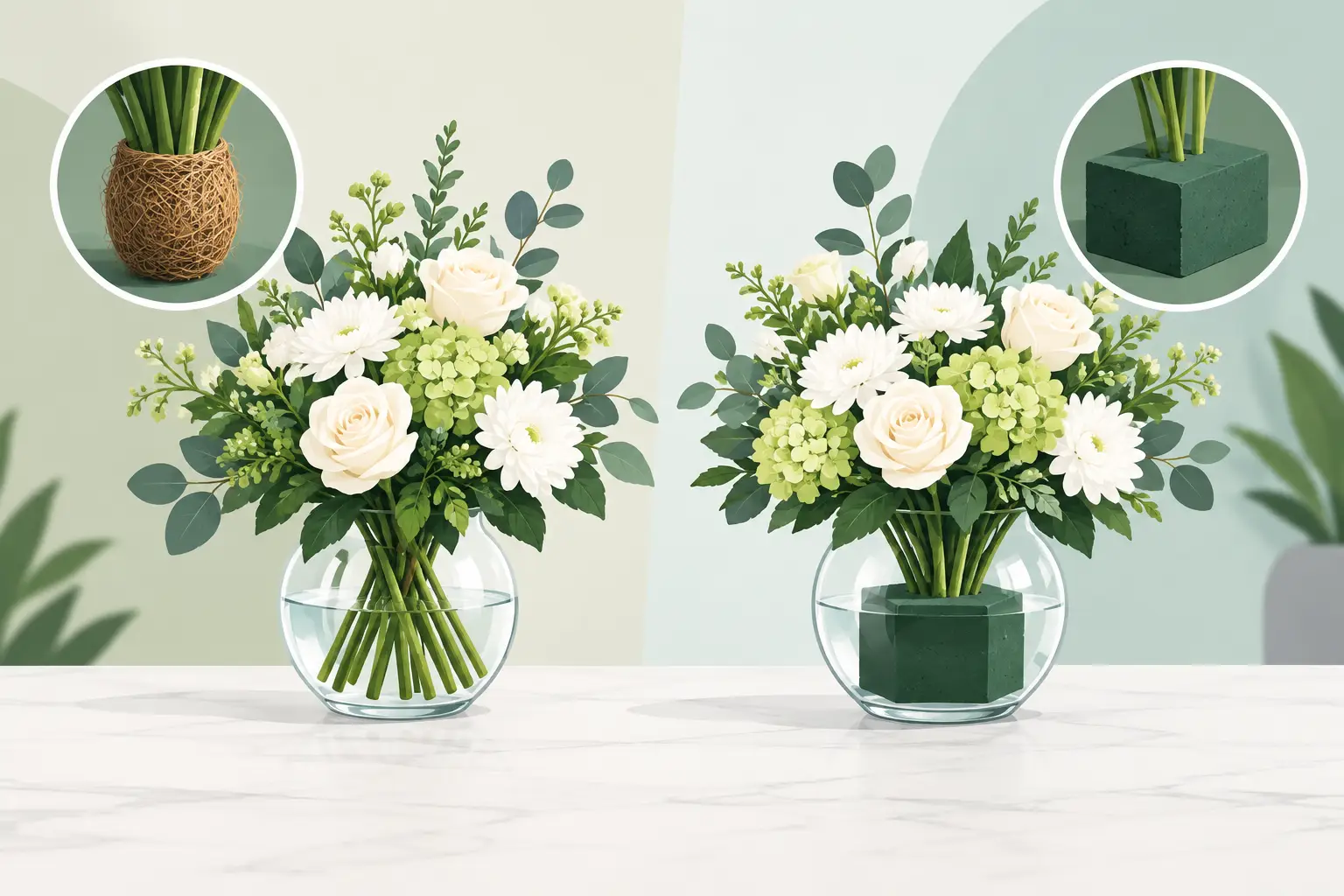
Foam-free floristry replaces the block with reusable, compostable or lower-impact mechanics. The exact method depends on the vessel, the flowers, the scale of the work and where the arrangement will be displayed.
A vase arrangement may need no mechanics at all beyond fresh water and thoughtful stem placement. For a garden-style centrepiece in a low bowl, a florist might use a reusable metal flower frog, chicken wire, twigs, moss or a combination of techniques to create a discreet framework. A large urn design may be built with carefully secured wire structures and water-filled containers, while a hand-tied bouquet needs only clean water, good conditioning and an appropriate wrap.
The visual difference is often striking. Floral foam can encourage flowers to sit at fixed, evenly spaced angles. Foam-free work tends to follow the natural direction of each stem, allowing a little more air, looseness and movement. That does not mean it is messy or less considered. Quite the opposite: it asks the florist to understand balance, stem strength, water needs and proportion at a deeper level.
A foam-free arrangement can feel as though the flowers have gathered there naturally. For couples drawn to seasonal wedding flowers, or families seeking a gentle and personal farewell tribute, that sense of life and softness often matters.
Why foam-free design suits seasonal flowers
British-grown flowers are particularly lovely in foam-free work. Their stems can be characterful: a bend in sweet pea, the branching habit of cow parsley, the graceful curve of a narcissus or the gathered heads of garden roses. Rather than forcing every stem into a rigid position, foam-free mechanics can give these flowers room to do what they do best.
Seasonality also encourages a more responsive style of design. The available flowers change week by week, and each variety brings its own shape, scent and pace. A foam-free design is often built around those qualities rather than against them. It may be airy and meadow-like in late spring, full of dahlias and seed heads in early autumn, or richly textural with winter foliage and branches.
This approach is not about making an arrangement look deliberately wild. It is about creating considered movement and a sense of place. The result can be refined, abundant and beautifully finished without appearing stiff or overworked.
The environmental picture is broader than foam alone
Choosing foam-free flowers is a meaningful step, but sustainability in floristry is never one single decision. Flower miles, growing methods, packaging, vase hire, transport, seasonality and what happens after an event all play a part.
A foam-free arrangement made with locally grown, seasonal flowers and reusable vessels will usually have a lighter footprint than one reliant on imported blooms, disposable plastics and large quantities of packaging. Equally, a florist may need to make sensible decisions for a very hot summer wedding, a lengthy delivery route or a tribute that must remain presentable outdoors for several days.
The aim is not perfection. Flowers are perishable, and significant occasions sometimes require specific colours, varieties or structures that cannot be sourced locally at a particular time of year. What matters is choosing materials with care, avoiding unnecessary waste and being honest about the practicalities.
Are foam-free flowers as long-lasting?
They can be, provided the design is made with the right flowers and mechanics. Cut flowers need clean water, good conditioning and suitable temperatures whether they are arranged in foam or not. In fact, a vase-based arrangement makes it easier to refresh the water, which can be helpful for flowers kept at home.
There are differences. Floral foam holds water close to each inserted stem, although it can be difficult to rehydrate fully once dry. Foam-free arrangements may use hidden water sources such as jars, trays or vessels, and a florist needs to plan carefully so that every flower can drink.
Certain flowers are naturally more sensitive than others. Hydrangeas, for example, need generous hydration; delicate spring stems can be affected by warmth; and flowers displayed near radiators, sunny windows or candles will fade more quickly whatever method is used. A skilled florist selects suitable varieties for the conditions rather than promising that every bloom will behave in exactly the same way.
Weddings: beauty, practicality and reuse
Weddings offer some of the best opportunities for foam-free floristry. Table arrangements in vessels, bud vases, meadow-style floor displays, ceremony urns and hand-tied bridal flowers can all be created without foam. Designs can also be moved from the ceremony to the reception, allowing flowers to be appreciated twice rather than used for a single moment.
Some installations require more planning. A large floral arch exposed to wind, heat or rain needs secure engineering, dependable water sources and careful installation. Foam-free mechanics are entirely possible, but they may take more time, require more vessels or call for flowers that can cope well out of water for a shorter period.
That investment is worthwhile when the design is planned from the outset. It is much harder to take a conventional, foam-dependent idea and remove the foam at the last minute. A conversation early in the planning process allows the flower choices and the overall style to work together.
Funeral flowers deserve the same care
Funeral tributes are often ordered during a difficult time, when families need guidance rather than a long list of decisions. Traditional tribute shapes have frequently been made in floral foam, especially wreaths, letters and sprays intended for the graveside or crematorium.
There are now gentler alternatives. A hand-tied sheaf can be laid naturally and later separated for composting where appropriate. A seasonal posy in a reusable or natural vessel can be taken home after the service. Wreaths can be designed around natural bases, with foliage, willow, moss and carefully chosen flowers, although the exact materials should be discussed as different designs have different practical limits.
For many families, a foam-free tribute feels especially fitting: flowers returned to the earth as naturally as possible, chosen for their meaning, favourite colours or time of year. It need not be less beautiful or less generous. Often, its quieter simplicity says more.
What to ask your florist
If sustainability matters to you, it helps to mention it at the beginning rather than treating it as an added extra. You might share the setting, the date, the flowers you love and whether you are happy to be guided by what is in season. A florist can then suggest a design that feels right for the occasion and is realistic about longevity, weather and budget.
It is also worth asking what will happen after the event. Can vessels be returned? Can ceremony flowers be repurposed? Are there elements that guests can take home? Small decisions such as these can extend the pleasure of the flowers and reduce what is left behind.
At Sweetpea Macfie, foam-free methods are part of a wider way of working: choosing flowers with provenance, allowing seasonal materials to lead, and creating designs that feel personal rather than formulaic.
The most beautiful flowers are not those held in the most hidden mechanics. They are the ones that feel right in the room, in the season and in the hands of the people receiving them.
 I’m Marie,
the florist behind Sweet Pea Macfie.
I began Sweet Pea Macfie in 2018 and am a qualified florist with over 13 years’ experience.
The name is an ode to my Grandad, John Macfie, who in his day was one of the best Sweet pea growers in the country. He exhibited at all the major flower shows, and his Chelsea Gold Medal is one of my most treasured possessions, so you could say that growing and arranging flowers is in my blood.