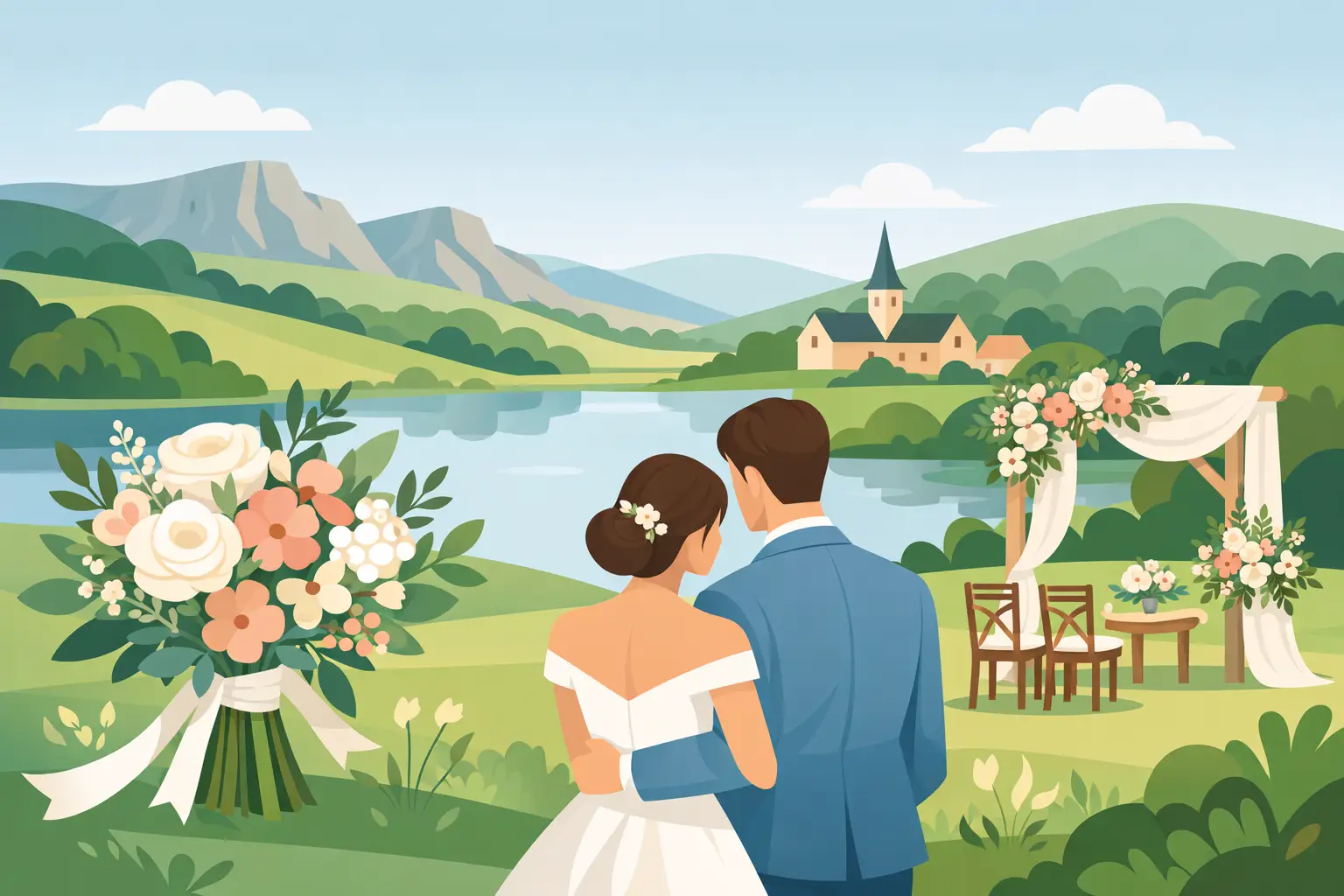
A small wedding gives flowers room to matter. When there are fewer tables, fewer formalities and a more intimate gathering of the people you love, each arrangement is noticed: the stem in a buttonhole, the scent on the table, the way a bridal bouquet moves as you walk through a village church or across a garden lawn. The best flowers for small weddings are not necessarily the grandest or most expensive. They are the ones that feel at home in the season, the setting and your day.
For couples marrying in Derbyshire, that might mean meadowy British flowers for a summer celebration near Matlock, sculptural branches and winter foliage for a candlelit dinner, or soft spring blossom for a small ceremony at home. A thoughtful floral scheme need not fill every corner to feel generous. In fact, a smaller guest list often allows for more considered choices and better quality in the places that count.
Start with the feeling, not a flower list
Before choosing individual stems, think about how you want the room to feel. Intimate weddings can be relaxed and garden-like, quietly elegant, abundant and romantic, or pared-back and contemporary. None of these approaches requires a huge quantity of flowers, but each benefits from a clear direction.
A long supper table calls for flowers that allow conversation to travel easily across it. A registry office ceremony may need one beautifully made bouquet and a few delicate personal flowers rather than an arch. If you are marrying in a barn, a historic house or a family garden, the existing textures – stone, timber, hedgerows, linen, candlelight – should guide the flowers rather than compete with them.
This is also where seasonality becomes useful rather than restrictive. British-grown flowers have a freshness, character and sense of place that is difficult to replicate. Their availability changes, but that is part of their charm. Choosing what is naturally flourishing around your wedding date often creates a design that feels more personal, and can reduce the need for flowers flown from far away.
The best flowers for small weddings by season
Spring: tulips, blossom, narcissi and sweet peas
Spring flowers suit small weddings beautifully because they carry such optimism without needing much embellishment. Tulips are wonderfully expressive, especially varieties with unusual shapes or painterly colours. They continue to grow and curve in the vase, which brings a lovely sense of movement to a table arrangement.
Blossom branches can make a modest space feel special very quickly. A few well-placed stems in weighty vessels create height without visual clutter, while narcissi offer scent and a distinctly British spring character. Later in the season, sweet peas bring softness and perfume to bridal bouquets and bud vases. Their stems are delicate, so they are best used where their detail can be appreciated up close.
Spring weather can be changeable, particularly for an outdoor ceremony. A florist may suggest more resilient companions for a bouquet or avoid placing delicate blooms in direct sun. It is not about removing the romance, but making sure the flowers look their best from the first photograph to the last toast.
Summer: garden roses, cosmos, dahlias and herbs
Summer offers the widest choice of British flowers, and it is an especially good season for couples who like a natural, gathered look. Garden roses give the fullness and fragrance many people hope for, but with more character than a tightly uniform rose. Their open centres and soft petal structure work particularly well in an intimate bouquet.
Cosmos has an airy, almost weightless quality that suits relaxed celebrations. It pairs beautifully with cornflowers, scabious, ammi and scented foliage. For late summer weddings, dahlias bring richer colours and stronger forms, from pale café-au-lait tones to deep berry and rust shades.
Herbs are worth considering here too. Mint, rosemary, flowering oregano and scented geranium add texture and a subtle fragrance to table flowers. They can connect a floral scheme to a meal in a way that feels understated and memorable. Do take care with heavily scented flowers where guests will be dining closely together: a little scent is lovely, but it should never overwhelm the food or the conversation.
Autumn: dahlias, chrysanthemums, seed heads and foliage
Autumn flowers have depth without needing to feel dark. Dahlias continue to be a highlight, while British-grown chrysanthemums bring an enormous range of forms, from soft and intricate to bold and architectural. Used thoughtfully, they are far removed from anything formal or predictable.
This is also the season for texture. Seed heads, grasses, turning leaves, hips and branches can add interest to a small wedding table without requiring masses of blooms. A low arrangement of dahlias, scabious, smoke bush and seasonal foliage may feel more generous than a taller display because guests can see its detail and one another.
Autumn is ideal if you are drawn to warm neutrals, faded pinks, plum, caramel, russet and deep red. But it can be equally beautiful in pale tones. Cream chrysanthemums, blush roses and soft grasses against candles and natural linen have a calm, gathered elegance.
Winter: hellebores, narcissi, evergreens and branches
Winter weddings invite a different kind of abundance: not necessarily lots of flowers, but beautiful materials with shape, scent and presence. Hellebores are a favourite for their gently nodding heads and subtle colours. Paperwhites and narcissi add fragrance, while evergreen foliage, winter berries and bare branches create a strong seasonal framework.
For a small celebration, consider a few statement vessels rather than many small arrangements. Mossy branches on a ceremony table, pots of flowering bulbs along a mantelpiece, or a bowl of seasonal flowers and foliage at the centre of a dining table can feel quietly special. Candlelight does much of the work in winter, allowing flowers to be more textural and restrained.
Choose flowers for the moments people will remember
A smaller wedding gives you permission to focus the floral budget where it has the most emotional and visual value. Usually, that begins with the bridal bouquet. It will be in your hands during the ceremony, appear in photographs and may later become a keepsake through pressing or drying a few stems. It should feel comfortable to hold, appropriate to your outfit and unmistakably yours.
Personal flowers are another meaningful place to invest. A buttonhole for a partner, a flower comb for a child, or a small posy for a parent can create a gentle thread between the people closest to you. These pieces do not need to match exactly. A family of colours and textures is often more natural than a rigidly identical set.
For the ceremony, one considered focal point can be enough. This might be meadow-like arrangements at the end of the aisle, flowers on a signing table, or two vessels that can later move to frame the wedding breakfast. Reusing ceremony flowers is sensible, but it needs planning. Designs should be made in vessels that can travel safely, and someone needs to be responsible for moving them at the right time.
At the table, low arrangements, bud vases and seasonal fruit or candles are often more successful than elaborate centrepieces. They create layers without forming a barrier between guests. If you have one long table, repeating a small number of flower varieties along its length can look more intentional than using a different arrangement everywhere.
Let the venue and guest count shape the scale
Small does not always mean minimal. Ten guests around a kitchen table may suit a run of tiny vases filled with individual seasonal stems. Thirty guests in a stone barn may need larger gestures at the entrance or ceremony area so the room does not feel lost. Scale is about the proportion of the flowers to the space, not the number of guests alone.
It also helps to be honest about what you do not need. Chair ends, every surface covered in foliage and multiple large installations can quickly pull a floral scheme away from the intimacy that made the wedding appealing in the first place. A few carefully placed arrangements often have more impact, particularly when they use flowers with interesting shape and movement.
A good florist will ask about timings, transport, light levels and where guests will gather. A bouquet that is perfect for a morning ceremony may need different flower choices for a hot summer afternoon. Similarly, a venue with strong patterned wallpaper or striking architecture may call for a simpler palette, while a plain village hall can carry more colour and texture.
Make room for a little flexibility
The most beautiful seasonal work is rarely built from an exact, fixed shopping list. Weather affects British flower crops. A warm spring may bring peonies early; a cold spell may hold them back. Some varieties arrive with exceptional length and abundance, while others have a shorter season than expected.
Rather than pinning the whole design to one must-have bloom, choose a colour story and a feeling, then allow your florist to select the best flowers available that week. You may begin with the idea of blush roses and sweet peas, but find that the most beautiful stems are scented garden roses, pale cosmos and soft blue scabious. The result will feel alive, rather than copied from a photograph taken in another country and another season.
At Sweetpea Macfie, this is the pleasure of working with flowers grown close to home: each wedding has its own seasonal signature. Foam-free mechanics and reusable vessels can also be considered from the outset, helping the designs feel as thoughtful behind the scenes as they do on the day.
The flowers at a small wedding do not need to prove anything. Let them echo the season outside, make your favourite people feel welcomed at the table, and give you a few quiet moments of beauty to notice amid all the happy noise.
 I’m Marie,
the florist behind Sweet Pea Macfie.
I began Sweet Pea Macfie in 2018 and am a qualified florist with over 13 years’ experience.
The name is an ode to my Grandad, John Macfie, who in his day was one of the best Sweet pea growers in the country. He exhibited at all the major flower shows, and his Chelsea Gold Medal is one of my most treasured possessions, so you could say that growing and arranging flowers is in my blood.
I’m Marie,
the florist behind Sweet Pea Macfie.
I began Sweet Pea Macfie in 2018 and am a qualified florist with over 13 years’ experience.
The name is an ode to my Grandad, John Macfie, who in his day was one of the best Sweet pea growers in the country. He exhibited at all the major flower shows, and his Chelsea Gold Medal is one of my most treasured possessions, so you could say that growing and arranging flowers is in my blood.