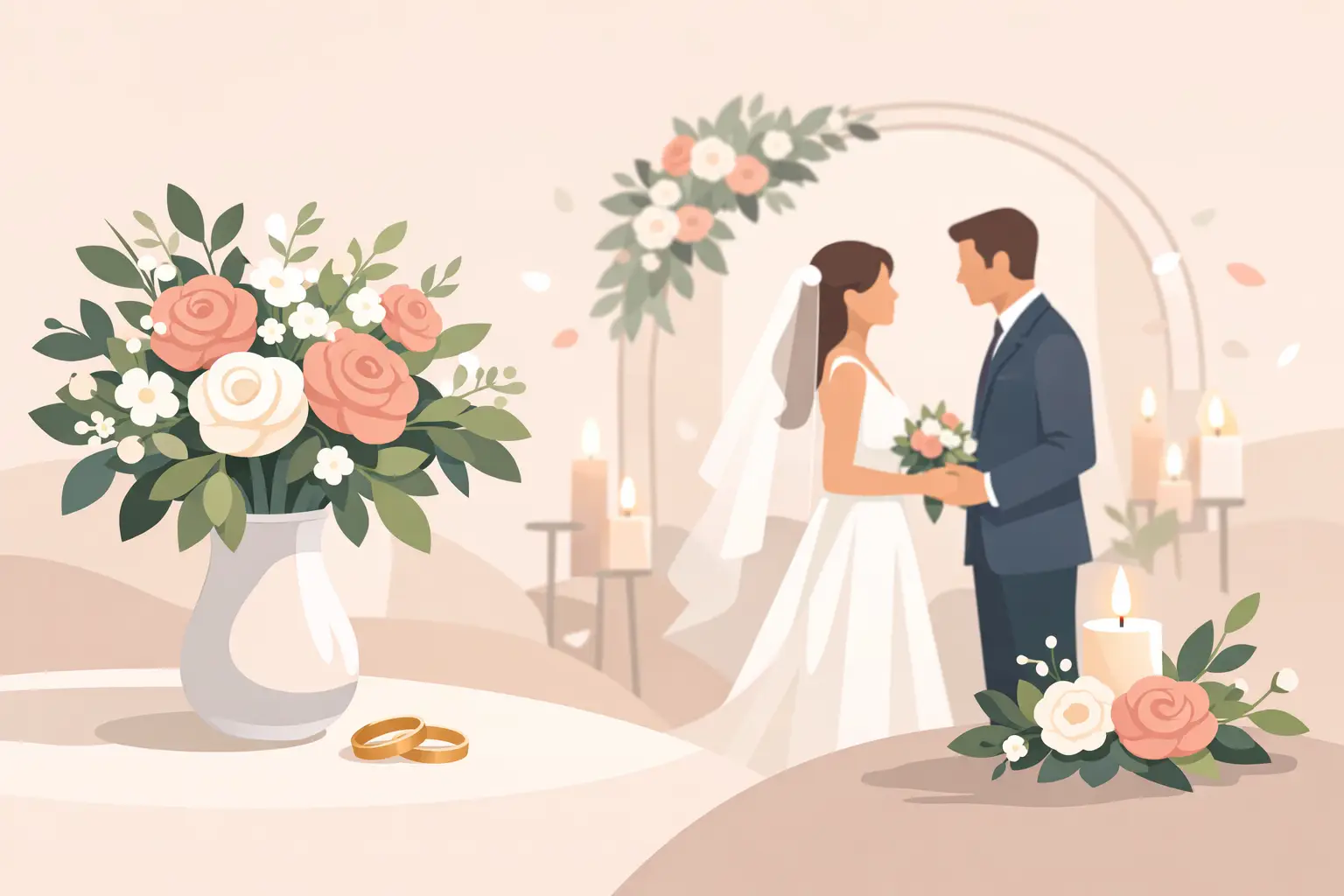
A small guest list does not mean small-hearted flowers. Micro wedding flowers have room for lovely detail: a garden rose with a soft, open face, a sprig of scented sweet pea, a trailing stem that catches the light as you walk into the room. With fewer tables, fewer buttonholes and often a more relaxed setting, couples can make choices that feel especially personal rather than simply trying to fill a large venue.
For an intimate wedding in Derbyshire, flowers can help create the sense that everyone has been welcomed into something thoughtful. They might soften a village hall table, bring a little life to a restaurant’s private dining room, or make a family garden feel ready for a proper celebration. The best designs do not need to shout. They simply belong there.
Why micro wedding flowers deserve careful thought
A micro wedding usually means a smaller number of guests, often around 20 to 50, though every couple defines it differently. The scale may be reduced, but the occasion is no less significant. In fact, with a close group of family and friends, the details are often seen and appreciated more closely.
This is where floral design can become wonderfully considered. Rather than repeating the same arrangement across 12 tables, you may choose a few generous, characterful pieces: flowers around the ceremony table, small bud vases where everyone gathers for supper, and a bouquet designed to feel entirely like you. The flower budget can be concentrated in the places that will matter most in photographs and in the experience of the day.
There is a useful balance to strike. Fewer arrangements do not automatically mean a smaller spend, particularly if you are choosing sought-after British flowers, intricate designs or a large statement installation. Equally, an intimate wedding does not require a ceremony arch to feel special. Good floristry begins with the atmosphere you want to create, then works carefully with the season, venue and budget.
Start with the feeling, not a flower checklist
Before naming varieties, think about how you want the day to feel. Perhaps it is a relaxed spring lunch with linen napkins and home-baked cake. Perhaps it is candlelit, autumnal and slightly wild, with gathered foliage and rich berries. Or perhaps you are marrying at home and want the flowers to look as though they have grown naturally around you.
A clear feeling gives the flowers direction. Soft and romantic might lead towards garden roses, sweet peas, cosmos and flowering herbs. Airy and meadow-like could include scabious, achillea, grasses and delicate branches. For a more sculptural look, a restrained palette of elegant blooms with interesting foliage may be more effective than lots of different colours.
Bring a few images to a florist, but do not feel you need to arrive with every stem decided. Photographs are helpful for showing shape, mood and texture, although the exact flowers pictured may not be in season or may have been grown in another climate. A good florist will translate what you respond to into flowers that are fresh, available and appropriate for your date.
Let the season do some of the work
Seasonality is one of the quiet advantages of planning a small wedding. When designs are not dependent on a prescribed list of imported blooms, there is room to use what is looking particularly beautiful that week. British-grown flowers often have movement, scent and a natural variation that gives arrangements their character.
In spring, narcissi, tulips, ranunculus, anemones and early blossom can bring freshness without looking stiff. Summer offers sweet peas, dahlias, cosmos, phlox and scented herbs, while autumn brings rich dahlias, chrysanthemums, grasses, seed heads and berries. Winter flowers may be more restrained, but hellebores, foliage, branches and seasonal texture can feel deeply elegant.
Choosing with the season also supports a more considered approach to sourcing. Flowers may travel less, and the finished work is more likely to reflect the time and place of your wedding rather than a passing trend. Nature is not uniform, and that is part of its beauty.
Where to spend your flower budget
For a micro wedding, it often makes sense to focus on a few moments rather than spreading flowers thinly across every surface. Your bouquet is usually a natural priority. It will be close to you for much of the day and should feel comfortable to hold, proportioned to your outfit and full of the colours and textures you love.
The ceremony is another worthwhile place to invest. A pair of meadow-like arrangements, urns or large vessels can frame your vows without overwhelming them. If the venue allows, these can usually be moved afterwards to sit behind the top table, beside the cake or near the entrance to your meal. Repurposing flowers in this way is practical, but it also means your favourite pieces remain part of the celebration for longer.
Table flowers can be beautifully simple. A single low arrangement shared along a table may be enough, or a collection of small vessels with differing stems can create a relaxed, abundant feel. Keep sightlines clear, especially where guests are seated closely together. Flowers should invite conversation, not make people lean sideways to see one another.
For a very small gathering, consider giving each guest place a tiny floral gesture: a sprig of herbs tied to a napkin, a single seasonal stem in a little bottle, or a small posy for the most important members of your wedding party. These details are not essential, but they can feel lovely when used with restraint.
Choosing designs for your venue
The setting should guide the scale and style of your flowers. A stone barn near Matlock may suit loosened, textural designs that soften timber, brick and beams. A Derbyshire garden can be enhanced with flowers that echo the planting already there. In a restaurant, the focus may be on an exceptional bouquet and low arrangements that work around the tableware and candlelight.
It is helpful to ask practical questions early. Are there stairs, uneven paths or a long walk from parking to the ceremony space? Is there somewhere cool to keep the bouquet before photographs? Does the venue have a policy on attaching flowers to walls or beams? A florist can plan around these details, but knowing them beforehand avoids unnecessary compromises.
If you are marrying outdoors, have a gentle plan for the weather. British summer days can be wonderfully warm, but heat and direct sun are not kind to every flower. Wind can also make tall arrangements or delicate trailing designs impractical. The answer is not to abandon the idea, but to choose materials and vessels that are stable, well-conditioned and suited to the conditions.
Personal flowers can carry the story
With a smaller wedding party, personal flowers become even more noticeable. A bouquet may include a flower that reminds you of your grandmother’s garden, a ribbon from a family dress, or colours drawn from a meaningful place. These touches work best when they are woven into the design rather than added for the sake of sentiment alone.
Buttonholes should be small, secure and proportionate. A single flower, a bud, or a little combination of textured foliage and seasonal bloom can be far more elegant than a miniature bouquet pinned to a jacket. For parents, siblings or witnesses, small posies or corsages can offer a gentle sense of occasion without making anyone feel overly formal.
When flowers are personal, they need not all match exactly. A bride’s bouquet, a partner’s buttonhole and a few table stems can share a colour palette or a particular ingredient while still feeling natural. This is often more beautiful than trying to make every arrangement identical.
A more thoughtful approach to floral mechanics
Many couples now ask how their wedding flowers are made, not just how they will look. This is a welcome question. Traditional floral foam is convenient, but it is a single-use plastic product, and it is not necessary for every design.
Foam-free mechanics can include reusable vessels, chicken wire, moss where appropriate, water-filled tubes and carefully chosen structures. The method depends on the design and venue, but a florist who works this way can create flowers with movement and security while reducing avoidable waste. Minimal packaging, hired vessels and locally grown material where possible all contribute to a lighter-touch celebration.
Sustainability is rarely about claiming perfection. Some flowers will need to be sourced from further afield, and certain colours or varieties may simply not be available locally at the time of year. The most honest approach is to be open about priorities: seasonal flowers first, considered mechanics, and designs made to be enjoyed rather than discarded without thought.
Working with a florist for an intimate wedding
A personal consultation is especially valuable for micro wedding flowers because there is no need to follow a standard package. At Sweetpea Macfie, the starting point is the people, setting and season behind the celebration, then the flowers take shape around them.
Share your date, venue, guest numbers and a comfortable budget from the outset. It is also useful to mention anything that matters emotionally, whether that is a favourite flower, a colour you would rather avoid, or the need for designs that can be moved between ceremony and supper. Honest conversations make the best use of every stem.
Try to leave some room for the season to speak. A florist’s work is at its most alive when it is not forced into an exact replica of a photograph, but allowed to respond to the beautiful flowers available at the time. On a day centred on the people closest to you, that sense of freshness and individuality is often what guests remember most.
The loveliest flowers for a small wedding are not necessarily the biggest or the most elaborate. They are the ones that make the room feel cared for, catch a familiar scent as you pass, and quietly mark the beginning of a day you will want to hold close.
 I’m Marie,
the florist behind Sweet Pea Macfie.
I began Sweet Pea Macfie in 2018 and am a qualified florist with over 13 years’ experience.
The name is an ode to my Grandad, John Macfie, who in his day was one of the best Sweet pea growers in the country. He exhibited at all the major flower shows, and his Chelsea Gold Medal is one of my most treasured possessions, so you could say that growing and arranging flowers is in my blood.
I’m Marie,
the florist behind Sweet Pea Macfie.
I began Sweet Pea Macfie in 2018 and am a qualified florist with over 13 years’ experience.
The name is an ode to my Grandad, John Macfie, who in his day was one of the best Sweet pea growers in the country. He exhibited at all the major flower shows, and his Chelsea Gold Medal is one of my most treasured possessions, so you could say that growing and arranging flowers is in my blood.