When a family asks for natural funeral flower arrangements, they are often looking for something quieter than the standard catalogue tribute. Not plainer, and certainly not less thoughtful, but more personal. The flowers need to feel right for the person being remembered, and they need to sit comfortably within the tone of the day.
That is often where natural floristry comes into its own. A design with movement, seasonal detail and a gathered, garden-like feel can carry real warmth. It can feel more human than a tightly formal arrangement, particularly when the aim is to reflect a life, a character or a deep sense of place.
What natural funeral flower arrangements really mean
Natural funeral flower arrangements are not one fixed style. They are usually defined less by a particular shape and more by the way they are made and the feeling they create. They tend to use flowers and foliage with softness, texture and variation, rather than highly manufactured-looking stems arranged into rigid patterns.
A natural tribute may include branching foliage, scented herbs, garden flowers, seedheads or seasonal materials with a looser silhouette. The effect is often elegant but understated. Nothing too glossy, nothing overly dressed, and nothing that feels detached from the landscape or the person it is for.
For some families, natural means wild and meadow-like. For others, it means simple whites and greens with very little embellishment. Sometimes it means asking for British-grown flowers where the season allows, or choosing a foam-free design because environmental impact matters to the person who has died. It depends on what is meaningful to the family and what feels appropriate.
Why many families prefer a more natural style
Funeral flowers are deeply emotional, but they are also visual. They become part of the atmosphere of the service, the graveside or the wake. A natural style can soften the formality of those settings without losing dignity.
There is often a gentleness to this kind of work. Flowers can look as though they have been gathered with care rather than manufactured for display. That matters when families want something sincere and not showy.
Natural designs also tend to be more expressive. If someone loved their garden, walked in the Derbyshire hills, kept bees, grew sweet peas, or simply preferred things to be unfussy, a natural arrangement can speak to that more clearly than a conventional tribute. It allows for nuance. You are not simply ordering flowers. You are making design choices that help tell the truth about someone.
Choosing flowers that feel personal
The best funeral flowers nearly always begin with the person rather than the product. Favourite colours can be a useful starting point, but they are only one part of the picture. Often, the most moving arrangements are shaped by memory.
A family might ask for narcissi because they always marked the start of spring in the garden. Someone else may be remembered through roses, not because roses are formal, but because they grew old-fashioned scented varieties at home. Herbs such as rosemary, mint or thyme can be quietly powerful too, bringing fragrance and familiarity into the design.
Seasonality can help here. Choosing flowers that naturally belong to the time of year often gives an arrangement greater ease and authenticity. Spring tributes might include tulips, blossom, muscari or ranunculus. In summer, there may be cosmos, scabious, scented stocks or sweet peas. Autumn can bring dahlias, textural grasses, berries and turning foliage. Winter arrangements may rely more on structure, with hellebores, evergreen foliage and carefully chosen flowers for softness and light.
There are practical limits, of course. Not every flower is available every week, and not every delicate stem is suitable for every setting. A good florist will guide you through what is both beautiful and realistic.
Natural funeral flowers do not have to mean informal
One concern some families have is that a natural arrangement might look too relaxed for a funeral. In practice, natural design can still be very composed. The difference lies in the details.
A sheaf tied with beautiful ribbon, a wreath with layered foliage and carefully placed focal flowers, or a casket arrangement with soft movement can all feel refined and respectful. The design may be looser than a traditional massed tribute, but it should still feel intentional. Natural does not mean unfinished.
This is especially important when flowers are being sent on behalf of a close family member, a group of friends or a workplace. The tribute needs to hold its own in a formal setting while still feeling considered and individual.
Shapes that work especially well in a natural style
Some forms lend themselves naturally to this approach. A hand-tied sheaf is one of the most versatile and quietly elegant choices. It sits beautifully beside a coffin, can be laid at a graveside, and has an honesty to it that many people respond to.
Wreaths are another strong option, particularly when made with mixed seasonal foliage and flowers rather than tightly packed blooms. Their circular shape carries symbolism, but they do not need to feel stiff or conventional.
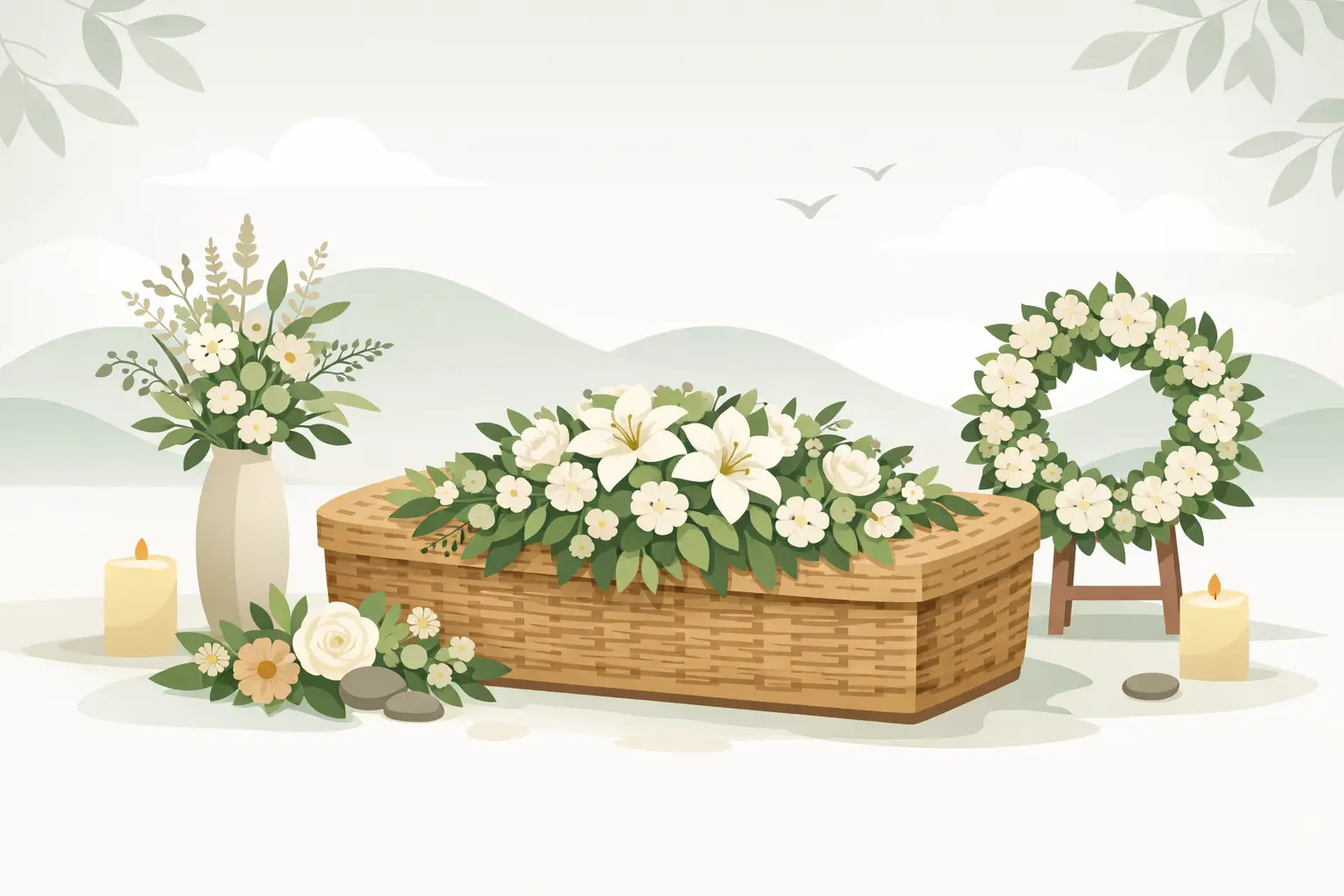
Coffin sprays can be designed in a natural way too, with layered textures and a soft line that follows the shape without becoming overly formal. Posies and baskets may also suit smaller gestures of sympathy, depending on where the flowers are going and who they are from.
Letter tributes and shaped designs have their place, particularly when they would genuinely mean something to the family. But if the preference is for something understated and nature-led, simpler forms usually allow the flowers themselves to speak more clearly.
Sustainability matters here too
For many families, sustainability is not a separate concern from beauty. It is part of what makes a tribute feel right. If the person being remembered cared about the countryside, gardening, local growing or waste reduction, those values can be reflected in the flowers.
Foam-free funeral work is one important part of this. Traditional floral foam is convenient, but it is single-use and environmentally harmful. Natural mechanics can create generous, secure designs without relying on it.
British-grown flowers, when available in season, are another thoughtful choice. They often bring a character and freshness that suits natural funeral flower arrangements particularly well. Their shapes are less uniform, their scent is often better, and their provenance can feel closer to home. That said, season and reliability do matter at funerals, so sometimes a mix of British and imported stems is the most sensible approach.
Minimal packaging and reusable or compostable elements can also make a difference. These details may seem small, but for some families they matter a great deal.
How to talk to your florist when you are arranging funeral flowers
Most people do not order funeral flowers often, and there is no reason you should know all the terminology. What helps most is to speak plainly. A florist can work from feeling as much as from flower names.
It is useful to explain who the flowers are for, where they are going, and whether there are any colours, flowers or materials that feel especially right or wrong. If you want something natural, say what that means to you. You might mean garden-inspired, seasonal, hedgerow-like, softly structured, not too formal, or simply not floristy in the traditional sense.
Photographs can help, but so can descriptions of the person. Were they elegant and understated, cheerful and colourful, devoted to their allotment, or happiest outdoors with the dog? Those glimpses give shape to the design.
If budget is a concern, say so early. A good florist can suggest the right scale and form without making the tribute feel compromised. In bespoke work, restraint often reads better than trying to do too much.
Natural funeral flower arrangements and the feeling they leave behind
Flowers at a funeral are fleeting, but they leave a strong impression. Families often remember not only what was there, but how it felt. A natural arrangement can bring softness to a difficult day. It can offer beauty without performance and comfort without excess.
For families in Derbyshire who value craftsmanship, seasonality and a more personal approach, this style of floral design often feels especially fitting. At Sweetpea Macfie, that means creating funeral flowers with care, texture and emotional sensitivity, always led by the person being remembered rather than a set formula.
If you are choosing flowers for a farewell, it is enough to begin with what felt true about them. The right arrangement does not need to say everything. It simply needs to say something honest, and say it beautifully.
 I’m Marie,
the florist behind Sweet Pea Macfie.
I began Sweet Pea Macfie in 2018 and am a qualified florist with over 13 years’ experience.
The name is an ode to my Grandad, John Macfie, who in his day was one of the best Sweet pea growers in the country. He exhibited at all the major flower shows, and his Chelsea Gold Medal is one of my most treasured possessions, so you could say that growing and arranging flowers is in my blood.
I’m Marie,
the florist behind Sweet Pea Macfie.
I began Sweet Pea Macfie in 2018 and am a qualified florist with over 13 years’ experience.
The name is an ode to my Grandad, John Macfie, who in his day was one of the best Sweet pea growers in the country. He exhibited at all the major flower shows, and his Chelsea Gold Medal is one of my most treasured possessions, so you could say that growing and arranging flowers is in my blood.