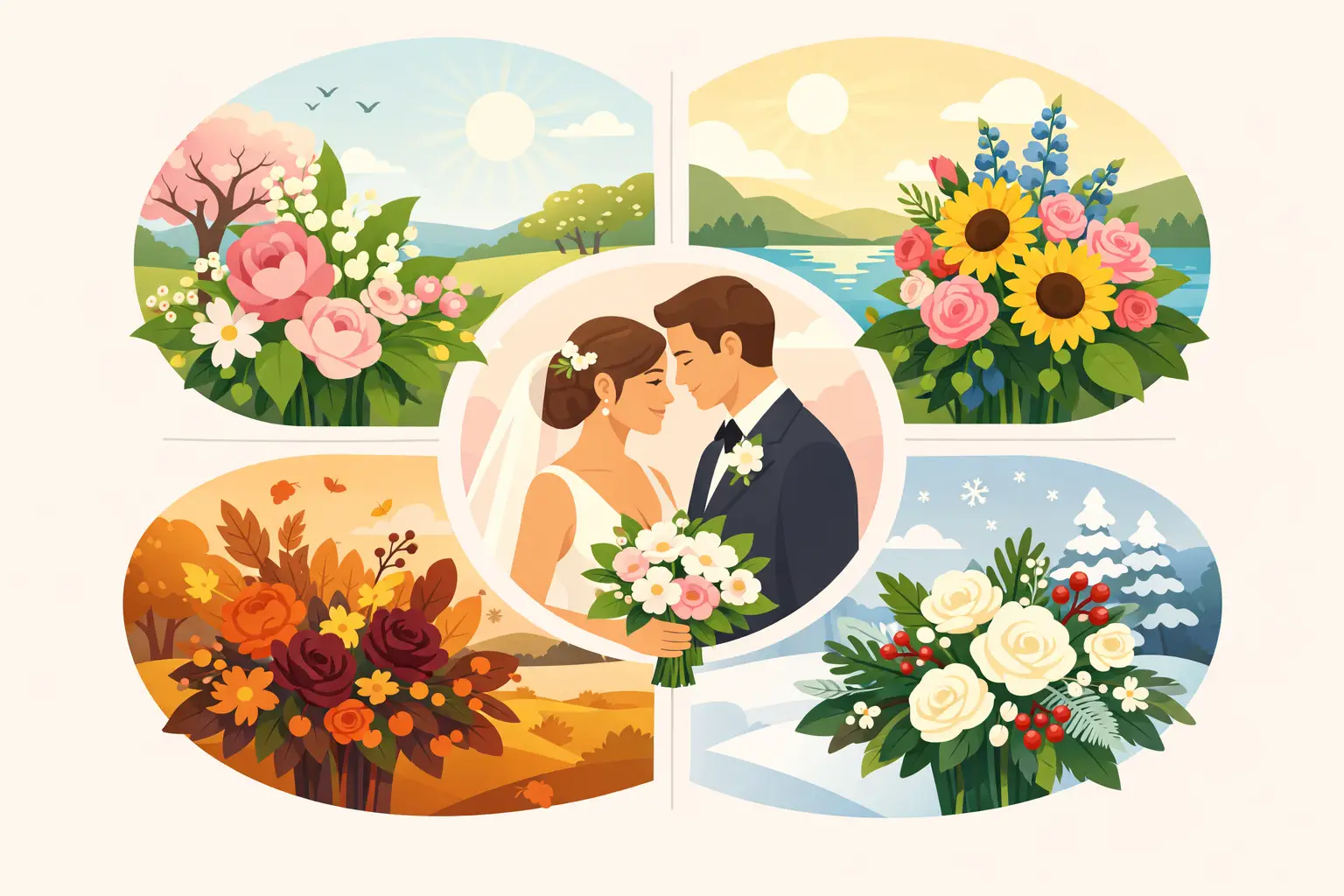
There is usually a moment in every wedding consultation when a couple shows me a saved image filled with flowers that simply do not belong to the month they are marrying in. It is never a problem, exactly, but it is often where the most useful conversations begin. Choosing wedding flowers by season is not about limiting your options. It is about finding flowers that look at home in your day, move beautifully in the setting, and feel true to the time of year.
Seasonality matters for more than appearance. British flowers grown in their natural window tend to have better character, gentler scent and a looseness that suits romantic, personal wedding work. They also support a more thoughtful approach to sourcing, with fewer air miles and less need to force stems beyond their natural rhythm. For couples planning a wedding in Derbyshire and beyond, that often means flowers that feel more grounded, more individual and far less generic.
Why wedding flowers by season make sense
A seasonal wedding rarely needs flowers to fight against its surroundings. Spring already brings freshness, summer offers abundance, autumn gives depth, and winter has its own quiet drama. When flowers echo what is happening outside, the whole design feels more settled.
There is also the practical side. Seasonal stems are often in better condition and more readily available, which can make your budget work harder. That does not mean every in-season flower is inexpensive, nor that every out-of-season flower is impossible. It simply means the best results usually come from working with the season rather than against it.
This is especially true if you are drawn to natural, garden-inspired floristry. Movement, texture and variation are easier to achieve when flowers are doing what they are meant to do. A bouquet should not look as though it has been assembled from a shopping list alone. It should feel alive.
Spring wedding flowers by season
Spring flowers have a particular kind of optimism. After the bareness of winter, everything feels newly awake. Colours can be soft and airy, but spring is not limited to pastels. It can also be bright, scented and full of personality.
Tulips are often underestimated because people think of them as simple. In reality, the best tulips are elegant, expressive and full of movement, with varieties ranging from clean and refined to ruffled and painterly. Narcissi bring fragrance and a distinct sense of the season, while ranunculus offer delicacy and detail without feeling fussy. Anemones, fritillaries, muscari, hellebores and blossom all have their place too, depending on the weather and exact timing.
Spring is ideal for couples who want their flowers to feel fresh, light and naturally romantic. It suits country houses, village churches, garden marquees and smaller, intimate weddings particularly well. The palette might lean into butter, ivory, soft blue and primrose, or it might move towards richer shades such as aubergine, deep plum and oxblood for a more dramatic early spring look.
The one caveat with spring is that it can be fleeting. Certain flowers have quite a short season, and British-grown availability can shift by a week or two depending on the weather. That is not a drawback so much as part of the charm. It asks for flexibility, and in return you get flowers with real sense of place and moment.
Summer wedding flowers by season
If spring is tender, summer is generous. This is the season when British flower growing comes into its own, and the range becomes wonderfully broad. For wedding floristry, summer allows for softness and abundance without needing to import character from elsewhere.
Sweet peas are one of the clearest examples. Their scent alone can transform a bouquet, and they bring a lightness that is difficult to imitate. Garden roses, when in full stride, offer far more nuance than standard year-round rose varieties, with beautiful petal formations and subtle colour shifts. Cosmos, nigella, cornflowers, scabious, delphiniums, phlox and dahlias can all appear across the season, alongside textural foliage and herbs.
Summer flowers are particularly well suited to relaxed, elegant wedding designs – meadow-like aisle arrangements, abundant pedestal flowers, and bouquets that feel gathered rather than stiffly arranged. If you love colour, this is the easiest season to embrace it. If you prefer neutrals, summer can still be wonderfully restrained, using cream, blush, green and soft apricot with plenty of texture.
That said, summer has its own considerations. Heat matters. Delicate flowers need careful handling, and some varieties are better for bouquets than for long ceremony installations in full sun. A thoughtful florist will guide you towards stems that not only look right but last well in your venue conditions. Beauty is important, but so is performance.
Autumn wedding flowers by season
Autumn tends to attract couples who want richness without fuss. The light changes, the landscape deepens, and flowers can take on a more textured, tonal quality. This is a season of warmth, shape and subtle drama.
Dahlias are often the stars here, bringing depth and structure in shades from peach and toffee through to burgundy and near-black. Chrysanthemums, when carefully chosen, can be extraordinarily elegant and nothing like the stiff, dated forms some people imagine. There is also plenty of interest from berries, seedheads, grasses and turning foliage. Late roses, cosmos and scabious may still appear, depending on the weather.
Autumn wedding flowers work beautifully with stone venues, candlelight, timber interiors and outdoor ceremonies that lean into the landscape rather than trying to outshine it. The palette can be generous – rust, amber, claret, caramel – or quieter, with mauve, smoke, antique pink and soft brown. Not every autumn wedding needs burnt orange. Sometimes the loveliest schemes are the most restrained.
This is also a season where texture really matters. The difference between a flat arrangement and one with real presence often comes from the supporting details: hedgerow elements, wispy grasses, seedpods and foliage with movement. These are the ingredients that make arrangements feel composed rather than decorated.
Winter wedding flowers by season
Winter requires a slightly different mindset. It is not a season of abundance in the same way as summer, but that does not make it sparse. In fact, winter flowers can be deeply atmospheric when used with care.
Hellebores, narcissi, anemones and early tulips may feature, alongside beautifully chosen foliage, berries and textural branches. Scent can play a lovely role in winter too, particularly where venues are more enclosed and intimate. The right flowers in winter do not need to shout. They simply need to hold their own against candlelight, low skies and rich fabrics.
Winter designs often benefit from contrast. Crisp whites and deep greens can feel clean and timeless. Soft neutrals with brown, plum or wine tones feel quieter and more layered. For festive weddings, there is always a risk of slipping into something too themed, so restraint is often what keeps the flowers elegant.
Winter is also the season where mechanics and planning become especially important. If certain favourite flowers are unavailable from British growers, you may need to decide what matters most – strict seasonality, a particular look, or a specific flower. There is rarely a perfect answer. It depends on your priorities, and good floristry begins with being honest about them.
How to choose wedding flowers by season without feeling restricted
The most successful wedding flowers usually begin with atmosphere rather than a fixed flower list. Instead of saying you must have peonies in October or dahlias in April, it helps to think about the feeling you want your flowers to create. Soft and romantic. Textural and wild. Refined and understated. Colourful but natural. Once that is clear, seasonal stems can be chosen to achieve the look in a way that feels right for the month.
This is where personal guidance matters. Most couples are not expected to know which flowers are naturally available, what will hold up in a warm marquee, or how a bouquet should relate to a dress and venue. A florist should help translate taste into flowers, not ask you to become an expert first.
At Sweetpea Macfie, that often means starting with the season, the setting and the emotional tone of the day, then building a design that feels individual to the couple rather than copied from a mood board. Sometimes the answer is a much-loved flower used sparingly. Sometimes it is trusting a beautiful seasonal substitute that turns out to be even better.
A final thought on seasonal wedding flowers
The best wedding flowers do not just match a colour palette. They belong to the day. When flowers are chosen with the season in mind, they tend to feel easier, more expressive and more personal – as though they could only have been for this wedding, in this place, at this particular moment.
 I’m Marie,
the florist behind Sweet Pea Macfie.
I began Sweet Pea Macfie in 2018 and am a qualified florist with over 13 years’ experience.
The name is an ode to my Grandad, John Macfie, who in his day was one of the best Sweet pea growers in the country. He exhibited at all the major flower shows, and his Chelsea Gold Medal is one of my most treasured possessions, so you could say that growing and arranging flowers is in my blood.
I’m Marie,
the florist behind Sweet Pea Macfie.
I began Sweet Pea Macfie in 2018 and am a qualified florist with over 13 years’ experience.
The name is an ode to my Grandad, John Macfie, who in his day was one of the best Sweet pea growers in the country. He exhibited at all the major flower shows, and his Chelsea Gold Medal is one of my most treasured possessions, so you could say that growing and arranging flowers is in my blood.