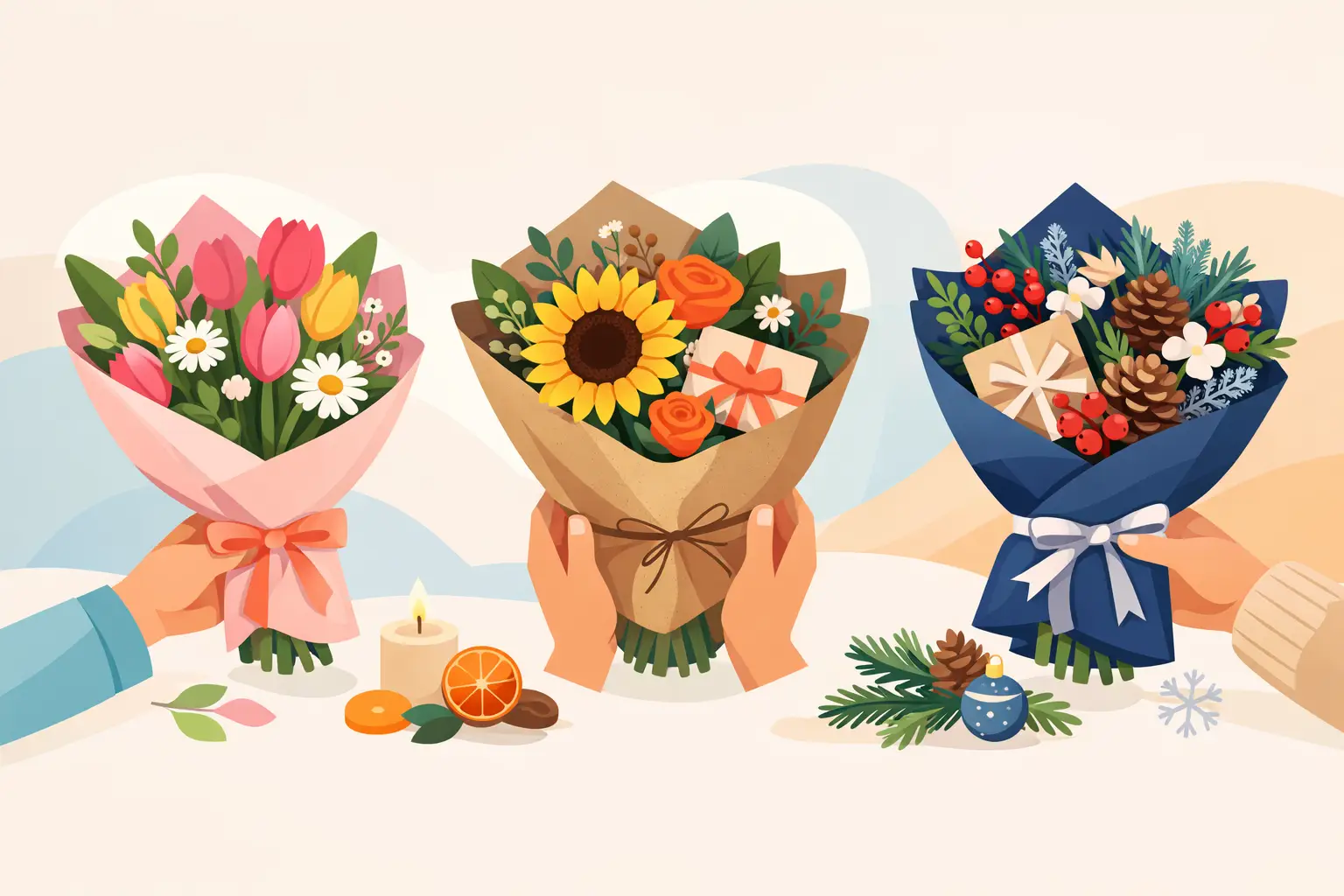
There is a noticeable difference between flowers that simply arrive and flowers that feel chosen. Seasonal gift bouquets have that quality. They carry the character of a particular moment in the year – the first lightness of spring, the abundance of high summer, the richer tones of autumn, the quiet texture of winter – and that makes them feel more personal from the outset.
For many people, sending flowers is not really about making a grand gesture. It is about saying something with care, especially when words feel clumsy or insufficient. A birthday, a thank you, a new baby, a difficult week, a house move, an anniversary, or a simple wish to let someone know they are thought of – each calls for a different sort of arrangement. Seasonal flowers help shape that message in a way that feels considered rather than formulaic.
Why seasonal gift bouquets feel more meaningful
When flowers are selected with the season in mind, they tend to feel more grounded and more honest. Spring naturally lends itself to softer, hopeful designs with tulips, narcissi, blossom and fragrant stems. Summer brings looseness and generosity, with garden roses, sweet peas, cornflowers, scabious and other airy varieties that move beautifully. Autumn has depth and warmth, often with berries, seed heads, dahlias and foliages in burnished tones. Winter asks for a quieter kind of beauty, where texture, line and subtle colour become especially important.
That changing palette matters because gifting is emotional. A bouquet for a joyful celebration may suit bright, fresh movement, while flowers sent during a gentler or more reflective moment might call for softer tones and a more understated shape. Seasonality gives a bouquet its natural context. It avoids the sense that the same arrangement could be sent to anyone, at any time, for any reason.
There is also something reassuring about flowers that have not been forced into pretending to be out of season. They look as they should look, at the point in the year when they are naturally at their best. The result is often more elegant, not less. Restraint and appropriateness usually age better than excess.
What makes a bouquet feel personal rather than generic
A personal bouquet is rarely about including the most expensive stems or the biggest possible quantity of flowers. More often, it comes down to proportion, palette and sensitivity to the occasion. A good florist will think about who the flowers are for, what needs to be expressed, and how the bouquet will sit in someone’s home and day.
That might mean choosing a looser, garden-led style for someone who loves natural arrangements, or a more gathered, tonal bouquet for somebody with a quieter aesthetic. It may mean avoiding anything overly romantic for a professional thank you, or resisting very bright colours for a sympathy gift where something more restful would be welcome. These details matter.
Texture plays an equally important role. Bouquets that combine open flowers, smaller detailing stems, foliage and a little movement often feel more refined than arrangements built only around large focal blooms. They have rhythm. They feel composed rather than assembled.
This is one reason bespoke floristry is so valued for gifting. It allows room for judgement. Not every gesture should look the same, and not every recipient will respond to the same style of flowers.
Choosing seasonal gift bouquets for different occasions
The occasion sets the tone, but it should not dictate a rigid formula. There is always some nuance.
For birthdays, people often want flowers that feel generous and joyful, though that does not always mean bright or bold. For one person, a birthday bouquet full of blousy summer stems may feel exactly right. For another, a softly coloured arrangement with fragrance and movement may feel far more thoughtful.
Thank you flowers tend to work best when they are warm and elegant without feeling overdone. A natural palette, beautiful foliage and a few distinctive seasonal stems can say a great deal without becoming showy.
For new baby flowers, softer forms and gentle colours are often chosen, but there is no need to default to anything overly sweet. A seasonal bouquet can still feel fresh, modern and quietly celebratory.
Sympathy and thinking-of-you bouquets need the greatest sensitivity. In these cases, flowers should offer comfort, not demand attention. Simplicity is often the better path. Gentle colour, airy texture and a balanced shape can feel far more supportive than anything too dramatic.
Housewarming flowers are another lovely fit for seasonal design. They can bring life into a new space immediately, especially when they include textured foliage and flowers that open gradually over several days.
British-grown flowers and why provenance matters
For many customers, where flowers come from is now part of what makes a gift feel thoughtful. British-grown flowers have a character that is hard to replicate. They are often more scented, more delicate in the best sense, and more reflective of the landscape and season they come from.
There is also a freshness to locally or regionally grown stems that supports both longevity and appearance. Flowers that have travelled less can arrive with more vitality and less handling. That does not mean every bouquet can be made exclusively from British flowers in every month of the year, because seasonality brings its own limits. But a British flower-first approach does shape the look and feel of the work in a meaningful way.
It is not only about aesthetics. Provenance matters because people increasingly want to give gifts that align with their values. Sustainability, lower mileage, reduced packaging and foam-free floristry all contribute to a bouquet that feels considered beyond the visual impression. The flowers are still beautiful, but they are beautiful with purpose.
At Sweetpea Macfie, that approach sits at the centre of how bouquets are designed – with a preference for natural materials, seasonal stems and a style that lets the flowers speak clearly for themselves.
Seasonal gift bouquets and the value of guidance
Most people are not expected to know which flowers are in season, which colours work well together, or how a bouquet should be styled for a particular moment. In fact, many clients come to a florist precisely because they want help getting it right.
That guidance is often the difference between a decent bouquet and one that truly lands. A florist can help refine broad ideas into something more fitting. If someone asks for flowers that feel cheerful but not loud, elegant but not formal, or romantic without being overly pretty, those are all understandable requests. They simply need interpretation.
This is where experience shows. Knowing when to include fragrance and when to keep things cleaner, when to use stronger colour and when to hold back, when to favour shape over volume – these are not fixed rules. They depend on the season, the occasion and the recipient.
A personal service also leaves room for details that matter. Perhaps the recipient loves hedgerow textures, dislikes lilies, prefers softer tones, or is marking a difficult anniversary rather than a straightforward celebration. Those small notes change the design in important ways.
When simpler seasonal bouquets are the better choice
There can be a temptation to assume that more stems, more wrapping and more visual impact must mean a better gift. Often, the opposite is true.
Some of the most memorable bouquets are deceptively simple. A handful of exceptional seasonal flowers, arranged with care and space, can have much more presence than a crowded design. Simplicity allows each stem to be seen. It gives a bouquet calmness and confidence.
This is especially true in homes where flowers will be placed on a kitchen table, a hallway console or beside a bed. The bouquet needs to feel part of the space rather than an interruption to it. Natural proportions and an unfussy finish help enormously.
That said, there are moments that call for abundance. A milestone birthday or a particularly heartfelt thank you may suit something larger and more expressive. The point is not that one approach is better than the other. It is that the scale and style should fit the message.
A bouquet that belongs to its moment
The best floral gifts rarely shout. They feel timely, generous and quietly right. Seasonal gift bouquets do this especially well because they are shaped by what the year is offering at that particular moment, not by a fixed recipe repeated again and again.
That gives them a kind of integrity. They can be joyful without feeling brash, elegant without feeling stiff, and personal without becoming sentimental. For the person sending them, that often brings peace of mind. For the person receiving them, it creates a gift that feels noticed rather than processed.
If you are choosing flowers for someone important, it is worth paying attention to season, mood and meaning. The right bouquet does more than look beautiful for a few days. It tells the recipient that this was chosen with care, and that is usually what they remember longest.
 I’m Marie,
the florist behind Sweet Pea Macfie.
I began Sweet Pea Macfie in 2018 and am a qualified florist with over 13 years’ experience.
The name is an ode to my Grandad, John Macfie, who in his day was one of the best Sweet pea growers in the country. He exhibited at all the major flower shows, and his Chelsea Gold Medal is one of my most treasured possessions, so you could say that growing and arranging flowers is in my blood.
I’m Marie,
the florist behind Sweet Pea Macfie.
I began Sweet Pea Macfie in 2018 and am a qualified florist with over 13 years’ experience.
The name is an ode to my Grandad, John Macfie, who in his day was one of the best Sweet pea growers in the country. He exhibited at all the major flower shows, and his Chelsea Gold Medal is one of my most treasured possessions, so you could say that growing and arranging flowers is in my blood.