A vase of sweet peas that has travelled a few miles from a British grower tells a rather different story from a bouquet flown halfway around the world. That distinction sits at the heart of sustainable floristry trends: choosing flowers with a sense of season, place and purpose, then arranging them beautifully without unnecessary waste.
For many people, sustainability is no longer a separate box to tick when choosing wedding flowers, a funeral tribute or a gift bouquet. It is part of what makes the flowers feel right. The good news is that more responsible floristry need not look worthy, sparse or rustic in the clichéd sense. It can be abundant, elegant, expressive and deeply personal.
Sustainable floristry trends with real staying power
Some trends arrive with a great deal of noise, then disappear. The most meaningful changes in floristry are quieter. They ask better questions: Where were these stems grown? What will hold them in place? Can the arrangement be reused, composted or returned to the earth with as little impact as possible?
The answers are rarely identical for every commission. A large installation has different practical demands from a hand-tied bouquet, and flowers for a graveside need to behave differently from flowers for a summer wedding table. Thoughtful floristry is not about chasing perfection. It is about making informed, proportionate choices while retaining the beauty and emotional character the occasion deserves.
British-grown, seasonal flowers taking centre stage
The most visible shift is a renewed appreciation for British-grown flowers. In spring, this might mean scented narcissi, tulips, ranunculus, blossom and early garden foliage. Summer brings sweet peas, cosmos, dahlias, roses, scabious and fragrant herbs; autumn offers richly toned dahlias, seed heads, grasses and berried branches.
Seasonal flowers have a freshness and individuality that is difficult to replicate. They are often less uniform than imported blooms, but that is part of their charm. A stem may curve, a flower may open at a slightly different pace, and the resulting arrangement has movement rather than stiffness.
There are practical benefits too. British flowers can reduce transport miles and cold storage, while supporting local growers and the skills that keep a varied flower-growing landscape alive. Availability changes with the weather, however, and that is worth embracing rather than treating as a disappointment. A particular variety cannot always be guaranteed months ahead, especially after an unusually cold spring or wet summer. Working to a colour palette, feeling and season usually creates a more beautiful result than insisting on one exact bloom.
Foam-free mechanics becoming the considered choice
Florists have traditionally relied on floral foam to support stems in arrangements. It is convenient, especially for certain shapes and installations, but conventional foam is a single-use plastic product that breaks down into microplastics. Its use is therefore being reconsidered across the industry.
Foam-free design uses mechanics such as reusable chicken wire, pin frogs, water vessels, moss used with care, branches, and well-placed foliage to support flowers. The method takes planning and technical skill. It also changes the appearance of an arrangement for the better: stems can sit more naturally, with space for line, air and movement.
Foam-free does not mean every design must be loose or wild. It can be tailored, formal and architectural when needed. Nor does it mean that all alternatives carry no environmental cost. Reusable mechanics need cleaning, storing and using repeatedly, while some natural materials should be harvested responsibly. The intention is not to claim an immaculate solution, but to avoid disposable materials where a better method is available.
Designs made to be enjoyed more than once
Another welcome development is the move away from flowers being treated as a single, fleeting moment. At weddings, ceremony flowers can often be moved to the reception, repurposed around a cake table or given to guests at the end of the day. Bud vases and small arrangements can travel particularly well, bringing a sense of generosity to the celebration rather than being left behind.
For gift flowers, a carefully hand-tied bouquet wrapped in minimal materials can be placed straight into a vase at home. This avoids the need for a disposable presentation box or unnecessary plastic. A smaller number of excellent stems, chosen for scent, longevity and season, can feel far more generous than an overfilled bouquet with little character.
Repurposing is not always appropriate. Funeral flowers, for example, should first and foremost feel respectful to the person being remembered and to their family. Yet natural, garden-inspired designs without plastic-backed bases or artificial accessories can still offer a gentler choice. In many cases, flowers and foliage that can naturally return to the earth are both beautiful and fitting.
Less packaging, more considered presentation
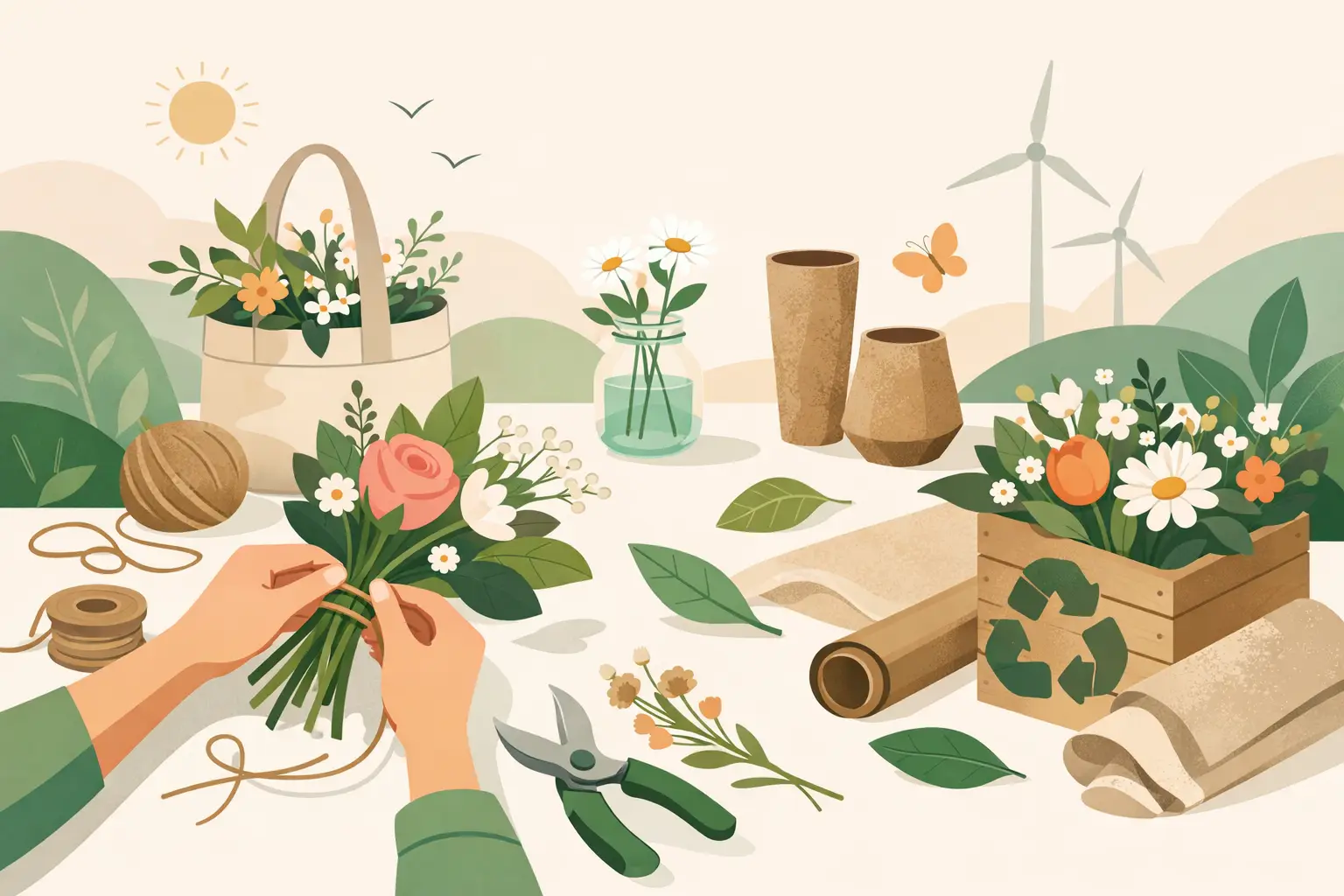
The best packaging often has the good sense to disappear. Paper wrapping, twine, reusable vessels and simple care instructions can protect flowers without turning a bouquet into a pile of waste. Plastic may occasionally be necessary to keep stems hydrated during transport or in very poor weather, but it should be used purposefully rather than as default decoration.
This more restrained approach suits the way many people now want flowers to feel: not overproduced, but properly made. The quality lies in the flowers themselves, in thoughtful conditioning, balanced colour and a maker’s eye for detail. An arrangement does not need glitter, dyed foliage or layers of cellophane to make an impression.
Locally gathered texture, used with restraint
Foliage, branches, grasses and seed heads provide depth and seasonality, and locally sourced material can reduce reliance on imported greenery. They also bring a particular Derbyshire character to designs: hedgerow movement, orchard blossom, textural grasses and the changing tones of the garden.
Responsible sourcing matters here. Foraging should never deplete a site, disturb wildlife or involve taking from private land without permission. A florist may also need to supplement locally gathered material with bought foliage, particularly outside the growing season or for a larger event. Sustainability is strengthened by transparency, not by pretending every stem comes from one field nearby.
The return of flowers with a sense of place
Perhaps the loveliest of the sustainable floristry trends is a move towards flowers that belong to the moment. Couples are choosing designs that respond to the month of their wedding, the setting and their own story instead of copying an image created in another country, season or climate. Families arranging farewell flowers are often drawn to familiar garden blooms, favourite colours or a gentle, natural shape that reflects the person they love.
This approach makes room for conversation. Rather than beginning with a fixed recipe, a florist can ask what matters: Is scent important? Are there flowers from a parent’s garden that carry a memory? Does the venue call for something airy and meadow-like, or more restrained and sculptural? Is longevity essential because flowers need to look their best over several days?
At Sweetpea Macfie, that conversation is central to the work. British-grown flowers, foam-free methods and minimal packaging are valuable choices, but they are most meaningful when they support an arrangement that feels entirely right for the person and occasion.
Choosing sustainable flowers without losing the magic
If you are planning flowers for an important event, start by sharing the season, your budget and the atmosphere you hope to create. Ask about British-grown options, foam-free mechanics and what may be reused after the event. A good florist will explain what is possible without making you feel that every choice carries a moral test.
Be open to a little flexibility. Choosing “soft spring flowers in cream, apricot and pale blue” gives far more scope for seasonal sourcing than requesting a precise imported bloom. Equally, if one particular flower holds real emotional significance, it may be worth including it thoughtfully. Sustainable choices are not about denying sentiment. They are about giving it proper weight alongside provenance, practicality and waste.
The most memorable flowers are rarely those that follow a formula. They are the ones that feel alive to their season, made with care and chosen with someone in mind. That is a lovely place for any bouquet, tribute or celebration to begin.
 I’m Marie,
the florist behind Sweet Pea Macfie.
I began Sweet Pea Macfie in 2018 and am a qualified florist with over 13 years’ experience.
The name is an ode to my Grandad, John Macfie, who in his day was one of the best Sweet pea growers in the country. He exhibited at all the major flower shows, and his Chelsea Gold Medal is one of my most treasured possessions, so you could say that growing and arranging flowers is in my blood.
I’m Marie,
the florist behind Sweet Pea Macfie.
I began Sweet Pea Macfie in 2018 and am a qualified florist with over 13 years’ experience.
The name is an ode to my Grandad, John Macfie, who in his day was one of the best Sweet pea growers in the country. He exhibited at all the major flower shows, and his Chelsea Gold Medal is one of my most treasured possessions, so you could say that growing and arranging flowers is in my blood.