A bridal bouquet is held close for much of the day. It appears in the quiet moments before the ceremony, in photographs, and often in the memories that remain long after the last glass has been cleared away. The most memorable wedding florals do more than match a colour scheme. They give a celebration a feeling: relaxed and gathered, softly romantic, abundant, wild, elegant or quietly joyful.
For couples planning a Derbyshire wedding, flowers can also offer a connection to the place and time of year. A May wedding at a country house, a late-summer celebration in a barn and a winter ceremony in a village church each invite a different floral response. Beginning with what is naturally beautiful in that moment tends to create designs that feel less prescribed and far more personal.
Start with the feeling, not the flower list
It is perfectly understandable to arrive at a floral consultation with saved images and a few favourite blooms in mind. These references are useful, but they are only one part of the conversation. Before choosing individual stems, consider how you want the day to feel when your guests arrive.
Perhaps you are drawn to meadow-like arrangements with fine texture and a little looseness. Perhaps the setting calls for considered simplicity: sculptural branches, tactile foliage and a restrained palette. Or perhaps you would like the room to feel generous and garden-led, with flowers spilling gently from vessels and trailing along tables.
A good florist will ask about more than colours. The venue, ceremony time, table shape, dress, bridesmaids’ outfits and the atmosphere you hope to create all matter. So does what you do not want. Saying that you would rather avoid anything stiff, overly formal or overly rustic is often as helpful as naming a favourite flower.
The aim is not to reproduce a photograph from another wedding. It is to take the elements you love – a colour, a shape, an air of abundance – and interpret them for your own setting, season and budget.
Let seasonal wedding florals lead the design
Seasonality is not a limitation to work around. It is one of the most useful starting points for flowers with character. British-grown blooms have a freshness and particularity that is difficult to replicate when every stem has travelled long distances or been forced to meet a year-round demand.
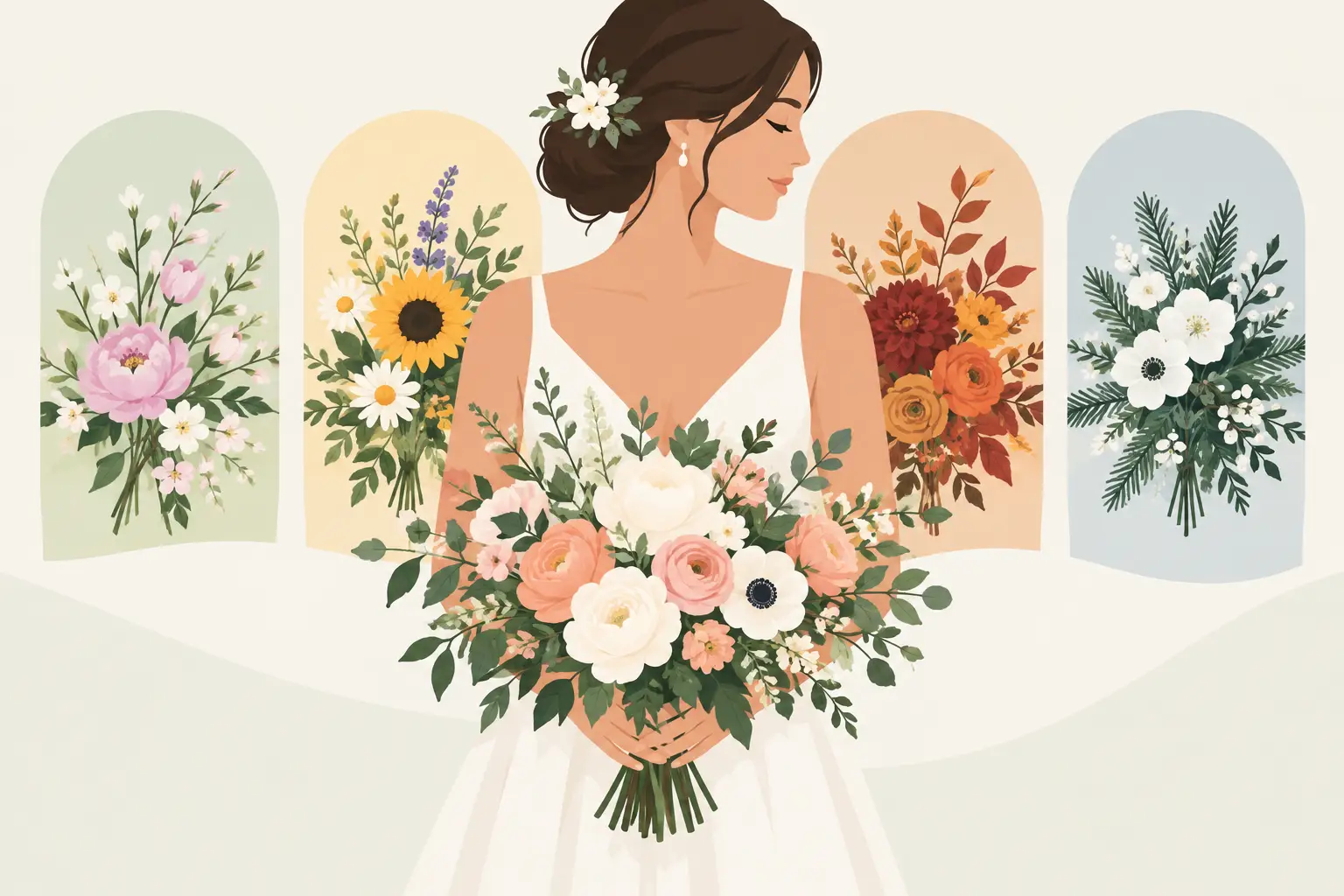
In spring, there may be narcissi, tulips, ranunculus, blossom, anemones and the first delicate foliage. Early summer brings sweet peas, cornflowers, scented garden roses, foxgloves and a wonderful sense of lightness. High summer offers dahlias, cosmos, phlox and rich, generous colour. By autumn, seed heads, grasses, berries and turning foliage introduce depth and movement. Winter can be pared back and beautiful too, with hellebores, evergreen texture, branches and seasonal berries.
Availability changes with weather, local growing conditions and the natural pace of each variety. That uncertainty is part of the appeal, although it does require a little trust. Rather than promising every named flower months in advance, a seasonal approach reserves space for the best stems available nearer the date.
If one specific flower is central to your plans, mention it early. It may be possible to source it, but your florist can explain whether it is likely to be at its best, whether it will travel well, and whether a seasonal alternative would give a similar effect. Peonies in June, for example, bring a different sense of occasion from peonies sought for an October wedding. The right answer depends on how essential that exact bloom is to you, and how much flexibility you are happy to have.
Colour is more than a palette
A palette should feel at home in its surroundings rather than sit separately from them. Soft peach and butter yellow can be beautiful against warm stone. Deep wine, plum and rust might enrich an autumn celebration. Whites are never simply white: they can lean cool and crisp, warm and creamy, or green and garden-like.
Texture gives colour its life. Fine flowers beside broad petals, airy grasses against clustered blooms, and a little foliage among the flowers all help arrangements feel natural rather than flat. This is where a florist’s eye is particularly valuable. The distinction between tonal and dull, or relaxed and untidy, is often made through small, thoughtful choices.
Choose the places where flowers will matter most
Wedding flowers do not need to be everywhere to make an impression. It is usually better to concentrate the budget where flowers will be seen, photographed and enjoyed most closely. For many couples, that begins with personal flowers: the bridal bouquet, buttonholes and perhaps a few posies or floral pieces for key members of the wedding party.
The ceremony is the next important moment. A pair of arrangements at the entrance, meadow-like designs around the signing table, or flowers framing the couple can transform the space without overwhelming it. Consider what can be moved afterwards. Ceremony flowers may become a focal point behind the top table, welcome guests at the reception, or add presence to the bar.
For tables, think about conversation as well as appearance. Low arrangements allow guests to see one another easily. Taller designs can be striking in a grand room, but they need to sit high enough that they do not interrupt the view across the table. Long trestle tables often suit bud vases, small grouped arrangements or a flowing, garden-inspired line of flowers and foliage. Round tables can carry a more central design.
There is a trade-off between impact and scale. A room filled with hundreds of tiny arrangements may feel charming, but can involve more vessels, more mechanics and more set-up time than a smaller number of generous focal pieces. Share your overall budget early, not as an awkward final detail. It gives your florist the information needed to design with honesty and imagination.
Consider the flowers after the ceremony
Flowers work hard on a wedding day, and a little forward planning helps them do so beautifully. Ask how arrangements can be repurposed, whether vases are hired, and who will move pieces between spaces. This is particularly useful when the ceremony and reception are in the same venue, or when there is a gap between them.
Sustainability is also found in these practical decisions. Reusing ceremony designs, choosing locally grown material where possible, favouring reusable vessels and avoiding floral foam can reduce waste without making the flowers feel any less special. Foam-free work requires considered mechanics and skilled conditioning, but it supports a more thoughtful approach to floral design.
Not every element needs to be kept after the day. Some couples like to give table flowers to guests, a kind gesture that sends a little of the celebration home with them. Others choose to keep their bouquet, or have a few stems dried as a memento. It is worth discussing these wishes in advance, especially if flowers are delicate or particularly seasonal.
Bring useful details to your florist
You do not need to know botanical names or arrive with every decision made. The most helpful information is simply a clear picture of the day: your date, venue, approximate guest numbers, timings, table plans and a sense of your style. Images are welcome, particularly when you can say what you respond to in each one.
It also helps to share practical constraints. A church with no water source, a marquee on a hot August afternoon, a venue with narrow tables, or a ceremony held outdoors in an exposed spot will influence the design. Honest details allow for solutions that look effortless because they have been properly considered.
At Sweetpea Macfie, the process begins with listening. The purpose is not to steer every couple towards one recognisable look, but to create flowers that belong to their celebration: guided by the season, shaped by the setting and made with care for the people in the room.
When choosing your wedding flowers, allow room for the unexpected stem that is looking particularly beautiful that week. Those small seasonal surprises are often what make the flowers feel alive, and unmistakably yours.
 I’m Marie,
the florist behind Sweet Pea Macfie.
I began Sweet Pea Macfie in 2018 and am a qualified florist with over 13 years’ experience.
The name is an ode to my Grandad, John Macfie, who in his day was one of the best Sweet pea growers in the country. He exhibited at all the major flower shows, and his Chelsea Gold Medal is one of my most treasured possessions, so you could say that growing and arranging flowers is in my blood.
I’m Marie,
the florist behind Sweet Pea Macfie.
I began Sweet Pea Macfie in 2018 and am a qualified florist with over 13 years’ experience.
The name is an ode to my Grandad, John Macfie, who in his day was one of the best Sweet pea growers in the country. He exhibited at all the major flower shows, and his Chelsea Gold Medal is one of my most treasured possessions, so you could say that growing and arranging flowers is in my blood.