
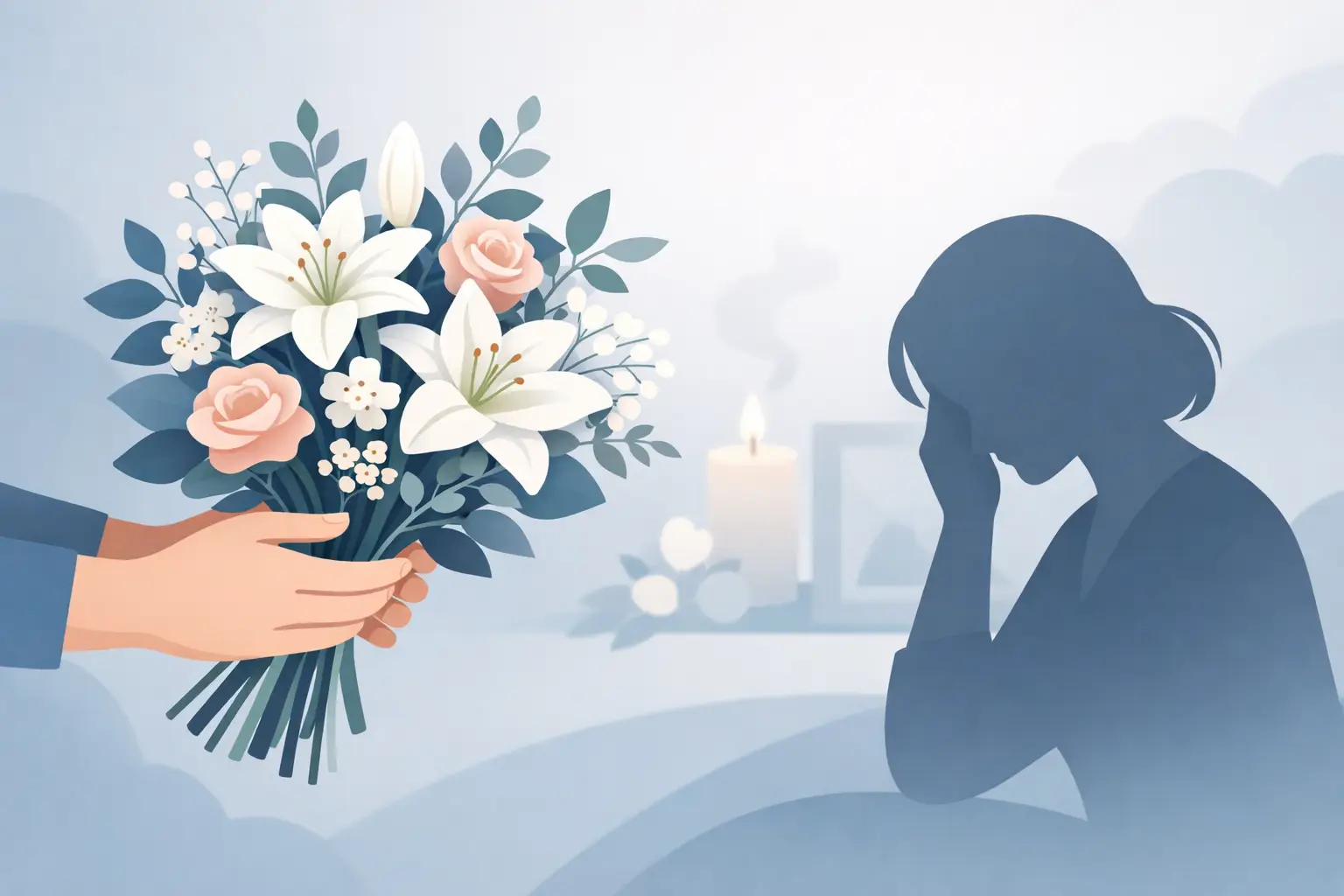
A sympathy bouquet is often sent when words feel inadequate. It says, simply and gently, that someone is being held in your thoughts. Knowing how to choose sympathy flowers can make that gesture feel more personal, particularly when you are balancing your own sadness with the wish to offer comfort to someone else.
There is no single correct choice. The most fitting flowers depend on your relationship with the person who has died, the preferences of those close to them and whether the arrangement is intended for the funeral, the home or a private moment of remembrance. A thoughtful design need not be grand. It needs to feel sincere.
Start with the recipient and the setting
Before choosing particular stems, consider who will receive the flowers. A hand-tied bouquet sent to a family home can bring a little softness to the days immediately after a loss. It should be easy to place in a vase and designed to remain beautiful as the individual flowers open.
Funeral flowers serve a different purpose. A wreath, sheaf, posy or bespoke tribute is usually displayed at the service, often alongside other floral arrangements. These designs can reflect the life and character of the person being remembered, while remaining appropriate for a shared, formal setting.
If you are unsure whether to send flowers to the funeral or the family home, it is perfectly acceptable to ask a close family member or the funeral director. Some families request donations in place of flowers, while others welcome both. Following their wishes is always the kindest starting point.
How to choose sympathy flowers that feel personal
Personal does not have to mean elaborate. It may be a colour palette that recalls a beloved garden, a flower grown by the person who has died, or a natural, meadow-like arrangement for someone who preferred the countryside to anything formal.
Think about what you know of them. Perhaps they loved spring bulbs, kept sweet peas by the back door, enjoyed rambling in Derbyshire or favoured a quiet, uncluttered home. These details can guide the mood of the flowers without turning the tribute into something overly literal.
For a funeral tribute, a florist can also create a design with a gentle sense of place. Seasonal foliage, garden flowers and varied textures can feel especially meaningful for someone who valued nature. A loosely gathered sheaf may be more appropriate than a tightly structured arrangement for a person remembered for their warmth, creativity or connection to the outdoors.
When you did not know the person well, keep the gesture simple and considerate. A calm bouquet in soft seasonal tones, accompanied by a short handwritten message, is rarely out of place.
Let colour set the tone
White sympathy flowers are traditional for good reason. They bring a sense of peace and simplicity, and can suit almost any setting. But sympathy flowers do not need to be entirely white.
Soft greens, creams, pale blues, gentle lilacs and blush tones often create a quiet, comforting feeling. Muted autumnal shades can be beautiful for an autumn funeral, while spring flowers may bring a sense of tenderness and renewal. For someone known for their colourful character, richer tones can be right too, provided the overall design still feels considered rather than celebratory in a way that may jar.
It is worth remembering that colour carries different associations for different families and cultures. If the family has a particular faith, heritage or expressed preference, let that lead. A florist can advise on suitable choices, but the family’s wishes should always come first.
Choose flowers for their meaning, not just tradition
Lilies, roses and chrysanthemums are familiar choices for sympathy flowers, but they are not the only options. A seasonal design can be just as respectful and often feels more individual.
Roses can convey love, gratitude and deep affection. Lilies are frequently chosen for their elegant form and gentle fragrance, although their scent may be too strong for a home where people are grieving or for anyone sensitive to perfume. If sending flowers to a house, ask for a lightly scented arrangement if you are uncertain.
Tulips, ranunculus, narcissus, cosmos, dahlias and garden roses each bring their own character at different times of year. Branches, herbs and textured foliage can add movement and a natural feel without making a design feel busy. For a funeral, choosing flowers in season can offer a more grounded expression of remembrance than an arrangement made from standard imported stems.
British-grown flowers are not available in the same quantity throughout the year, especially in winter, but a seasonal approach still gives a design a genuine sense of time and place. It also allows the flowers themselves to lead, rather than forcing a particular recipe regardless of the season.
Consider the form of the tribute
The style of arrangement should suit both the occasion and your relationship to the person who has died. For close family, a large casket spray or an individually designed tribute may feel appropriate. Friends, colleagues and neighbours often choose a wreath, a sheaf or a smaller posy.
A wreath is a traditional symbol of continuity and remembrance. It is a fitting choice for a funeral service and can be made in a range of styles, from classic whites and greens to a softer garden-inspired design.
A sheaf is designed to lie flat and has a natural, gathered appearance, as though flowers have been picked from a garden. It can feel less formal than a wreath and is often a beautiful option when the person loved the natural world.
A posy or small arrangement is a quieter gesture. It may be suitable from a child, a group of friends or someone who wishes to send something modest but heartfelt. The cost of the flowers does not measure the depth of feeling behind them.
Add a message that sounds like you
The card does not need to say everything. A few honest words are enough: “Thinking of you and your family”, “With love and fond memories”, or “Remembering a much-loved friend”. If you shared a particular connection with the person who has died, a brief personal line can mean a great deal.
Try not to worry about finding perfect language. Grief is not a situation that can be neatly resolved with a card message. What matters is that the recipient knows you have taken a moment to acknowledge their loss.
For funeral tributes, make sure the card includes your name or the names of everyone contributing. In the rush of organising a service, families may not immediately recognise who has sent each arrangement.
Timing and practical details matter
For a funeral tribute, the florist will usually need the funeral date, service time, funeral director’s details and the name of the person who has died. Ordering as soon as you can gives more scope for a considered, seasonal design, though a good florist will always try to help where time is short.
For flowers being sent to the home, there is no fixed deadline. Sending them in the first few days can be a warm immediate gesture, but flowers arriving a week or two later can be just as meaningful, when the visitors have gone and the quieter reality of grief begins.
It can also be helpful to choose a design made with thoughtful materials. Foam-free mechanics, minimal packaging and locally or British-grown flowers where possible allow the gesture to reflect care beyond the day itself. At Sweetpea Macfie, this quieter, seasonal approach is part of creating funeral flowers that feel individual rather than generic.
When in doubt, ask for guidance
You do not need to know flower names or funeral traditions to make a sensitive choice. Tell your florist who the flowers are for, where they are going, your budget and anything you know about the person being remembered. Even one small detail can shape a design with real feeling.
The right sympathy flowers are not necessarily the most formal, the largest or the palest. They are the ones that offer comfort without asking anything in return: a gentle reminder that, in a difficult time, someone is thinking of them.
 I’m Marie,
the florist behind Sweet Pea Macfie.
I began Sweet Pea Macfie in 2018 and am a qualified florist with over 13 years’ experience.
The name is an ode to my Grandad, John Macfie, who in his day was one of the best Sweet pea growers in the country. He exhibited at all the major flower shows, and his Chelsea Gold Medal is one of my most treasured possessions, so you could say that growing and arranging flowers is in my blood.
I’m Marie,
the florist behind Sweet Pea Macfie.
I began Sweet Pea Macfie in 2018 and am a qualified florist with over 13 years’ experience.
The name is an ode to my Grandad, John Macfie, who in his day was one of the best Sweet pea growers in the country. He exhibited at all the major flower shows, and his Chelsea Gold Medal is one of my most treasured possessions, so you could say that growing and arranging flowers is in my blood.