
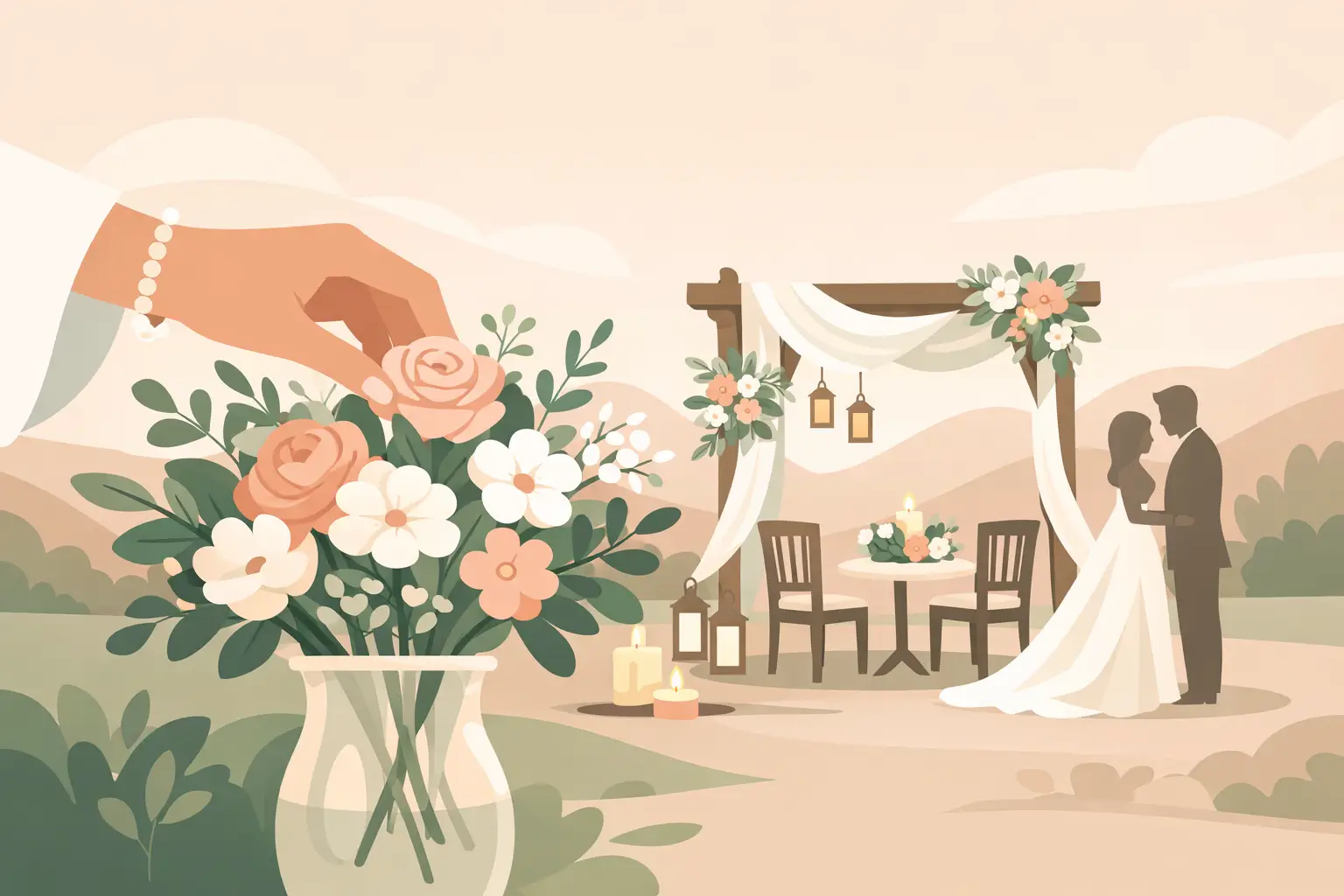
A small wedding changes the role flowers play. With fewer tables, fewer formal moments and a closer gathering of people, flowers for intimate weddings are seen properly. They sit beside the vows, frame the shared meal and appear in the photographs that will be returned to for years. There is little need for excess. What matters is choosing flowers with character, proportion and a connection to the day you are creating.
For many couples, an intimate celebration is not a scaled-down version of a larger wedding. It is a deliberate choice: a ceremony at a family home, a meal in a favourite Derbyshire restaurant, a village hall transformed for one evening, or a gathering in a garden. The flowers can reflect that same sense of ease – personal, seasonal and beautifully made rather than overly formal.
Start with the feeling, not the flower list
Before discussing varieties, consider how you would like the room to feel. Perhaps you imagine an abundant country-garden table, with stems gathered as though they have just come in from outside. Or perhaps your venue calls for quieter arrangements: sculptural branches, meadowy grasses and a restrained palette of cream, green and soft brown.
A good floral brief is often built from atmosphere rather than Pinterest images alone. Think about the setting, the time of year, the colours already present, and the way guests will use the space. A candlelit supper needs flowers that feel lovely in low light and leave room for conversation. A bright conservatory may suit looser arrangements with movement and air between the stems.
It is also useful to decide where flowers will make the greatest difference. At a wedding of 20 or 30 people, a beautiful bridal bouquet, a ceremony arrangement and a thoughtfully dressed table may be all that is needed. Concentrating the budget in a few visible, meaningful places usually feels more generous than scattering small arrangements around every corner.
Flowers for intimate weddings should feel in proportion
Scale is one of the quietest signs of considered wedding flowers. An oversized floral arch can overwhelm a small ceremony, just as tiny jam jars can disappear on a long dining table. The aim is not to make everything smaller, but to make each element belong.
For a ceremony, a pair of meadow-like urns, two generous arrangements on plinths, or a floral meadow at the base of the signing table can give the moment a sense of occasion without creating a barrier between you and your guests. Once the vows are finished, these arrangements can often be moved to frame the meal or entrance, allowing one floral piece to work harder across the day.
For the table, low arrangements are especially effective when everyone is sitting together. Guests can see one another easily, while flowers create a rhythm along the linen. A series of small vessels in related tones can feel relaxed and abundant. Alternatively, one long, garden-inspired design can be wonderful for a single shared table, particularly when paired with taper candles and seasonal fruit.
Tall designs do have their place, especially in rooms with high ceilings or at a standing drinks reception. They simply need to be planned around sightlines. The best arrangements invite people into the room rather than asking them to look around them.
Let the bouquet carry a little of the story
A bridal bouquet is held closely and photographed often, so it is a lovely place for more personal detail. This might be a favourite rose variety, a flower grown in a parent’s garden, a small length of inherited ribbon, or a subtle echo of the landscape around your venue.
The most natural-looking bouquets are carefully composed. They need a balance of focal flowers, lighter blooms, foliage and textural stems so that they move well and still hold their shape. A bouquet should also feel comfortable to carry. For an informal celebration, a smaller, lighter design can be as striking as a large cascade, especially when the dress and setting are simple.
Choose the season as your starting point
Seasonality gives wedding flowers a sense of place. British-grown stems bring their own particular charm: the fleeting perfume of sweet peas in early summer, unruly cosmos in late summer, richly coloured dahlias in autumn, or hellebores and catkins at the turn of spring. Their availability is not identical every year, which is part of their appeal.
Spring weddings can feel fresh and hopeful with tulips, narcissi, ranunculus, blossom and emerging foliage. In late spring and early summer, garden roses, sweet peas, peonies, foxgloves and larkspur offer softness, scent and generous shape. High summer brings cosmos, scabious, cornflowers and herbs, while September and October are a wonderful time for dahlias, hydrangea, grasses, seed heads and changing leaves.
Winter need not mean settling for an all-evergreen scheme. Bare branches, dried textures, scented narcissus, ranunculus, hellebores and interesting foliage can make an elegant, intimate setting. The palette may be quieter, but the texture can be particularly rich.
Choosing seasonally also calls for a little flexibility. If one exact bloom is unavailable or has had a difficult growing season, a florist can suggest another flower with a similar colour, shape or mood. This approach creates arrangements that are responsive and individual, rather than fixed to a shopping list created months before the day.
Build a palette with room to breathe
Intimate weddings often benefit from a contained palette. This does not mean everything must match. In fact, the most memorable designs usually include subtle shifts: faded apricot beside warm ivory, dusky pink against burgundy, or soft blue threaded through green and white.
Begin with the colours of the venue and the clothes you will wear. Stone walls, timber, patterned carpets, painted dining rooms and garden planting all influence what will feel right. If your bridesmaids are in a strong colour, the flowers might be quieter. If the room is neutral, a deeper floral palette can provide warmth and focus.
Texture is as important as colour. A combination of ruffled, rounded, airy and linear forms gives an arrangement depth. Roses or dahlias may provide softness; grasses, ammi or spires add lift; herbs and foliage bring scent and a sense of looseness. This is often what makes an arrangement feel gathered from a garden rather than assembled from identical flowers.
Make space for details that mean something
A smaller guest list creates the opportunity for considered gestures. A single stem at each place setting can be charming, though it is worth choosing a variety that will not shed pollen or wilt in the warmth of the room. Flowers can also be tied around menus, placed beside a handwritten note, or gathered into a small posy for a much-loved family member.
Buttonholes and corsages deserve the same care as larger pieces. They are small, but they are close to the wearer and often become part of those treasured getting-ready photographs. A delicate buttonhole with a flower, textured foliage and a neat ribbon finish can feel far more fitting than something bulky or overly coordinated.
If there is a family member who cannot be present, a discreet flower can offer a gentle acknowledgement. This might be a bloom chosen for its association, a small arrangement near a photograph, or simply a stem included in the bouquet. There is no prescribed way to do this. The right gesture is the one that feels true to you.
Plan for beauty after the ceremony
Thoughtful floral design considers what happens after each part of the day. Can ceremony flowers move to the reception? Can bud vases from the table be taken home by guests? Could a larger arrangement be gifted to a family member the following morning?
These choices are practical, but they also suit a more sustainable approach. Using seasonal British flowers where possible, working foam-free and avoiding unnecessary packaging can reduce waste without making the flowers feel any less special. It may mean accepting the natural curve of a stem or a slightly less uniform look, but those are often the details that give flowers life.
At Sweetpea Macfie, the starting point is always a conversation about the day itself: who will be there, how the spaces will be used and which details matter most. That allows the flowers to feel woven into the celebration, not simply delivered into it.
When the plans are becoming busy, return to the simplest question: which floral moments will make you pause and feel that this day is yours? Choose those well, let the season have its say, and the rest can remain beautifully uncomplicated.
 I’m Marie,
the florist behind Sweet Pea Macfie.
I began Sweet Pea Macfie in 2018 and am a qualified florist with over 13 years’ experience.
The name is an ode to my Grandad, John Macfie, who in his day was one of the best Sweet pea growers in the country. He exhibited at all the major flower shows, and his Chelsea Gold Medal is one of my most treasured possessions, so you could say that growing and arranging flowers is in my blood.
I’m Marie,
the florist behind Sweet Pea Macfie.
I began Sweet Pea Macfie in 2018 and am a qualified florist with over 13 years’ experience.
The name is an ode to my Grandad, John Macfie, who in his day was one of the best Sweet pea growers in the country. He exhibited at all the major flower shows, and his Chelsea Gold Medal is one of my most treasured possessions, so you could say that growing and arranging flowers is in my blood.