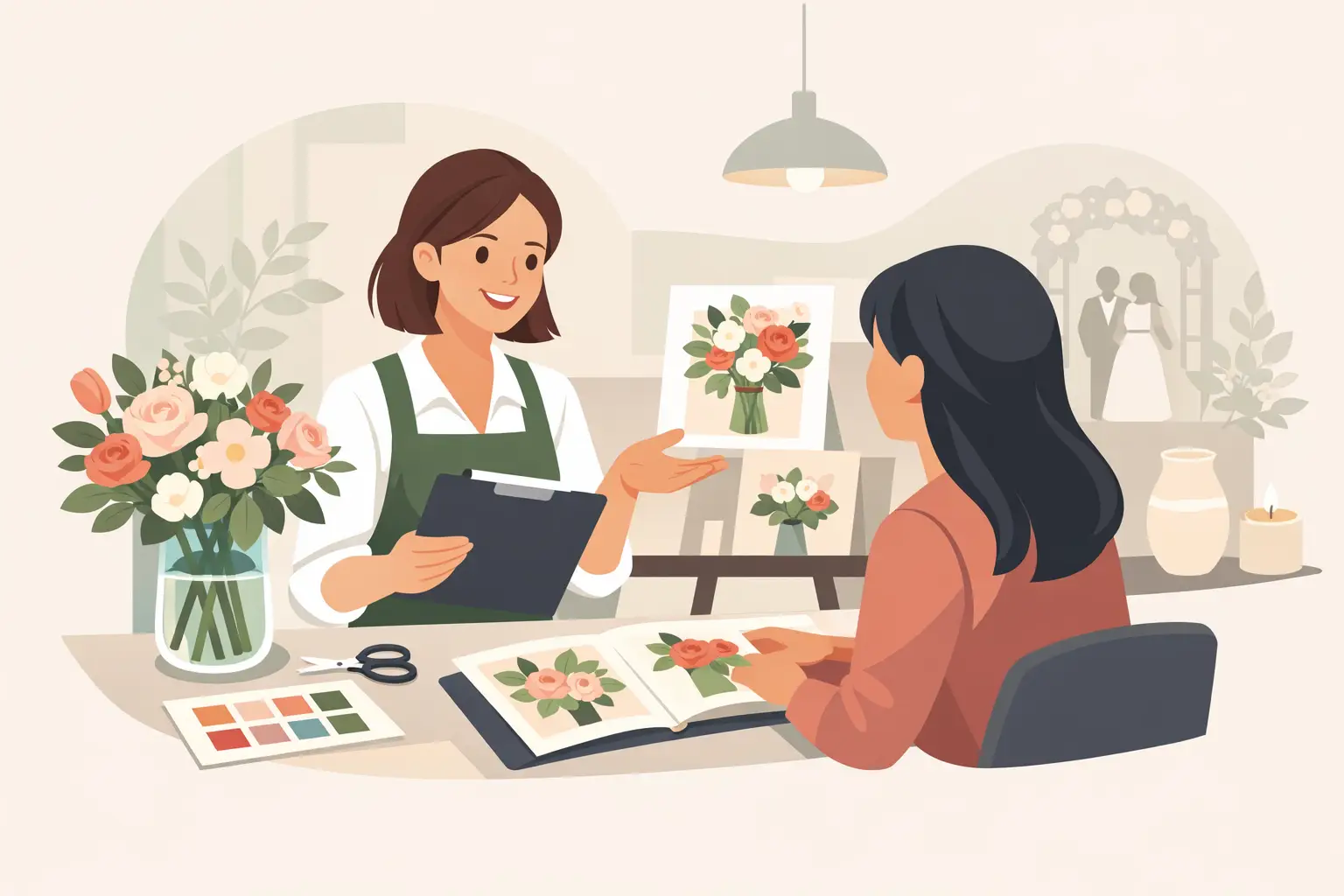
The first conversation about flowers is rarely just about flowers. It may begin with a wedding venue you have fallen for, a favourite garden bloom, or the difficult task of choosing a fitting farewell for someone dearly missed. A local florist consultation gives those early thoughts a calm, practical place to land – with someone who can turn them into flowers that feel personal, appropriate and beautifully considered.
For weddings, funerals and meaningful gifts, a consultation is not a sales exercise or a test of your floral knowledge. It is an opportunity to share what matters, ask honest questions and benefit from professional guidance on seasonality, scale, colour and budget. The result should feel like your occasion, not a version of somebody else’s.
What happens at a local florist consultation?
A good consultation starts with listening. Before discussing individual stems, your florist will want to understand the occasion, the setting and the feeling you hope the flowers will create. A relaxed, garden-led wedding in a Derbyshire barn calls for a different approach from a small civil ceremony, just as a colourful tribute to a lively parent will have a different character from a simple, quiet arrangement.
You do not need a complete plan. Many people arrive with a handful of saved images, a sense of colour, or simply the certainty that they do not want anything too formal, too bright or too structured. That is more than enough to begin. The useful details are often less obvious: the fabric and shape of an outfit, the light in a room, a much-loved flower from someone’s garden, or the way a person made others feel.
Your florist can then draw these fragments together, explaining what will work well and where flexibility may bring a more natural result. This is particularly valuable when working with seasonal British flowers. Rather than promising a fixed list of stems months in advance, a florist may suggest a palette and style that allows the best available flowers to lead. There is often more beauty in this approach – and more movement, scent and individuality too.
The questions that help most
For a wedding, expect to talk about your date, venue, ceremony and reception spaces, clothing, guest numbers and the parts of the day where flowers will make the greatest difference. You might discuss a bridal bouquet, buttonholes, table flowers, ceremony meadow arrangements or larger statement pieces. It is also helpful to consider what can be moved and reused between spaces, especially if you would like your budget to work harder without making the room feel over-styled.
For funeral flowers, the conversation is usually quieter and more personal. Your florist may ask about the person being remembered, their favourite colours, the service location and whether close family members would like flowers to take away afterwards. You can choose traditional forms, such as a wreath or sheaf, but there is room for softer, more individual designs too. A meadow-like casket spray, a garden-style arrangement, or flowers gathered in a favourite colour palette can say a great deal without feeling elaborate.
When arranging a gift bouquet, it helps to mention the recipient, the reason for sending flowers and anything you would prefer to avoid. Perhaps the bouquet is for a new home, a birthday, an apology or a difficult week. A thoughtful florist can shape the gesture accordingly, using the season rather than relying on a standard recipe.
Bringing inspiration without losing your own voice
Photographs can be very useful, especially when it is hard to describe a style. Bring a few that genuinely appeal to you, along with images of your venue, outfit or home if relevant. The aim is not to copy a picture stem for stem. Flowers are seasonal, growers vary and a design that looks effortless in one setting may feel out of place in another.
A consultation helps identify what you are responding to in an image. It may be the looseness of the arrangement, the quiet palette, the contrast between delicate flowers and sculptural foliage, or simply the sense that the design belongs in its surroundings. Once that is clear, your florist can create something with the same spirit while making it right for your date and occasion.
This is where local knowledge matters. A florist who knows Derbyshire venues can consider stone walls, low beams, country gardens, village churches and changing natural light. They can also advise on practicalities that are easy to overlook, such as access times, table sizes, where guests will gather and whether arrangements need to withstand a warm room or an outdoor ceremony.
Talking honestly about budget and priorities
Flowers can be made in many ways, and cost is affected by more than the size of an arrangement. Season, stem variety, growing method, design time, vessel hire, installation requirements and delivery all play a part. The most helpful thing is to share a realistic budget early. It allows your florist to make thoughtful recommendations rather than presenting ideas that are difficult to achieve.
A smaller budget does not mean settling for generic flowers. It simply means choosing where the impact should sit. For a wedding, you may decide that a beautiful bouquet and generous ceremony flowers matter more than styling every table. Or you may favour seasonal bud vases over large centrepieces, creating texture and abundance through repetition. For a funeral, a single expressive arrangement can feel more meaningful than several unrelated pieces.
There are trade-offs, and a good florist will explain them clearly. A precise flower request may be possible, but it may require imported stems or a higher budget. A more seasonal brief gives greater freedom to use British-grown flowers at their best. Neither choice is automatically right. The right choice is the one that reflects your values, the occasion and what you want the flowers to communicate.
Why seasonal flowers make the consultation richer
There is a particular pleasure in choosing flowers that belong to the time of year. Spring brings narcissi, tulips, blossom and scented sweet peas; summer offers cosmos, dahlias, garden roses and abundant foliage; autumn introduces rich seedheads, berries and textural forms. Winter can be wonderfully understated, with evergreen foliage, hellebores, branches and carefully chosen focal flowers.
Seasonality does ask for a little trust. Exact shades and varieties may change as the weeks pass, particularly with British-grown blooms. Yet that gentle unpredictability is often what prevents a design from feeling formulaic. It gives a bouquet or tribute a sense of place and a character that cannot be ordered from a catalogue.
At Sweetpea Macfie, this conversation also includes the way flowers are made. Foam-free mechanics, minimal packaging and a British flower-first approach are considered alongside the finished look. Sustainable floristry is not about making an arrangement appear worthy or austere. It is about finding thoughtful methods that support the beauty, movement and natural quality of the flowers themselves.
After your florist consultation
Following a wedding consultation, you should come away with a clearer direction: a proposed floral style, likely seasonal ingredients, the arrangements being considered and an understanding of the next steps. There may be a written proposal after the conversation, with space to refine details as plans develop. It is normal for guest numbers, layouts and priorities to shift, particularly in the months before a wedding.
For funeral flowers, the timescale is often shorter. Your florist should make the process as straightforward as possible, confirming the design, message cards, delivery details and any wishes about flowers being returned to the family. You should not feel pressured to make every decision alone. Sensitive guidance is part of the service.
For gifts, the conversation may be brief, but it can still be meaningful. A few well-chosen words about the recipient allow the florist to make a bouquet with more personality than a simple colour choice ever could.
Choosing the right florist for the conversation
Look for someone whose work already feels close to your own taste, but also someone who makes you feel heard. The most beautiful portfolio in the world is less useful if the florist cannot explain their ideas clearly or respond sensitively to what matters to you.
Ask about seasonal sourcing, their approach to sustainability, delivery and set-up, and how they handle changes. For weddings, it is worth asking how arrangements are installed and whether designs can be repurposed during the day. For funeral flowers, ask what forms are available and whether they can incorporate a personal detail without making the tribute feel contrived.
Most of all, allow room for expertise. You may know exactly what you love, or you may have no idea where to begin. Both are welcome starting points. The best floral work comes from a conversation where practical knowledge meets personal meaning – then lets the season have its say.
 I’m Marie,
the florist behind Sweet Pea Macfie.
I began Sweet Pea Macfie in 2018 and am a qualified florist with over 13 years’ experience.
The name is an ode to my Grandad, John Macfie, who in his day was one of the best Sweet pea growers in the country. He exhibited at all the major flower shows, and his Chelsea Gold Medal is one of my most treasured possessions, so you could say that growing and arranging flowers is in my blood.
I’m Marie,
the florist behind Sweet Pea Macfie.
I began Sweet Pea Macfie in 2018 and am a qualified florist with over 13 years’ experience.
The name is an ode to my Grandad, John Macfie, who in his day was one of the best Sweet pea growers in the country. He exhibited at all the major flower shows, and his Chelsea Gold Medal is one of my most treasured possessions, so you could say that growing and arranging flowers is in my blood.