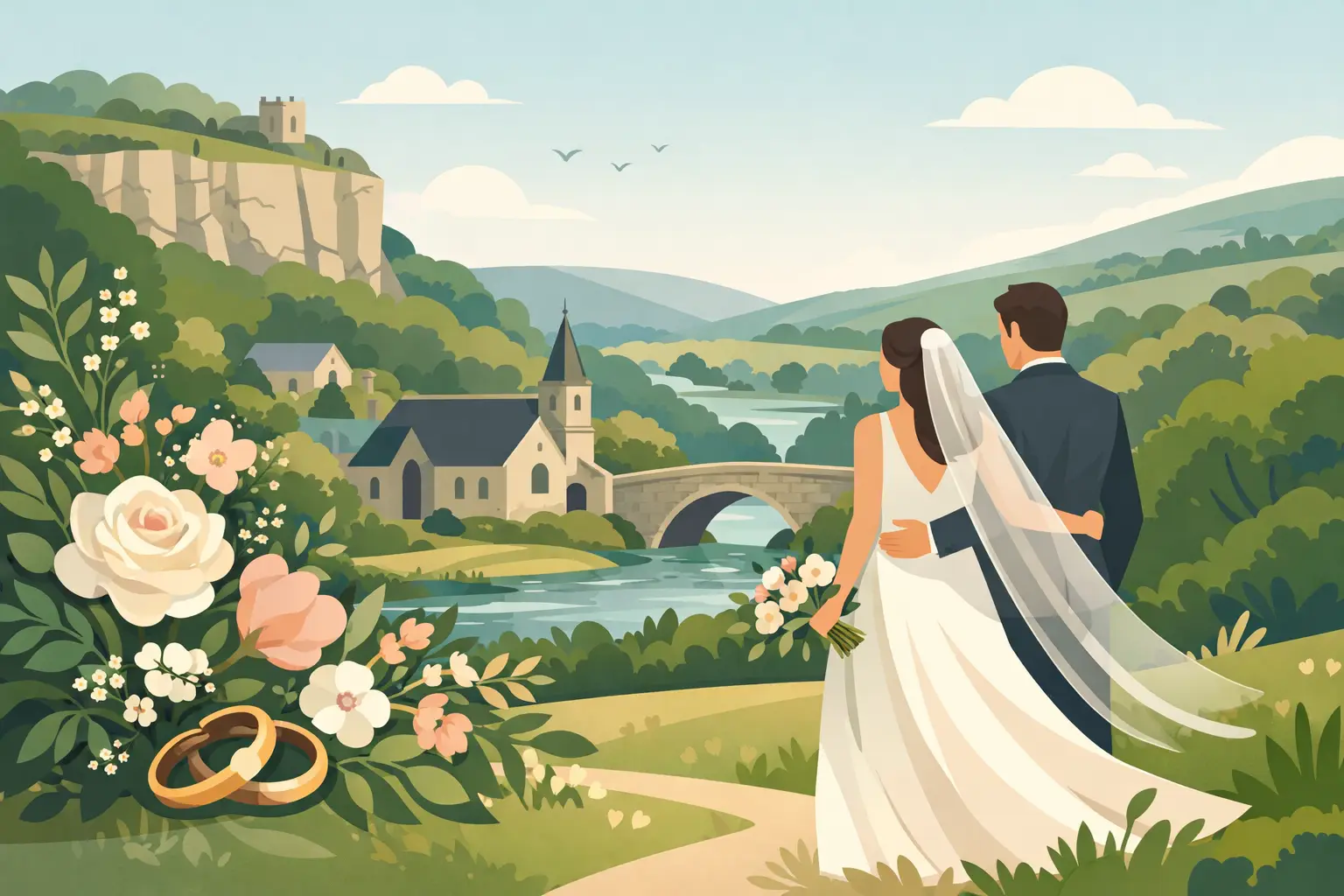
A wedding in and around Matlock already has a strong character: stone buildings warmed by evening light, Peak District views, garden paths, old mills and village halls with their own quiet charm. The most memorable Matlock wedding flowers do not compete with that setting. They belong to it, bringing colour, texture and a sense of occasion while still feeling like a natural part of the day.
For couples who are drawn to flowers with movement rather than rigid perfection, the starting point is rarely a fixed recipe. It is the season, the venue, the clothes you are wearing and the atmosphere you hope your guests will carry away with them. A thoughtful floral scheme can be beautifully understated, but it should never feel like an afterthought.
Matlock wedding flowers that reflect your day
There is no single Derbyshire wedding look. A celebration in a candlelit inn near the river calls for something different from an airy barn reception, a grand country house or a small ceremony at home. The scale of the room matters, but so do the details that make it yours: a silk dress with a soft sheen, a tailored suit, coloured glassware, a favourite wild place, or the fact that you simply want the tables to feel welcoming rather than overly styled.
Natural wedding flowers are particularly suited to this variety. They allow for gathered-looking shapes, changing textures and stems that have a little freedom. A bouquet may hold garden roses, sweet peas, cosmos and scented herbs in summer, then turn to dahlias, asters, berries and richly toned foliage in early autumn. Both can feel abundant, but neither needs to look formal or predictable.
The aim is not to make every arrangement identical. Repetition creates cohesion, while slight variation gives a wedding flowers their life. A few carefully chosen flowers, used well across personal pieces and the venue, will often say more than a long list of varieties with no clear connection.
Begin with the feeling, not a Pinterest board
Images are useful, especially when they show a colour, shape or mood you are instinctively drawn to. Yet they can also be misleading. A photograph taken in California in May may rely on flowers that are unavailable, costly or simply out of place in Derbyshire in October.
Rather than trying to recreate one image exactly, think about what you respond to in it. Is it the looseness of the bouquet? The soft apricot and butter-yellow palette? The depth created by trailing foliage? Is it the fact that the flowers look as though they have been gathered from a generous garden? These are the observations that help a florist translate inspiration into something personal and seasonally right.
A useful starting point is to consider three things together: the setting, the season and the level of formality. Once these are clear, the flowers become much easier to shape. A relaxed meadow-like design can work beautifully in a formal room when the palette is restrained. Equally, a more sculptural arrangement may suit a rustic setting if the stems and vessels are carefully chosen.
Let the Derbyshire seasons lead
Working with the season is not about limiting choice. It is about choosing flowers when they are at their most expressive. British-grown stems often have a delicacy, scent and character that is difficult to find in flowers grown solely for year-round uniformity. They may be shorter, more fleeting or gently imperfect, but those qualities are often exactly what makes them special.
Spring weddings can be filled with narcissi, tulips, ranunculus, blossom and the fresh greens that arrive after winter. There is a lightness to this season, with graceful stems and subtle colour shifts that suit intimate celebrations particularly well.
By high summer, the choice broadens. Sweet peas, roses, delphiniums, scabious, cornflowers and cosmos offer scent, movement and a lovely looseness. Summer is often the moment for flowers that feel most garden-led, whether the palette is soft and romantic or brighter and more playful.
Autumn brings a different kind of abundance. Dahlias, chrysanthemums, amaranthus, seed heads and turning foliage can create real depth without becoming heavy. In winter, branches, hellebores, berries, evergreen foliage and sculptural forms offer a quieter beauty. Candlelight and generous texture become part of the design.
Of course, some favourite flowers can be sourced beyond their British season, and there are occasions when that matters. It is always a question of balance: the flower itself, its provenance, its journey and the role it plays in your overall design. A seasonal approach leaves room for those considered choices without building the entire scheme around imported expectations.
Choosing the flowers that matter most
Most weddings need fewer types of arrangement than couples first imagine. The pieces that tend to carry the most visual and emotional weight are the bridal bouquet, buttonholes, ceremony flowers and the tables where guests will spend time together. Giving these proper attention usually creates a more coherent result than scattering small arrangements throughout every corner.
Your bouquet is especially personal. It should sit comfortably against your outfit, feel good to hold and photograph beautifully without taking over. A bouquet with a little asymmetry can be wonderfully natural, but it still needs balance, a considered handle and flowers that will hold well through the day.
Ceremony flowers can be quietly transformative. A pair of meadow-like arrangements at the front, an urn at the entrance or a few arrangements placed where vows are exchanged can frame the moment without obscuring it. If possible, these can then be moved to the reception, allowing the flowers to work harder and giving familiar pieces a second life.
For tables, consider how guests need to use the space. Low arrangements encourage conversation across the table, while tall designs can add drama in rooms with high ceilings, provided they are genuinely high enough to keep sightlines clear. Bud vases are often lovely for long tables, especially when mixed with taper candles, but they require enough flower variety and careful placement to feel intentional rather than sparse.
Thoughtful methods behind natural designs
A natural floral style still requires substantial craft. Flowers need conditioning, vessels need to be secure, and every arrangement must be designed for its setting and duration. The work behind an apparently effortless gathering of blooms is what allows it to feel relaxed while remaining dependable.
For many couples, sustainability is also part of the decision. Foam-free mechanics, reusable vessels, minimal packaging and a focus on British-grown flowers can significantly reduce waste without compromising beauty. Foam-free work asks for different techniques and planning, particularly for large-scale installations, but it supports a more considered way of working with flowers.
It also helps to be realistic about the nature of fresh flowers. A locally grown stem may arrive with a curve, a smaller flower head or a fleeting moment of perfection. That is not a flaw to disguise. It is part of working with a living material, and it gives wedding flowers their individuality.
A calmer way to plan your wedding flowers
Good floral guidance should make decisions feel clearer, not more complicated. Start the conversation with your date, venue, approximate guest numbers and the parts of the day that matter most to you. A florist can then advise on what is likely to be in season, where the budget will have most impact and which ideas are best adapted to your space.
Be open about budget from the beginning. It is not a test, and it does not prevent beautiful work. It simply allows the design to be shaped honestly. A smaller budget may be best spent on a generous bouquet, personal flowers and one well-placed ceremony feature, rather than trying to stretch a modest number across multiple installations. With a larger budget, the focus may expand to statement ceremony work, suspended designs or abundant reception tables.
The clearest brief is often a short one. Share the atmosphere you want, colours you love and colours you would rather avoid, alongside any sentimental details. Perhaps your grandmother grew roses, you are marrying near the place you walk every weekend, or you would like to include flowers that recall a particular summer. These small points help create designs with real meaning.
At Sweetpea Macfie, the process is built around that conversation: listening closely, offering practical advice and creating flowers that feel right for the people and place at the heart of the celebration.
When you choose wedding flowers with the season and setting in mind, they become more than decoration. They mark the doorway you walked through, the table where people lingered, and the ordinary, beautiful details that later bring the day back most clearly.
 I’m Marie,
the florist behind Sweet Pea Macfie.
I began Sweet Pea Macfie in 2018 and am a qualified florist with over 13 years’ experience.
The name is an ode to my Grandad, John Macfie, who in his day was one of the best Sweet pea growers in the country. He exhibited at all the major flower shows, and his Chelsea Gold Medal is one of my most treasured possessions, so you could say that growing and arranging flowers is in my blood.
I’m Marie,
the florist behind Sweet Pea Macfie.
I began Sweet Pea Macfie in 2018 and am a qualified florist with over 13 years’ experience.
The name is an ode to my Grandad, John Macfie, who in his day was one of the best Sweet pea growers in the country. He exhibited at all the major flower shows, and his Chelsea Gold Medal is one of my most treasured possessions, so you could say that growing and arranging flowers is in my blood.