
A sympathy bouquet delivery is a small but tangible way to say: I am thinking of you. When someone is grieving, there is rarely a perfect thing to say or do. Flowers cannot remove the loss, but a thoughtfully chosen bouquet can bring a moment of beauty, gentleness and care into a difficult week.
The most meaningful sympathy flowers do not need to be grand. They need to feel appropriate to the person receiving them, to arrive at the right time, and to carry a message that is simple and sincere. Choosing them well is less about following strict rules and more about considering what will feel comforting.
When is a sympathy bouquet the right choice?
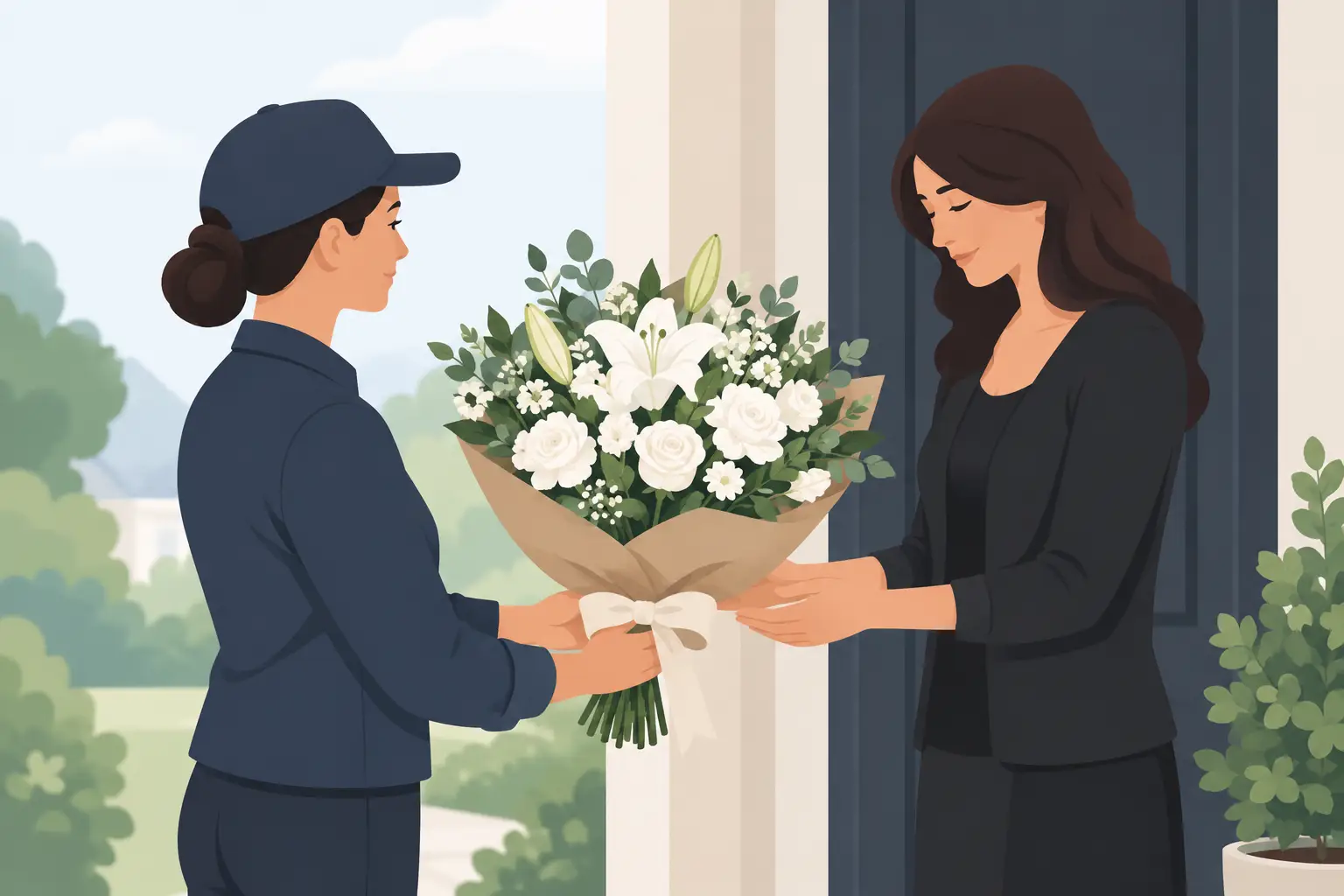
A bouquet is usually best sent to the home of a bereaved friend, relative or colleague. Unlike formal funeral tributes, which are designed for the service itself, a hand-tied bouquet is for the days around it: when visitors have gone home, practical tasks continue, and the quiet can feel particularly acute.
It can be sent as soon as you hear the news, before or after the funeral, or on a significant date that may be difficult. There is no narrow window in which flowers are acceptable. In fact, a bouquet arriving a fortnight later can be especially touching, when the initial flood of cards and arrangements has eased.
If the family has requested donations rather than funeral flowers, respect that wish for the service. A sympathy bouquet sent privately to a close family member is often still welcome, though it is worth checking the wording of any family notice if you are unsure.
Choosing flowers that offer comfort
There is no universal sympathy palette. White and green flowers remain a classic choice because they feel calm and quietly elegant, but they are not the only appropriate option. Soft blush, pale blue, gentle apricot and muted seasonal shades can feel equally considered, particularly if they reflect the recipient’s home, garden or the personality of the person who has died.
The most successful designs have a natural sense of movement rather than looking stiff or overly arranged. Seasonal foliage, delicate stems and flowers with varied texture make a bouquet feel personal and alive. In spring, this might mean narcissus, tulips, blossom and scented stocks. Summer can bring garden roses, sweet peas, scabious and herbs. Autumn arrangements may include dahlias, cosmos, grasses and berries, while winter calls for evergreen foliage, hellebores, ranunculus and early scented stems.
British-grown flowers are particularly lovely for sympathy work when the season allows. Their natural variation and character are part of their beauty. A locally grown stem may not look identical to the next one, but that is precisely what makes a bouquet feel gathered with care rather than produced to a formula.
Strongly coloured flowers are not wrong, either. If the person who has died was known for a vivid garden, a love of colour or a bright, joyful style, a more colourful design can be a fitting gesture. The deciding factor is sensitivity, not tradition alone.
Fragrance and practicality
Scent can be comforting, but it deserves a little thought. Lilies are traditional and beautiful, yet their perfume can be overwhelming in a small room, and their pollen may be troublesome. Highly scented flowers may also be unsuitable where someone has allergies or is caring for a newborn.
A florist can suggest gentler alternatives that still have presence and longevity. It is also helpful to choose a bouquet delivered in water, or in a vase if appropriate, so the recipient does not have to find a container or arrange flowers during an already demanding time.
What to write in a sympathy card
The card is often the part people find hardest. There is no need to write a long message or search for an original phrase. Clear, warm words are enough.
For someone you know well, mention the person who has died by name and, if it feels right, share a small memory. A line such as, “Thinking of you and remembering how warmly John always welcomed us,” is more meaningful than trying to explain loss away.
For a colleague or acquaintance, something simple is entirely appropriate: “With deepest sympathy,” “Thinking of you and your family,” or “Sending love at this very sad time.” If you are sending on behalf of a group, make sure every name is included clearly, especially where family members may not recognise the sender immediately.
Try to avoid phrases that tell someone how they should feel or suggest grief has a timetable. The most comforting messages make space for sadness rather than attempting to fix it.
Sympathy bouquet delivery: details that make a difference
A few practical details can make sympathy bouquet delivery feel much more considerate. Give the florist the recipient’s full address, a reliable telephone number where possible, and any useful delivery instructions. If the recipient may be away at the funeral, a neighbour who can safely accept flowers or a sheltered place to leave them can prevent an avoidable worry.
Timing matters, but so does flexibility. Same-day delivery can be helpful when news has just reached you, although a little notice gives a florist more scope to select the best seasonal stems and create something properly considered. During busy periods, particularly around Mother’s Day, Christmas and Valentine’s Day, ordering ahead is especially kind.
It is worth telling the florist whether the flowers are for a home, a care setting, a workplace or a funeral director. Some hospitals and care homes have restrictions on flowers, while funeral directors may need the arrangement by a particular time. A bouquet for the home is generally more relaxed in style than a tribute intended for a service.
For families in Darley Dale, Matlock, Chesterfield and the surrounding Derbyshire area, working with a local florist also means the delivery can be handled with an understanding of the area and the occasion. At Sweetpea Macfie, each bouquet is made with the season, the recipient and the message in mind, rather than selected from a standardised sympathy range.
A considered alternative to traditional funeral flowers
Sometimes a bouquet is the more sustainable and useful choice. Funeral tributes can be beautiful and ceremonial, but they may have a short life at the service. A hand-tied arrangement can be enjoyed at home, divided into smaller vases, or placed where it brings a little colour to the days that follow.
Foam-free floristry is another thoughtful consideration. Traditional floral foam is often used in funeral designs because it holds stems in place, but it is single-use plastic and cannot be composted. A bouquet arranged in water and wrapped with minimal packaging can offer the same sense of care with less unnecessary waste.
Sustainability does not mean compromising on beauty. It often creates a more characterful arrangement: fewer imported flowers flown across long distances, more seasonal detail, and an honest response to what is naturally available. It does mean being open to a florist’s guidance if a particular bloom is out of season or unsuitable for the occasion.
Let the gesture be simple
Grief can make everyday decisions feel heavy. The person receiving your flowers may not reply straight away, and they may not have the energy to acknowledge them in the way they normally would. Send the bouquet without expectation. It is a gesture of support, not a task for someone else to manage.
If you are uncertain about colour, timing or wording, choose quiet seasonal flowers and a short, genuine message. What is remembered is rarely the exact variety of stem. It is the feeling that, at a painful time, somebody took the care to reach out.
 I’m Marie,
the florist behind Sweet Pea Macfie.
I began Sweet Pea Macfie in 2018 and am a qualified florist with over 13 years’ experience.
The name is an ode to my Grandad, John Macfie, who in his day was one of the best Sweet pea growers in the country. He exhibited at all the major flower shows, and his Chelsea Gold Medal is one of my most treasured possessions, so you could say that growing and arranging flowers is in my blood.
I’m Marie,
the florist behind Sweet Pea Macfie.
I began Sweet Pea Macfie in 2018 and am a qualified florist with over 13 years’ experience.
The name is an ode to my Grandad, John Macfie, who in his day was one of the best Sweet pea growers in the country. He exhibited at all the major flower shows, and his Chelsea Gold Medal is one of my most treasured possessions, so you could say that growing and arranging flowers is in my blood.