
A funeral tribute does not need to say everything. Often, the most fitting flowers simply reflect the person being remembered: their garden, their favourite colours, the season, or the quiet character of the family arranging them. When considering wreath vs sheaf funeral flowers, the choice usually comes down to shape, placement and the feeling you would like the tribute to carry.
Both are thoughtful, traditional choices, but they speak in slightly different ways. A wreath has a formal, enduring presence, while a sheaf often feels more personal and gently gathered, as though it has been picked from a garden. Neither is more meaningful than the other. The right choice is the one that feels appropriate for the person and for the farewell.
Wreath vs sheaf funeral flowers: the essential difference
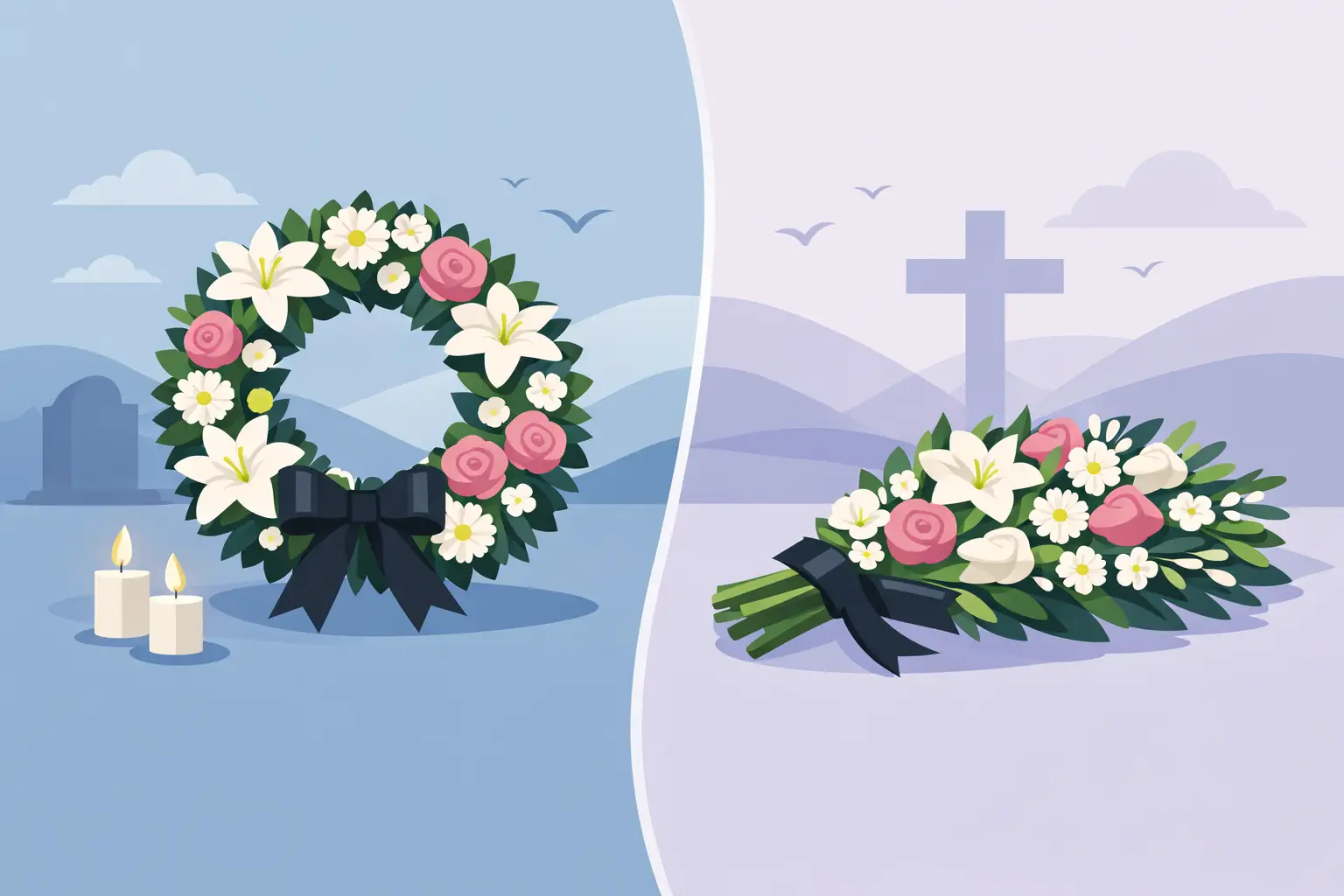
A funeral wreath is a circular floral design, traditionally arranged on a ring-shaped base. Its unbroken circle is often understood as a symbol of continuity, remembrance and everlasting love. Wreaths are usually placed on an easel, displayed near the coffin, or laid at the graveside after the service.
A sheaf is a hand-tied arrangement designed to lie flat. The flower heads are gathered at one end, with stems extending naturally beneath them, usually finished with ribbon, twine or foliage. It has a softer, less structured appearance than a wreath and is commonly laid on or beside the coffin, at the grave, or amongst other tributes.
The distinction is visual, but it also affects the atmosphere of the flowers. A wreath creates a defined, complete shape. A sheaf allows stems, grasses and seasonal foliage to move more freely, bringing a sense of the countryside and the changing seasons into the arrangement.
When a funeral wreath may feel right
A wreath is often chosen by close family members, a group of friends, colleagues or an organisation. Its circular form gives it a clear presence at a service, particularly when displayed on an easel. For a larger church, crematorium chapel or graveside gathering, this can make it a practical option as well as a beautiful one.
It can also suit a family who would like a tribute with an unmistakably traditional feel, without it becoming overly formal. A wreath need not be dense, stiff or heavily decorated. It can be made with an airy mix of garden roses, herbs, textural foliage, seed heads and British seasonal flowers, with space between the blooms and a natural rhythm to the design.
The circle itself can carry meaning without needing a written explanation. For some, it represents a life that continues in memory. For others, it simply feels like a graceful mark of respect. If the deceased loved gardening, nature or the Derbyshire landscape, the wreath can be designed in a loose, meadow-like style rather than a conventional, tightly packed ring.
A wreath may be less suitable if you would prefer the tribute to look as though it has been gathered by hand, or if flowers are being placed directly on the coffin and you would like several designs to sit together softly. Its shape is more architectural, which is precisely why some families love it.
Wreaths and sustainable design
Traditional funeral wreaths are often made using floral foam. However, a considered wreath can also be created using foam-free methods and reusable or compostable mechanics where appropriate. This may influence the exact choice of flowers and construction, but it need not mean compromising on beauty.
For families who value provenance, seasonal British flowers can give a wreath a more individual character. In spring, that might mean narcissi, tulips, blossom and fresh green foliage. Later in the year, dahlias, cosmos, garden roses, berries and grasses can bring depth and warmth. The available flowers will always shape the final design, which is part of what makes a tribute feel personal rather than mass-produced.
When a funeral sheaf may feel right
A sheaf is often the more natural choice for someone who loved their garden, walked in the countryside, or preferred things to be simple and unfussy. Its visible stems and looser silhouette make it feel less like a formal arrangement and more like a beautiful gathering of flowers.
Because a sheaf is designed to lie flat, it works particularly well when placed on the coffin. Several sheaves can sit alongside a main coffin spray without competing with it, each one expressing the relationship of the person who sent it. A sheaf from grandchildren might include soft, familiar flowers; one from friends might bring in a favourite colour, herb or foliage from a much-loved garden.
It is also a lovely choice for a graveside farewell. The stem length creates a gentle line across the ground, and the flowers can feel at home in an outdoor setting. If the family is holding a small, simple service, a sheaf can have the right amount of presence without feeling ceremonial or elaborate.
A sheaf is not necessarily smaller or less significant than a wreath. It can be generous, abundant and deeply expressive. Equally, it can be modest and understated. The scale should be guided by where it will be placed, the other flowers at the service and, most importantly, what feels comfortable for the sender.
The beauty of a hand-tied tribute
The hand-tied nature of a sheaf gives it particular emotional warmth. Stems are visible, flowers can be chosen at different stages of opening, and trailing foliage can soften the edges. There is room for a more botanical approach: scented rosemary for remembrance, delicate nigella, cottage-garden flowers, ferns, grasses or branches with seasonal berries.
That said, a sheaf needs careful construction to remain balanced and beautiful when laid down. It should not look like an ordinary bouquet placed flat. The flowers need to face well from above, the stems need to sit neatly, and the tying detail should feel in keeping with the tribute. These are small considerations, but they make a real difference on the day.
Choosing by relationship and setting
There are no fixed rules about who should send a wreath and who should send a sheaf. Immediate family may choose either. Friends, neighbours and colleagues may also choose either. The wording on the card, the flowers themselves and the thought behind them matter far more than convention.
It can help to think about the setting. A wreath displayed on an easel will be visible to everyone arriving at the service. A sheaf placed on the coffin can feel closer and more intimate. At a woodland burial or a natural graveside service, a sheaf often sits especially comfortably within the landscape. In a formal chapel, a wreath may offer a stronger visual focal point.
It is worth checking with the funeral director if you are unsure about space, placement or the number of tributes expected. They can explain what is practical at the venue and whether flowers will travel with the coffin or be moved to the graveside afterwards.
Colour, flowers and personal details
The most memorable funeral flowers are rarely those chosen from a standard picture. They are the ones that quietly belong to the person being remembered. That may mean white and green flowers for a calm, timeless look, but it could just as easily mean rich autumnal shades, cheerful spring colour, or a palette taken from a favourite scarf, garden border or football team.
A wreath lends itself well to a considered colour story around its circle. A sheaf can be more varied and spontaneous in feeling, with individual stems and textures allowed to show. Neither approach needs to be bright or restrained by default. The right balance depends on the person and the family.
If there is a flower you would particularly like to include, mention it early. Some blooms are seasonal, while others may not be reliably available from British growers at certain times of year. A skilled florist can suggest alternatives that keep the spirit of your idea, rather than simply substituting something generic.
A gentle way to decide
If you are torn between the two, begin with a simple question: would this person be best remembered by a lasting circle of flowers, or by a gathered, garden-led tribute? A wreath may feel right for its symbolism and presence. A sheaf may feel right for its softness, natural movement and intimacy.
You do not need to know the correct floral terminology before speaking to a florist. Sharing a few memories, colours, favourite flowers or details about the service is enough to begin. At Sweetpea Macfie, each funeral tribute is designed with that conversation in mind, using seasonal flowers and considered, foam-free methods wherever possible.
For a farewell, the most appropriate flowers are those that feel honest. Whether they take the form of a wreath or a sheaf, let them offer a small, beautiful reflection of a life that mattered.
 I’m Marie,
the florist behind Sweet Pea Macfie.
I began Sweet Pea Macfie in 2018 and am a qualified florist with over 13 years’ experience.
The name is an ode to my Grandad, John Macfie, who in his day was one of the best Sweet pea growers in the country. He exhibited at all the major flower shows, and his Chelsea Gold Medal is one of my most treasured possessions, so you could say that growing and arranging flowers is in my blood.
I’m Marie,
the florist behind Sweet Pea Macfie.
I began Sweet Pea Macfie in 2018 and am a qualified florist with over 13 years’ experience.
The name is an ode to my Grandad, John Macfie, who in his day was one of the best Sweet pea growers in the country. He exhibited at all the major flower shows, and his Chelsea Gold Medal is one of my most treasured possessions, so you could say that growing and arranging flowers is in my blood.