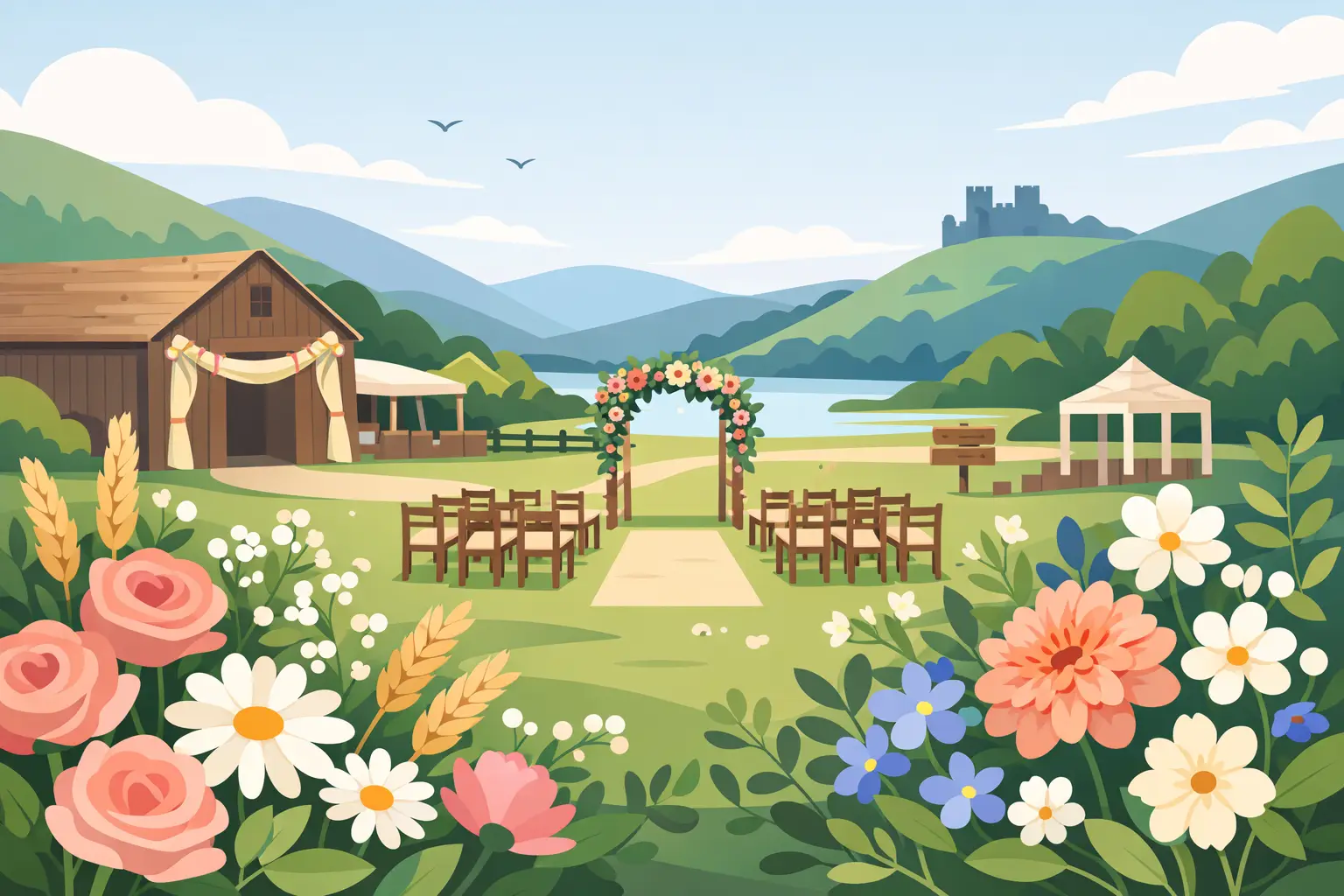
A country wedding rarely needs flowers that compete with the setting. A barn’s weathered timber, a village churchyard, long grass moving in the breeze or a Derbyshire stone farmhouse already bring character of their own. The best flowers for country weddings are the ones that belong there: seasonal stems with texture, softness and a little looseness, arranged with enough care to feel special without appearing too tightly controlled.
That does not necessarily mean every arrangement must look freshly gathered from a hedgerow. The most successful country wedding flowers balance an unforced, garden-led feeling with thoughtful structure. They need to photograph beautifully, travel well, suit the season and hold their own in a ceremony space, all while feeling personal to the couple.
Choosing the best flowers for country weddings
Begin with the time of year, rather than a fixed picture saved months earlier. British-grown flowers are at their most expressive when they are in season, and a country wedding is the perfect setting to let this lead the design. Spring offers gentle scent and fresh movement; high summer brings abundance and colour; autumn has richer tones and wonderful seed heads; winter calls for evergreen texture, berries and a quieter kind of beauty.
The venue matters too. A flower-filled barn can take generous, meadow-like arrangements, while a small church may need only a few well-placed urns, meadow jars or pew-end posies. For a marquee wedding, flowers can help soften the framework and draw the landscape in, particularly around the entrance, dining tables and bar. A good design should respond to the space rather than impose the same formula on every setting.
Colour is often more useful than a long list of named varieties. Soft whites, creams, buttery yellow, pale blue and faded pink sit naturally in most rural settings. Couples wanting something bolder might choose raspberry, plum, cornflower blue or warm apricot, tempered with foliage and quieter blooms. The aim is not to match every detail, but to create a palette that feels settled in the landscape and flattering in photographs.
Spring: scented, hopeful and full of detail
Spring flowers have a lightness that is difficult to imitate at any other time of year. Narcissi, tulips, ranunculus, anemones, blossom and fragrant sweet peas can make a wedding feel newly awake after winter. Their shapes are often naturally graceful, which suits hand-tied bouquets and relaxed table arrangements particularly well.
Tulips deserve a special mention. They continue to grow and move in water, so they bring life to a design rather than sitting rigidly in place. Used with blossom, viburnum, narcissi or fresh green foliage, they can feel far more characterful than their reputation as a simple supermarket flower suggests.
Spring can be unpredictable in Derbyshire, however. A cold spell may delay certain crops, while warm weather can bring others on quickly. A seasonal approach gives room to choose the best stems available close to the date, rather than relying on one exact flower that may not be at its peak.
Summer: abundance without excess
For many couples, summer provides the widest choice of flowers for a country celebration. Garden roses, sweet peas, cosmos, scabious, delphiniums, cornflowers, nigella, achillea and phlox all bring softness, scent or movement. They work beautifully with herbs such as mint, rosemary and flowering oregano, which add an understated garden quality and a lovely fragrance when guests lean close to the table.
Garden roses are often chosen for bridal bouquets because they offer a more open, romantic shape than tightly formed florist roses. They are especially lovely alongside airy summer flowers rather than used alone. Sweet peas, with their delicate stems and unmistakable perfume, are one of the joys of a June or July wedding, though they are best treated as a seasonal luxury rather than a flower expected to withstand intense heat all day.
For tables, a collection of smaller vessels can be more in keeping with a country wedding than one large, formal centrepiece. Low arrangements allow guests to see one another, while varied heights and flower types give the impression that the table has grown into bloom. This approach can also make good use of locally available flowers, without requiring every stem to be identical.
Autumn: berries, grasses and considered warmth
Autumn weddings invite a richer, more textural palette. Dahlias are often the stars, ranging from soft peach and blush to deep wine, bronze and claret. They pair well with cosmos, chrysanthemums, amaranthus, rudbeckia, grasses, seed heads and branches carrying hips or berries.
There is no need for an autumn scheme to be overtly orange or rustic in the themed sense. Pale dahlias with smoke-toned foliage and grasses can feel elegant and modern, while berry reds and chocolate-brown seed heads bring depth without becoming heavy. The season is particularly good for couples who want arrangements with movement and a slightly wilder edge.
Dahlias can be delicate, especially in rain or strong sunshine, so placement matters. A knowledgeable florist will keep the most tender blooms out of harsh conditions where possible and use more resilient ingredients for outdoor ceremony pieces or entrance arrangements.
Winter: texture, scent and a quieter palette
A country wedding in winter can be wonderfully atmospheric. Evergreen foliage, pine, conifer, eucalyptus, holly, berried branches and dried elements offer structure, while hellebores, ranunculus, anemones, early narcissi and seasonal imported flowers can add softness where needed.
The best winter designs do not have to be traditionally festive. Cream flowers, silvery foliage, lichen-covered branches and deep green textures can feel calm and refined in a candlelit barn or stone hall. If a December celebration calls for warmth, velvet reds, plum tones and dark berries can be used sparingly to create richness without turning the room into a Christmas display.
Flowers that create the country-garden feeling
Some flowers are especially useful because their form does much of the work. Rather than relying on a single focal bloom, country-style arrangements benefit from layers: a few larger flowers, smaller supporting blooms, airy stems and foliage that gives the design shape.
Garden roses and dahlias provide generous focal points. Cosmos, astrantia, scabious and nigella add an informal, dancing quality. Delphiniums, foxgloves when available from suitable sources, and larkspur introduce height. Grasses, seed heads, herbs and interesting foliage stop arrangements from looking too polished or uniform.
This mix is why a bouquet can feel natural while still being properly designed. The stems are not simply placed at random. Each one contributes colour, line, texture or movement, and the overall shape needs to be comfortable to hold as well as beautiful from every angle.
A note on wildflowers and meadow styles
“Wildflower wedding” can mean several different things. Often, couples are drawn to the looseness and spontaneity of a meadow rather than literal wildflowers. Many native wild plants are protected, seasonal in a very narrow window, or unsuitable for cutting. Foraging from roadsides and fields is not a responsible solution, either.
A meadow-inspired look is best created with cultivated British flowers and foliage that echo that feeling: cornflowers, scabious, achillea, nigella, grasses and delicate filler flowers. This gives the desired movement and informality while respecting the landscape and providing flowers that can be conditioned and arranged properly.
Making your flowers work hard on the day
Thoughtful re-use is especially effective at a country wedding. Meadow jars or urns framing the ceremony can later sit by the top table, bar or cake table. Pew-end arrangements can be moved to the reception, and larger entrance pieces can welcome guests again in the evening. Planning this from the start allows the flowers to have a full day rather than a brief moment.
It is also worth being realistic about what guests will notice. A bridal bouquet, ceremony backdrop or focal arrangement near the speeches may deserve a larger share of the budget than flowers placed in every corner. A few memorable floral moments, made from beautiful seasonal material, usually have more impact than trying to fill every available surface.
Foam-free mechanics and reusable vessels are a natural fit for this style. They allow flowers to be arranged with movement and hydration while reducing unnecessary waste. Minimal packaging, local sourcing where the season allows, and designs intended to be enjoyed after the day all make a quiet difference.
The right flowers should make your wedding feel more like itself, not like somebody else’s version of a country celebration. Whether that means soft spring blossom, a scented midsummer table, generous autumn dahlias or winter branches by candlelight, let the season and the place have a voice. At Sweetpea Macfie, that conversation is where the most personal designs begin.
 I’m Marie,
the florist behind Sweet Pea Macfie.
I began Sweet Pea Macfie in 2018 and am a qualified florist with over 13 years’ experience.
The name is an ode to my Grandad, John Macfie, who in his day was one of the best Sweet pea growers in the country. He exhibited at all the major flower shows, and his Chelsea Gold Medal is one of my most treasured possessions, so you could say that growing and arranging flowers is in my blood.
I’m Marie,
the florist behind Sweet Pea Macfie.
I began Sweet Pea Macfie in 2018 and am a qualified florist with over 13 years’ experience.
The name is an ode to my Grandad, John Macfie, who in his day was one of the best Sweet pea growers in the country. He exhibited at all the major flower shows, and his Chelsea Gold Medal is one of my most treasured possessions, so you could say that growing and arranging flowers is in my blood.